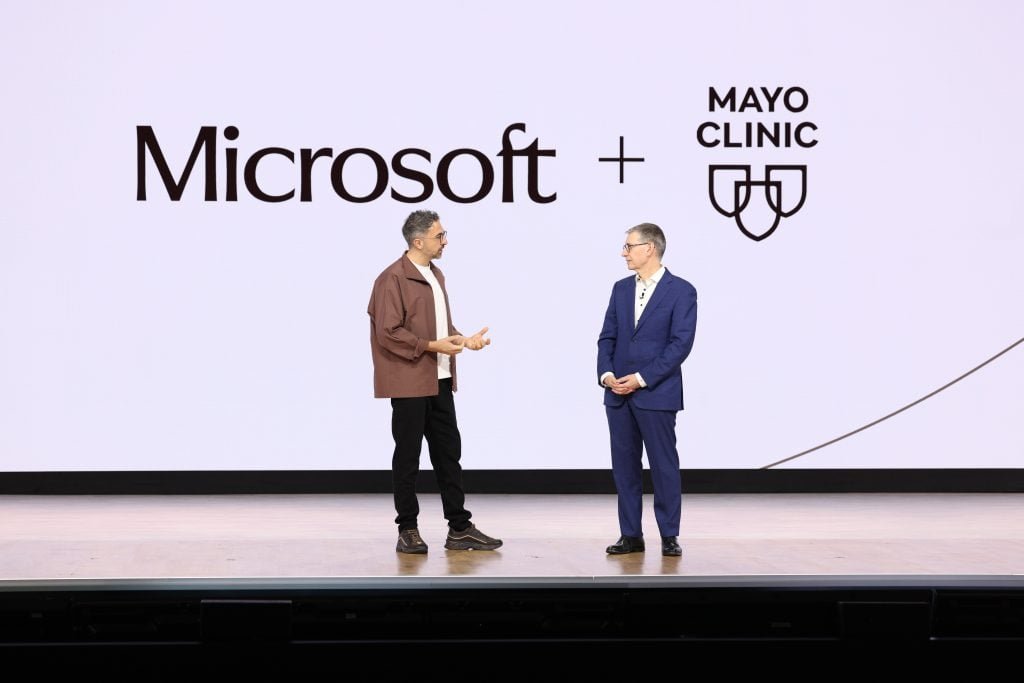
A frontier AI model built specifically for medicine, trained on real clinical data, owned by a hospital — not a tech company. That is what Mayo Clinic and Microsoft announced on June 2, 2026, and the details are worth reading carefully.
What Mayo and Microsoft are actually building
The partnership combines Mayo Clinic’s clinical expertise and de-identified patient data with Microsoft’s AI engineering and Azure infrastructure. The goal is a model capable of handling the full breadth of clinical reasoning: synthesising diverse patient data, supporting earlier diagnoses, and helping clinicians make more personalised treatment decisions.
Crucially, the model will be owned by Mayo Clinic, not Microsoft. That is a deliberate design choice, and Mayo has said it reflects their long-standing commitment to patient trust and responsible stewardship of clinical data. Microsoft plans to make the model available to other healthcare organisations through Azure Foundry APIs, but the originating institution retains control.
The model is already being tested inside Mayo’s own clinical environment, which means real-world refinement is happening now, not in two years.
The clinician problem AI is trying to solve
Ask any doctor or nurse what is breaking them, and the answer is rarely the medicine. It is the paperwork, the documentation, the cognitive load of managing hundreds of data points per patient across fragmented systems. A report released June 9 by Philips, based on their 2026 Future Health Index, found that AI is already saving clinicians the equivalent of 16 working days per year. Half of those surveyed reported lower work-related stress. Two-thirds said they felt more confident in clinical decision-making.
Perhaps most striking: 39 percent of clinicians said AI had identified or prevented a potential medical error at least three times in the past three months alone.
Those are not projections. That is reported behaviour from practitioners already using these tools in live clinical settings. The gap between “AI in healthcare” as a concept and AI in healthcare as a daily clinical reality is closing faster than most health system leaders anticipated.
Patients are changing too
While hospitals race to deploy AI on the back end, patients are quietly building their own AI habits on the front end. Philips’ research found that 52 percent of patients now use AI tools to research health conditions or diagnoses, and 54 percent use them to look up potential drug interactions or side effects.
That shift matters for how healthcare is delivered. Patients arriving at appointments having already consulted an AI are better informed in some ways, and potentially misinformed in others. Clinicians are increasingly managing not just a patient’s medical history but their AI-generated pre-diagnosis. Health systems that ignore this dynamic will find themselves behind it.
The market behind the momentum
The commercial picture is expanding rapidly. The global AI in healthcare market was valued at around $20 billion in 2025. Analysts now project it will reach $146 billion by 2031, growing at a compound annual rate of 39 percent. Those figures come from Wissen Research’s latest market report, published in mid-2026.
What is driving that growth is not one thing. It is ambient documentation tools that transcribe patient consultations in real time. It is diagnostic imaging systems that flag anomalies radiologists might miss on a long shift. It is appointment scheduling agents, clinical coding automation, and predictive tools that identify high-risk patients before they deteriorate. The Mayo-Microsoft announcement sits at the top of that stack: a model designed to reason across all of it, not just optimise one slice.
What to watch next
The World Health Organization published a discussion paper on June 2 examining how AI is beginning to reshape health policy-making at the national and international level. That is not a clinical deployment story — it is a governance one. As AI moves deeper into healthcare, the question of who regulates these systems, and how, is becoming as consequential as the technology itself.
The Mayo-Microsoft model is being tested now. Whether it performs as well on diverse populations as it does in Mayo’s own clinical environment will be the real test. Healthcare AI has a long history of tools that work brilliantly in controlled settings and struggle in the messy reality of under-resourced hospitals. The coming months should start to answer that question.
For more coverage of AI in health and medicine, visit Mylistingo.