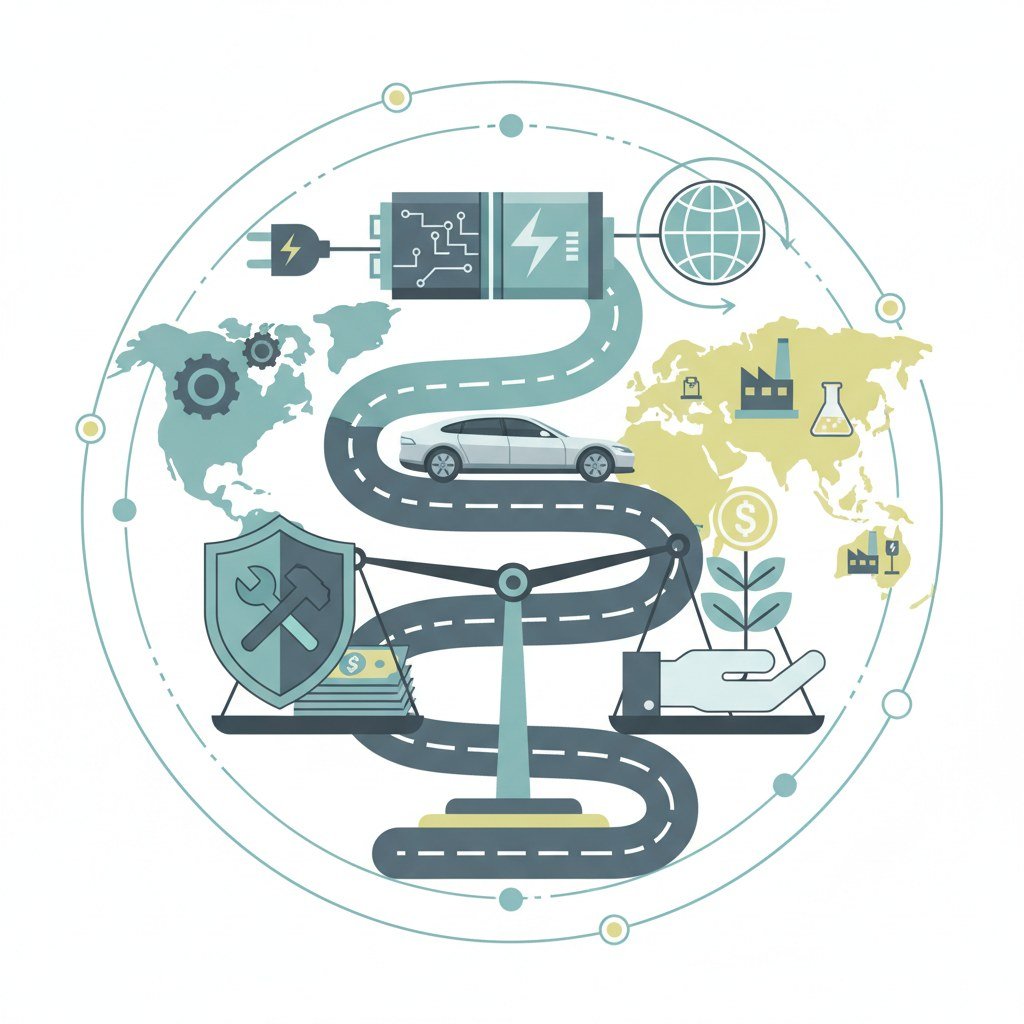
The electric vehicle market in 2026 stands at a pivotal crossroads. After years of rapid growth driven by generous government subsidies and falling battery costs, the industry now faces a more complex landscape of trade tariffs, shifting policy priorities, and the emergence of next-generation battery technologies that promise to fundamentally alter the economics of electrification.
Global EV sales are projected to reach 25 million units in 2026, representing approximately 35% of all new vehicle sales worldwide. This marks a significant acceleration from the 18% market share recorded just two years earlier. However, the path to this milestone has been anything but smooth, with regional disparities widening and trade tensions threatening to fragment what was once a globally integrated supply chain.
The Tariff Landscape Reshapes Global EV Trade
The most significant development shaping the 2026 EV market is the dramatic reconfiguration of trade tariffs affecting electric vehicles and their components. The European Union’s imposition of countervailing duties on Chinese-made EVs, set at rates between 17% and 36% depending on the manufacturer, has sent shockwaves through the industry. Chinese automakers, led by BYD, SAIC, and Geely, had been aggressively expanding into European markets with competitively priced models starting under $30,000.
These tariffs have forced a strategic pivot. Rather than absorbing the cost increases, Chinese manufacturers are accelerating plans to establish production facilities within the EU. BYD has broken ground on a mega-factory in Hungary capable of producing 200,000 vehicles annually. SAIC is reportedly in discussions with Spanish authorities for a similar facility in Valencia. This shift from export-based to local-production strategies represents one of the most significant industrial relocations since Japanese automakers established US plants in the 1980s.
In the United States, the Inflation Reduction Act’s tax credit provisions continue to reshape the market, but with a critical twist in 2026. The battery sourcing requirements have become increasingly stringent, with a rising percentage of critical mineral value now required to come from US free-trade agreement partners. This has created what industry analysts call a “two-tier” EV market: fully compliant vehicles eligible for the full $7,500 credit, and non-compliant imports facing a price disadvantage of roughly 25%.
Subsidy Programs Under Pressure
Government subsidy programs that fueled the initial EV boom are facing mounting fiscal pressure in 2026. Germany, once the poster child for generous EV incentives, has scaled back its environmental bonus program significantly. The country’s federal budget constraints, combined with debates about whether subsidies should continue benefiting higher-income households, have led to a more targeted approach focused on smaller, more affordable EVs and charging infrastructure.
France has taken a different approach, implementing an “eco-score” system that weighs the total carbon footprint of vehicle production — including battery manufacturing and shipping — rather than just tailpipe emissions. This has the practical effect of favoring European-produced EVs over Chinese imports, even as it purports to be a neutral environmental metric. The system has been challenged by China at the World Trade Organization, creating yet another layer of trade friction.
“The era of unlimited subsidies for EV adoption is ending,” notes Dr. Elena Marchetti, an automotive policy analyst at the Brussels Institute for Sustainable Mobility. “Governments are shifting from demand-side incentives to supply-side industrial policy. The question is no longer ‘how do we get people to buy EVs?’ but ‘how do we build the factories and supply chains to make them here?'”
Emerging markets face an even starker challenge. India’s FAME III subsidy program, launched in early 2026 with a budget of $3.5 billion, represents a significant commitment for a developing economy. But the subsidies are heavily skewed toward two-wheelers and three-wheelers — the vehicles that dominate Indian roads — rather than passenger cars. This reflects a pragmatic recognition that electric cars remain out of reach for most Indian consumers without massive subsidies that the government cannot sustain.
Battery Innovation Accelerates
Behind the policy turbulence, battery technology is advancing at a pace that few predicted even five years ago. The cost of lithium-ion battery packs has fallen below $95 per kilowatt-hour in 2026, down from $151/kWh in 2022 and closing in on the $70/kWh threshold that many analysts consider the point of parity with internal combustion engines.
Solid-state batteries, long promised but perpetually delayed, are finally entering commercial production. Toyota has begun limited production of solid-state cells at its plant in Japan, claiming an energy density of 400 Wh/kg — roughly double that of conventional lithium-ion packs. Initial production volumes are small and destined for hybrid vehicles rather than pure EVs, but the company has announced plans to scale to full production by 2028.
China’s CATL, the world’s largest battery manufacturer, has taken a different path with its “condensed battery” technology that achieves similar energy density using a semi-solid electrolyte. The company claims its batteries can power EVs for over 600 miles on a single charge, and several Chinese automakers have already signed supply agreements. The condensed battery technology has the advantage of using existing manufacturing infrastructure, making it faster to scale than true solid-state designs.
Perhaps the most disruptive development comes from sodium-ion batteries, which have moved from laboratory curiosity to commercial reality. CATL has ramped production of its second-generation sodium-ion batteries that achieve energy density of 200 Wh/kg — lower than lithium-ion but dramatically cheaper due to the abundance of sodium. These batteries are finding their niche in entry-level EVs and energy storage applications where weight is less critical than cost.
“The battery technology landscape in 2026 is more diverse than at any point in history,” explains Dr. Rajesh Patel, battery technology researcher at the Cambridge Energy Institute. “We’re no longer betting everything on a single chemistry. Different applications — from premium EVs to budget commuters to grid storage — are finding their optimal battery solutions. This diversification is healthy for the industry and ultimately benefits consumers through lower prices and better performance.”
Supply Chain Realignment
The geopolitics of battery minerals continues to drive supply chain restructuring. Lithium prices have stabilized after the dramatic volatility of 2022-2024, but new mining projects in Chile, Australia, and Argentina are coming online at a pace that some analysts warn could create a supply surplus by 2027. Meanwhile, the race to secure cobalt-free battery chemistries has accelerated, driven both by ethical concerns about artisanal cobalt mining in the Democratic Republic of Congo and by the price volatility that cobalt introduces.
Nickel, another critical battery mineral, has seen its supply dynamics shift dramatically. Indonesia’s ban on nickel ore exports, coupled with massive investment in domestic processing capacity, has transformed the country into a dominant force in the nickel supply chain. Chinese companies have invested over $15 billion in Indonesian nickel processing facilities, creating a vertically integrated supply chain that is increasingly difficult for Western automakers to replicate.
Recycling has emerged as a significant source of battery materials in 2026. Redwood Materials in the United States, Li-Cycle in Canada, and several European ventures have scaled operations to process end-of-life batteries and manufacturing scrap. The combined recycling capacity globally now exceeds 400,000 tons annually, enough to supply roughly 15% of new battery demand. While still a minority share, the recycling industry is growing at 35% annually and is projected to meet 30% of battery material demand by 2030.
The Charging Infrastructure Challenge
Range anxiety has given way to “charging anxiety” as the primary barrier to EV adoption in 2026. While battery ranges have increased dramatically — many new EVs are capable of 300-400 miles on a single charge — the availability and reliability of public charging infrastructure remains uneven.
The European Union’s Alternative Fuels Infrastructure Regulation, which mandated charging stations every 60 kilometers along major highways, has driven significant deployment. By mid-2026, the EU has over 800,000 public charging points, roughly triple the number in 2023. However, the distribution is heavily skewed toward Western Europe, with rural areas and Eastern European countries lagging significantly behind.
In the United States, the $7.5 billion National Electric Vehicle Infrastructure program has funded installation of over 50,000 fast-charging ports along designated alternative fuel corridors. But implementation has been slower than projected, with permitting delays, utility interconnection challenges, and equipment reliability issues all contributing to a pace that frustrates automakers and consumers alike.
The emerging solution in 2026 is ultra-fast charging technology capable of adding 200 miles of range in under 10 minutes. Both Tesla’s V4 Supercharger and the Combined Charging System (CCS) standard have pushed power levels beyond 350 kW, with experimental installations at 500 kW. However, the grid infrastructure to support such high-power charging at scale remains a significant engineering challenge, particularly in areas with limited transmission capacity.
Market Outlook for the Remainder of 2026
The second half of 2026 is expected to see continued growth in EV adoption, albeit at a moderating pace compared to the explosive growth of 2023-2025. Industry forecasts suggest global EV sales will reach 28-30 million units by year’s end, representing approximately 38% of new vehicle sales. China is projected to maintain its position as the largest EV market, with over 50% of new car sales being electric. Europe will likely see EV market share stabilize around 30-35%, while the US market approaches 25%.
The key variable remains policy direction. With major elections in several countries in 2025-2026, the political consensus around EV mandates and ICE phase-out dates is fraying. The United Kingdom’s review of its 2030 ICE ban, pushed back to 2035 for some vehicle categories, signals that political support for aggressive electrification timelines is not unconditional.
Yet the underlying economic momentum of electrification may have reached the point where policy support is a tailwind rather than a necessity. As battery costs continue to fall and production scale increases, the total cost of ownership for EVs is approaching parity with conventional vehicles without subsidies in many segments. “The electrification of transport is no longer a question of ‘if’ but ‘how fast’,” concludes Dr. Marchetti. “The tariffs and trade disputes of 2026 will shape who builds what and where — but they won’t stop the transition itself.”
Related: Global Debt Crisis Looms: How Emerging Markets Are Navigating the 2026 Economic Landscape
The Netherlands, for internationals
One email a week: the week's news for internationals in the Netherlands, new practical guides and what changed in the cities. No spam, unsubscribe any time.