ASML’s Dominance Faces New Tests as Global Chip Race Intensifies in 2026
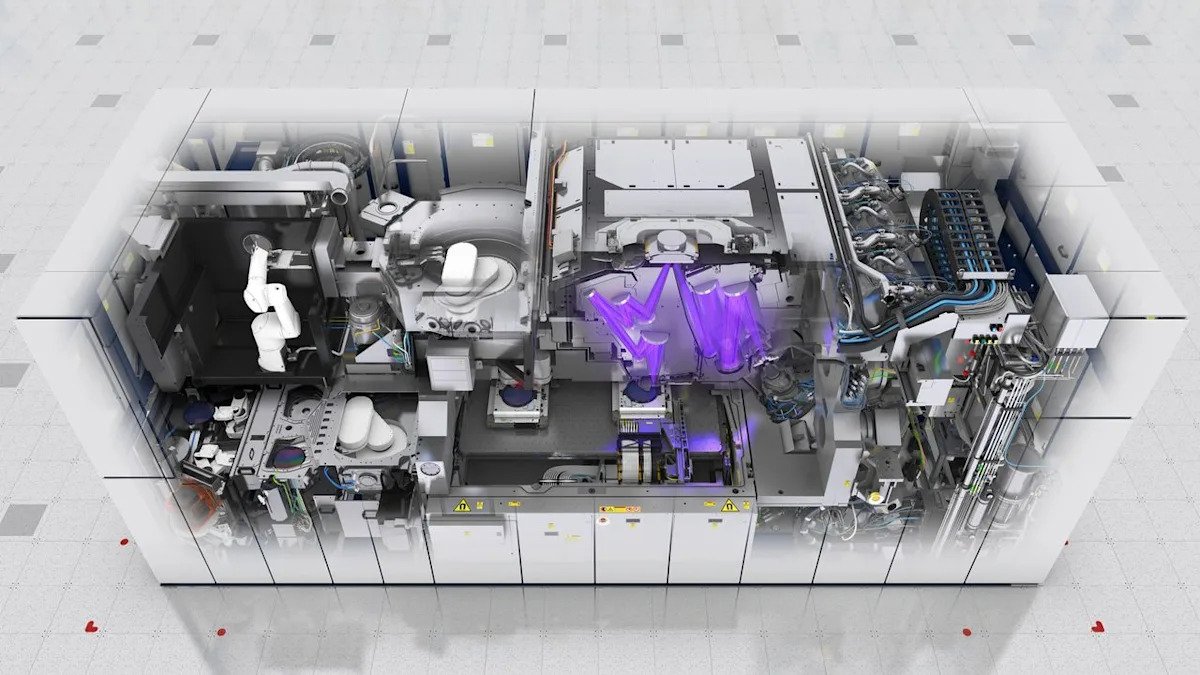
ASML, the Dutch semiconductor equipment maker based in Veldhoven, remains the world’s only manufacturer of extreme ultraviolet (EUV) lithography machines — the €350 million devices that etch circuit patterns onto silicon at atomic scales. Without ASML’s machines, the most advanced chips from TSMC, Intel, and Samsung simply cannot be made. In 2026, that monopoly is more strategically valuable than ever — and more politically contested.
The company’s latest generation of High-NA EUV systems, which use a numerical aperture of 0.55 to achieve resolution below 8 nanometres, began shipping to customers in late 2025. TSMC received the first unit for its 2-nanometre process node, with Intel’s installation in Arizona following in early 2026. Each High-NA machine is roughly the size of a city bus, weighs 150 tonnes, and requires 40 shipping containers to transport. The price tag: approximately €380 million per unit.
Geopolitical Pressure Mounts
ASML’s unique position has made it a focal point in the US-China technology conflict. Under pressure from Washington, the Dutch government has progressively tightened export controls. As of January 2026, ASML requires a licence to export not only EUV systems but also its most advanced deep ultraviolet (DUV) immersion lithography tools — machines that China’s Semiconductor Manufacturing International Corporation (SMIC) had been using to produce 7-nanometre chips for Huawei.
The impact on ASML’s order book has been mixed. China accounted for roughly 29% of ASML’s revenue in 2024 but fell to an estimated 18% in the first half of 2026, as the licensing regime restricted deliveries. However, demand from TSMC, Samsung, and Intel has more than compensated. ASML’s Q1 2026 results showed revenue of €7.8 billion, up 14% year-on-year, with a backlog of over €40 billion in orders extending into 2028.
European Chip Sovereignty
The European Chips Act, passed in 2023 with a €43 billion budget, is beginning to reshape the landscape. Intel’s Magdeburg fab — a €30 billion project expected to begin production in 2027 — will be equipped with ASML High-NA tools, making it one of the most advanced chip manufacturing sites in Europe. The project has faced delays and cost overruns, but construction resumed at full pace in Q2 2026 after a six-month pause for environmental review.
ASML itself is expanding. The company announced in May 2026 that it would add 2,000 engineering positions at its Veldhoven campus, bringing total headcount to over 44,000. The expansion is driven partly by the complexity of the next technology node beyond High-NA — tentatively called “Hyper-NA” — which would push numerical aperture toward 0.75 and require entirely new optical systems.
The Talent Constraint
ASML’s single biggest constraint is not geopolitics or capital — it’s people. The company competes for the same pool of specialised optics engineers, plasma physicists, and precision mechanics experts as every other advanced technology firm in Europe. The Eindhoven region, where ASML is based, has effectively zero unemployment among STEM graduates, and housing shortages complicate recruitment from abroad. The Dutch government’s “Beetle” programme, which fast-tracks visas for semiconductor engineers, has helped but hasn’t eliminated the gap.
Analysts broadly agree that ASML’s technological lead is secure for at least the next decade — the barrier to entry in EUV lithography is measured in decades of research, not years. The question for 2026 and beyond is whether the geopolitical environment allows the company to fully capitalise on that lead, or whether export controls will force a restructuring of the global semiconductor supply chain that leaves ASML caught between two competing blocs.
The Netherlands, for internationals
One email a week: the week's news for internationals in the Netherlands, new practical guides and what changed in the cities. No spam, unsubscribe any time.