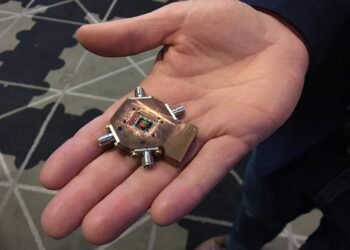
In the race to build more powerful artificial intelligence systems, a quiet revolution is taking place in semiconductor laboratories around the world. Neuromorphic computing, an approach that designs computer chips to mimic the structure and function of the biological brain, is emerging as one of the most promising alternatives to conventional computing architectures. In 2026, this technology has moved decisively from academic research into commercial deployment, with major technology companies racing to integrate brain-inspired processors into everything from data centers to smartphones.
The fundamental challenge driving this shift is simple: traditional computing architectures based on the von Neumann model are hitting fundamental limits. While Moore’s Law has slowed, the energy demands of AI workloads continue to grow exponentially. Training a single large language model can consume as much electricity as a small town, and the data centers housing these models now account for a significant and growing share of global energy consumption. As New York State halts construction of all new data centers over power grid concerns, the urgency for more efficient computing has never been greater.
How Neuromorphic Chips Differ from Traditional Processors
Traditional computer processors operate on a fundamentally different principle from the human brain. A conventional CPU or GPU processes information sequentially using binary logic, shuttling data between separate memory and processing units. This constant movement of data, known as the von Neumann bottleneck, consumes vast amounts of energy and creates heat that must be dissipated.
Neuromorphic chips, by contrast, integrate memory and processing in the same physical location, much like the synapses in a biological brain. Each artificial neuron on the chip can both store and process information, dramatically reducing the energy cost of data movement. These chips communicate using spikes, or brief electrical pulses, rather than continuous voltages, further reducing power consumption.
Leading this charge is Intel with its Loihi series of neuromorphic processors, now in its third generation. The Loihi 3, announced in early 2026, packs 2.6 million artificial neurons and can perform certain types of AI inference tasks using just one-thousandth the energy of a conventional GPU. IBM, meanwhile, has been developing its NorthPole chip, which achieves comparable efficiency gains by eliminating external memory access entirely.
The commercial impact is already visible. Several major smartphone manufacturers have begun incorporating neuromorphic coprocessors into their flagship devices, enabling always-on AI features like voice recognition and image processing without draining the battery. In the automotive sector, neuromorphic chips are being used for real-time sensor processing in autonomous vehicles, where low latency and energy efficiency are critical.
Real-World Applications and Industry Adoption in 2026
The application landscape for neuromorphic computing has expanded dramatically in 2026. In robotics, neuromorphic processors enable real-time sensory processing with minimal power, allowing robots to operate for extended periods on battery power. Boston Dynamics and several competing firms have begun integrating neuromorphic coprocessors into their latest robots, achieving significant improvements in response time and situational awareness.
Healthcare represents another major growth area. Neuromorphic chips are being used in portable medical devices for continuous monitoring and real-time analysis of biosignals. Researchers at Stanford Medical School have developed a neuromorphic-based system that can detect early signs of epileptic seizures up to five minutes before they occur, running on a device small enough to be worn as a patch. Similar systems are being developed for detecting cardiac arrhythmias and monitoring glucose levels in diabetic patients.
The financial sector has also taken notice. High-frequency trading firms are experimenting with neuromorphic processors to execute trades with microsecond precision while consuming a fraction of the power of conventional systems. The parallel processing architecture of neuromorphic chips is particularly well-suited to the pattern recognition tasks that underlie modern algorithmic trading.
Challenges and the Road Ahead
Despite the remarkable progress, neuromorphic computing faces significant hurdles before it can achieve widespread adoption. Programming these chips remains substantially more difficult than programming conventional processors. The spiking neural network algorithms that run on neuromorphic hardware require specialized expertise and tools that are still in their infancy. Most AI developers today are trained on conventional deep learning frameworks like PyTorch and TensorFlow, and adapting these frameworks to target neuromorphic hardware is a non-trivial undertaking.
Another challenge is integration with existing infrastructure. Neuromorphic chips excel at inference tasks but are not well-suited to training large neural networks, which still requires the brute-force parallelism of conventional GPUs. This means that hybrid systems, combining traditional and neuromorphic processors, are likely to be the norm for the foreseeable future. Managing the data flow between these heterogeneous computing elements adds complexity to system design.
Standards and interoperability are also concerns. With Intel, IBM, and a growing number of startups each pursuing their own architectures and programming models, the risk of fragmentation is real. Industry groups like the Neuromorphic Computing Consortium are working to establish common standards, but progress has been slow.
The Energy Efficiency Revolution
The most compelling argument for neuromorphic computing is energy efficiency. A typical data center GPU running continuous AI inference consumes 300 to 700 watts. A neuromorphic chip performing the same task might consume just 1 to 10 watts. When scaled across the thousands of chips in a modern AI data center, the energy savings become transformative.
Analysts at the International Energy Agency project that widespread adoption of neuromorphic processors could reduce the energy consumption of AI workloads by 80 to 95 percent by 2030. This would not only reduce operating costs for technology companies but also significantly decrease the environmental impact of the AI industry. Given that AI data centers are projected to consume as much as 4 percent of global electricity by 2027, the potential benefits are enormous.
The environmental angle has attracted attention from policymakers as well. Several European governments have launched initiatives to fund neuromorphic computing research as part of their broader green technology strategies. The European Union’s Horizon Europe program has allocated significant funding for brain-inspired computing research, recognizing its potential to reconcile AI advancement with climate goals.
Related: AI Data Centers Push Big Tech’s Emissions Sharply Higher
The Netherlands, for internationals
One email a week: the week's news for internationals in the Netherlands, new practical guides and what changed in the cities. No spam, unsubscribe any time.