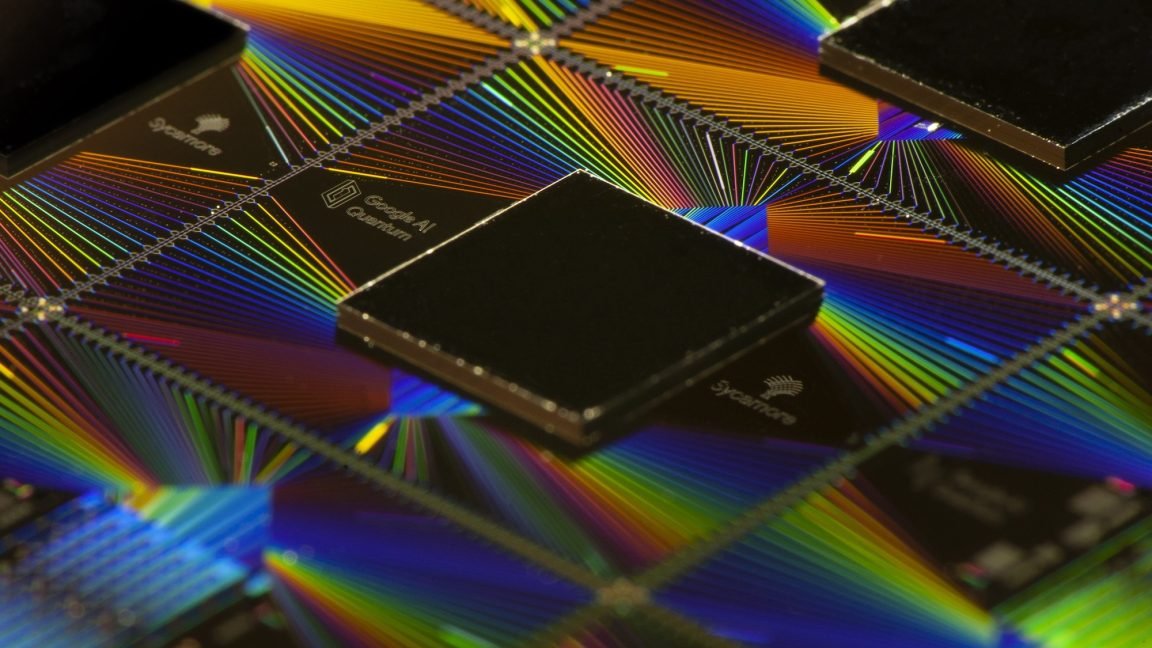
The quantum computing race intensified dramatically in mid-2026, with multiple research teams announcing breakthroughs in error correction, qubit stability, and practical applications that bring the technology closer to commercial viability than ever before.
The Error Correction Milestone
For decades, the biggest obstacle to useful quantum computing has been error rates. Quantum bits — qubits — are extraordinarily fragile, with environmental noise causing errors that corrupt calculations. Traditional error correction required thousands of physical qubits to create a single reliable “logical” qubit, making practical quantum computers prohibitively expensive and complex.
That equation changed in July 2026 when researchers at Google Quantum AI demonstrated a surface code implementation achieving logical error rates below the critical threshold using fewer than 1,000 physical qubits. The team’s “Willow” processor showed that as the number of qubits increases, the error rate actually decreases — the long-sought “below threshold” milestone that proves fault-tolerant quantum computing is physically achievable.
European Quantum Initiatives Gain Momentum
Europe has emerged as a serious contender in the quantum race. The Quantum Delta NL program in the Netherlands has invested over €600 million in quantum research infrastructure, including the House of Quantum in Delft — a dedicated facility housing startups, research labs, and quantum networking testbeds. Dutch researchers at QuTech, a collaboration between TU Delft and TNO, have demonstrated record coherence times in spin qubits, a technology platform considered highly scalable.
The broader European Quantum Flagship program has now funded over €1 billion in research projects, with particular emphasis on quantum sensing and quantum communication. A pan-European quantum communication network connecting major cities including Amsterdam, Paris, Berlin, and Vienna is on track for completion by 2028.
Early Commercial Applications Emerge
While universal fault-tolerant quantum computers remain years away, 2026 has seen the emergence of practical near-term applications. Pharmaceutical companies are using quantum-classical hybrid algorithms to simulate molecular interactions for drug discovery, achieving results that would be computationally infeasible on classical supercomputers.
Financial institutions are deploying quantum optimization algorithms for portfolio management and risk analysis. JPMorgan Chase, Goldman Sachs, and several European banks have established dedicated quantum teams and are running production workloads on cloud-accessible quantum processors from IBM, Google, and IonQ.
What Comes Next
The next major milestone on the horizon is demonstrating “quantum advantage” for a commercially relevant problem — not just a contrived mathematical exercise. Most experts predict this will happen in computational chemistry or materials science within the next 18 to 24 months. When it does, it will mark the beginning of the quantum computing industry’s transition from scientific curiosity to economic force.
Understanding Quantum Error Correction Breakthroughs
Quantum error correction represents one of the most significant barriers to practical quantum computing. Unlike classical bits, which exist as either 0 or 1, quantum bits (qubits) can exist in superpositions of states and are extremely sensitive to environmental noise. This fragility means that quantum computations are inherently error-prone, requiring sophisticated error correction codes to detect and correct errors without measuring the quantum state directly. The breakthrough announced by Microsoft and Quantinum builds upon decades of theoretical work to create logical qubits that can maintain coherence for significantly longer periods than physical qubits.
Implications for the Quantum Computing Industry
This milestone has significant implications for the timeline of practical quantum computing. Industry analysts now project that fault-tolerant quantum computers capable of solving problems beyond the reach of classical computers could arrive within 5-7 years rather than the 10-15 year timeline previously estimated. Financial services, pharmaceutical companies, and materials science researchers are among the most enthusiastic adopters of quantum computing capabilities. Banks are exploring quantum algorithms for portfolio optimization and risk analysis, while pharmaceutical companies are preparing to use quantum simulation for drug discovery and molecular modeling.
Governments around the world are also investing heavily in quantum capabilities. The United States, China, and the European Union have each committed billions of dollars to quantum research and development, recognizing that quantum supremacy in computation could translate to strategic advantages in cryptography, defense, and economic competitiveness. The race to achieve practical quantum computing has become a central element of the broader technological competition between major powers.
The Road to Fault-Tolerant Quantum Computing
Despite these advances, significant challenges remain before fault-tolerant quantum computing becomes a reality. Scaling quantum systems from hundreds to thousands of logical qubits will require advances in qubit fabrication, control electronics, and cryogenic cooling systems. The materials science challenges of building large-scale quantum processors are formidable, requiring purity levels and manufacturing precision that push the boundaries of current semiconductor fabrication capabilities. However, the momentum behind quantum computing research suggests that these challenges are solvable, and the era of practical quantum computing is drawing nearer with each passing month.
Related: Global Debt Crisis Looms: How Emerging Markets Are Navigating the 2026 Economic Landscape
Collaboration between industry and academia has been crucial to these advances. Research institutions including the University of Chicagos Pritzker School of Molecular Engineering, TU Delft, and the University of Tokyo have partnered with companies like IBM, Google Quantum AI, and IonQ to push the boundaries of quantum error correction. These partnerships combine theoretical insights with practical engineering capabilities, accelerating the transition from laboratory demonstrations to commercially relevant systems. The open-source quantum software ecosystem has also matured significantly, with platforms like Qiskit, Cirq, and PennyLane providing the tools needed to design and test quantum error correction codes at scale.
The Netherlands, for internationals
One email a week: the week's news for internationals in the Netherlands, new practical guides and what changed in the cities. No spam, unsubscribe any time.