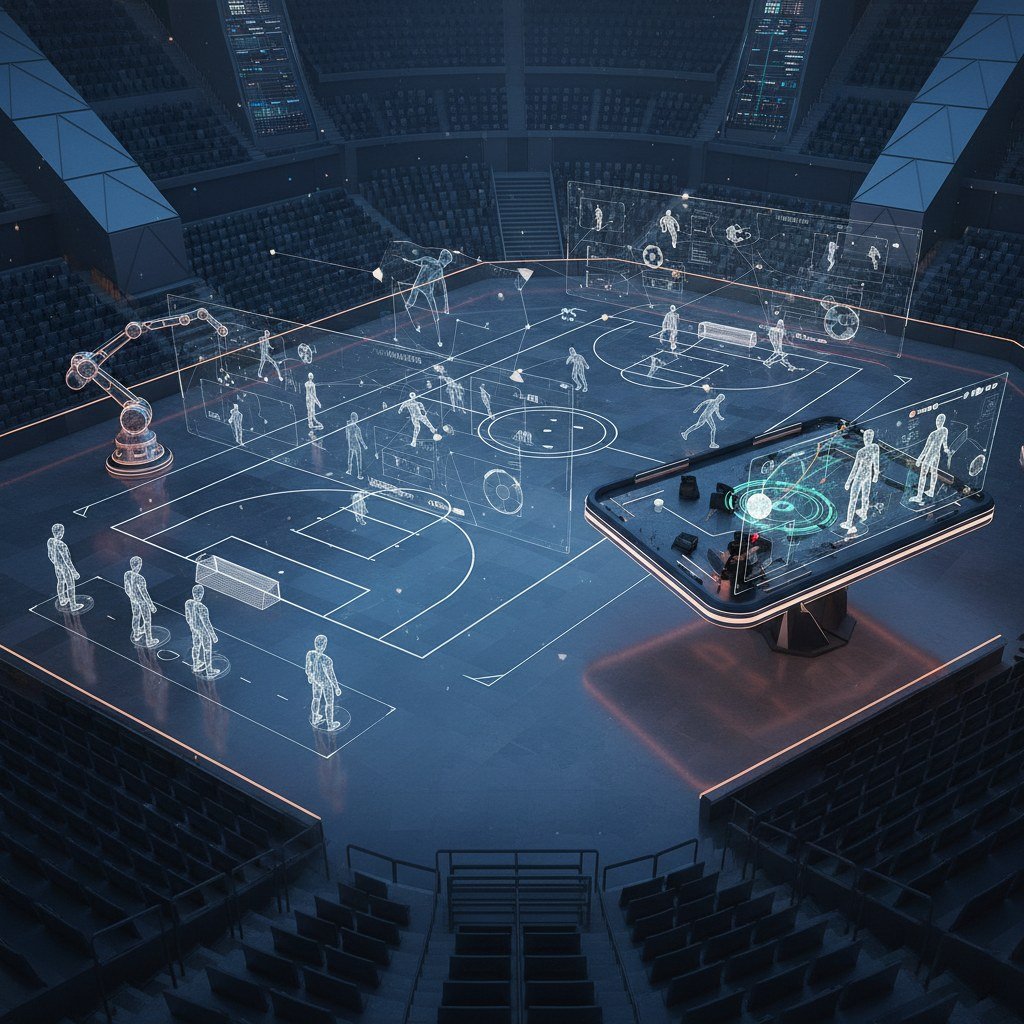
Artificial intelligence has become the most influential force in professional sports in 2026, fundamentally changing how athletes train, how coaches devise tactics, how referees make calls, and how fans experience the game. The multi-billion dollar sports industry has embraced AI not as a futuristic concept but as an essential competitive tool, with teams that fail to adopt the technology finding themselves at an increasingly insurmountable disadvantage.
AI-Powered Tactical Analysis: The New Competitive Edge
Professional sports teams across every major league are now employing AI systems that analyze thousands of hours of match footage to identify patterns invisible to the human eye. These systems can track every player movement, pass, shot, and defensive action, building comprehensive models of both their own and opponents’ tactical tendencies. The result is a level of tactical preparation that was unimaginable just five years ago.
In football, Premier League clubs are using AI-powered tactical analysis platforms that process data from dozens of cameras positioned around the stadium. These systems track the position and movement of all 22 players and the ball at 25 frames per second, generating over 3 million data points per match. Machine learning algorithms then identify patterns — a fullback who consistently leaves space when fatigued, a striker who favors the near post from certain angles, a midfield that loses shape when pressed aggressively.
“The tactical preparation in 2026 is completely different from even 2020,” explains Dr. Emma Richardson, head of sports analytics at a leading Premier League club. “Our AI systems can simulate an opponent’s response to specific formations and strategies before we even set foot on the pitch. We can test a tactical change 10,000 times in simulation before deciding whether to use it in a match.”
Basketball has seen perhaps the most dramatic transformation. NBA teams now use AI systems that analyze offensive and defensive sets in real-time, providing coaches with recommendations during timeouts and quarter breaks. The systems can identify when an opponent is about to run a specific play based on player positioning and initiate counter-strategies. Some teams have experimented with in-ear communication systems that relay AI-generated tactical advice to point guards during dead-ball situations.
AI in Refereeing: From Assistance to Automation
The most contentious area of AI adoption in sports has been officiating. AI-assisted referee systems have become standard across most major sports, with the technology progressing from advisory tools to increasingly automated decision-making. The 2026 World Cup and Olympic Games both featured AI-powered officiating systems that made real-time decisions on offsides, boundary calls, and scoring disputes.
In tennis, AI line-calling systems have completely replaced human line judges at all Grand Slam tournaments. The systems use multiple high-speed cameras and computer vision algorithms to track ball trajectory with millimeter accuracy, making calls in milliseconds. The technology has virtually eliminated erroneous line calls, which were once a routine and controversial part of the sport. Player complaints about officiating have dropped by over 90 percent since the systems were fully implemented.
Football has taken a more cautious approach. Semi-automated offside technology (SAOT), first introduced at the 2022 World Cup, has been refined and expanded across Europe’s top leagues. The system uses 12 tracking cameras and an inertial measurement unit inside the match ball to create 3D models of player positions at the moment the ball is played. Decisions that once required human review for two to three minutes are now communicated to the video assistant referee in under 30 seconds.
“The key challenge with AI in refereeing is maintaining the flow and spirit of the game,” says FIFA’s head of technology, Markus Berger. “We have systems that could call every single foul with perfect accuracy, but that would destroy the rhythm of football. The art is calibrating AI to intervene on clear and obvious errors while letting the game breathe.”
Athlete Training and Injury Prevention
Perhaps the most profound impact of AI in sports has been in athlete training and injury prevention. Wearable sensors combined with AI analysis have enabled personalized training programs that adapt to each athlete’s physiological state in real-time. Systems monitor heart rate variability, muscle oxygen levels, sleep quality, and biomechanical load to determine optimal training intensity and recovery periods.
The results have been striking. Several major clubs and franchises have reported 30-50 percent reductions in non-contact injuries since implementing AI-driven training optimization. The economic impact is enormous — a single star player missing weeks of competition can cost a team millions in lost revenue and diminished performance. For clubs with the largest investments in AI training systems, the technology has effectively paid for itself through injury prevention alone.
“We can now predict with 85 percent accuracy whether an athlete is at elevated risk of hamstring injury within the next seven days,” explains Dr. James Park, head of sports science at a leading Bundesliga club. “When the system flags a player, we modify their training load, focus on specific strengthening exercises, and sometimes rest them entirely. Two years ago, we were managing injuries after they happened. Now we prevent them before they occur.”
Fan Experience and Broadcasting Revolution
AI is also transforming how fans experience sports. Broadcasting companies now use AI systems that automatically generate personalized viewing experiences, selecting camera angles, highlighting key moments, and providing real-time statistics tailored to individual viewer preferences. A fan watching on a smart TV can choose to follow a specific player, view tactical overlays, or access AI-generated commentary analyzing the action as it unfolds.
Fantasy sports and sports betting, both multi-billion dollar industries, have been revolutionized by AI. Betting odds are now generated by complex machine learning models that process hundreds of variables in real-time, adjusting odds within seconds of in-game events. Fantasy sports platforms use AI to provide personalized player recommendations and lineup optimization, with the most sophisticated systems analyzing factors ranging from weather conditions to opponent defensive schemes to player sleep quality.
The metaverse and virtual reality have opened new frontiers for fan engagement. Several major leagues now offer VR viewing experiences that place fans in premium virtual seats, with AI-powered cameras providing perspectives that would be impossible in the physical world. Some clubs have created AI-powered virtual stadiums where fans can interact with each other and experience matches in shared virtual spaces.
The Future: Fully Autonomous Sports Analysis
Looking ahead, the trajectory of AI in sports points toward increasingly autonomous systems. Companies like DeepMind and Google Research are developing AI systems that can generate novel tactical strategies — plays, formations, and game plans that no human coach has ever conceived. Early results in basketball and American football have shown that AI-generated plays can outperform human-designed strategies against specific opponent configurations.
Scouting and recruitment have been transformed by AI systems that can evaluate player performance with unprecedented accuracy. These systems analyze not just traditional statistics but thousands of micro-actions in every match — positioning decisions, off-ball movement, defensive anticipation — to create comprehensive player profiles. Several Premier League clubs now rely on AI scouting systems as their primary talent identification tool, with human scouts serving in a verification and relationship-building role.
However, concerns about AI’s role in sports are growing. Critics argue that the technology threatens to homogenize playing styles, as teams increasingly adopt similar data-driven strategies. Others worry about the privacy implications of continuous athlete monitoring, or the potential for AI to exacerbate existing inequalities between wealthy and less wealthy clubs.
For athletes and teams in 2026, the message is clear: AI is no longer an optional competitive advantage but a fundamental requirement for competing at the highest level. The sports organizations that embrace AI most effectively will not just win more matches — they will redefine how sport itself is played, coached, and experienced.
Related: Robotaxis Arrive in Rotterdam: Netherlands Launches Europe’s Largest Autonomous Ride-Hailing Fleet
The Netherlands, for internationals
One email a week: the week's news for internationals in the Netherlands, new practical guides and what changed in the cities. No spam, unsubscribe any time.