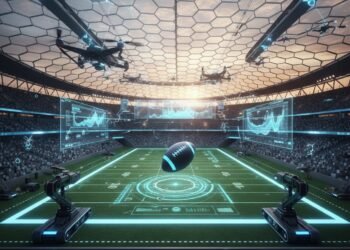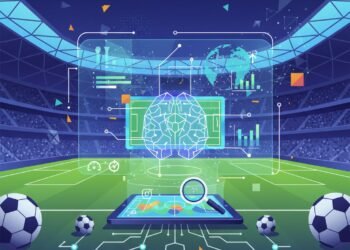
In 2026, the landscape of professional sports has been transformed by artificial intelligence in ways that would have seemed like science fiction just a decade ago. From predictive injury prevention to real-time tactical adjustments, AI-driven analytics have become the competitive edge that separates championship teams from the rest of the pack. The global sports analytics market, valued at approximately $4.5 billion in 2025, is projected to exceed $8 billion by 2030, with AI playing an increasingly central role in this growth.
This article explores how AI is revolutionizing sports analytics across major leagues, the key technologies driving this transformation, and what the future holds for data-driven athletic performance. Whether you are a coach, a player, a sports executive, or simply a fan, understanding these developments is essential to appreciating the modern game.
The data revolution in professional sports
The journey from traditional scouting to AI-powered analytics began with simple statistics collection, but today’s systems capture millions of data points per game. Player tracking technologies using computer vision and wearable sensors generate a firehose of information: player positioning, speed, acceleration, heart rate, fatigue levels, and biomechanical stress on joints and muscles.
In the NBA, Second Spectrum technology uses six cameras in every arena to track player and ball movements 25 times per second, generating over 2.5 million positional data points per game. AI algorithms analyze this data to identify patterns that human coaches might miss — optimal defensive rotations, shooters’ release points, and pass interception probabilities.
The English Premier League has similarly embraced AI analytics. All twenty clubs now employ dedicated data science teams, with Manchester City, Liverpool, and Arsenal employing over thirty analysts each. These teams work alongside traditional coaching staff to provide real-time match insights and inform transfer market decisions during windows.
Baseball has seen perhaps the most dramatic adoption, where the Oakland Athletics’ “Moneyball” approach has evolved into a fully AI-driven system used by every MLB team. Neural networks predict a batter’s performance against specific pitch types, accounting for variables such as weather conditions, stadium dimensions, and even the time of day.

Injury prevention and player health monitoring
One of the most valuable applications of AI in sports is injury prevention. Professional teams invest heavily in keeping their star players healthy, and AI systems have proven remarkably effective at predicting when athletes are at elevated risk of injury.
Wearable technology has been a game-changer in this domain. Devices worn during training and matches collect real-time data on heart rate variability, muscle oxygen saturation, and movement asymmetry. AI models trained on historical injury data can flag players whose physiological markers suggest they are approaching dangerous fatigue levels or compensating for an undiagnosed minor injury, allowing medical staff to intervene before a major injury occurs.
The results have been striking. FC Barcelona’s medical team reported a 35 percent reduction in hamstring injuries among first-team players after implementing an AI-driven monitoring system in 2024. In the NFL, teams using similar technology have seen practice session injuries drop by nearly 25 percent, saving millions in player salaries and improving team performance throughout the season.
AI also assists in rehabilitation. Computer vision systems analyze a recovering athlete’s movement patterns, comparing them frame-by-frame with pre-injury baseline data. When a player’s gait or joint angle deviates from their normal pattern, the system alerts physiotherapists, who can adjust the rehabilitation program accordingly. This precision medicine approach has accelerated return-to-play timelines by an average of 15 to 20 percent across multiple sports.
Real-time tactical analysis and decision support
During live matches, AI systems now provide coaches with real-time tactical recommendations that would have been impossible to compute manually. In soccer, AI models running on edge computing hardware at the stadium analyze the current formation and movement patterns of both teams, identifying vulnerabilities in the opponent’s defensive structure and suggesting attacking strategies.
In tennis, IBM’s Watson has evolved into an advanced tactical advisor used by several top-ranked players. The system analyzes an opponent’s serve patterns, return tendencies, and movement preferences, providing recommendations on shot selection and positioning between points. Players review this data on handheld devices during changeovers, adjusting their strategy for the next game based on the AI’s analysis.
Basketball teams have taken this further, using AI to call specific plays during timeouts. The system analyzes the opponent’s defensive setup over the preceding possessions and suggests offensive sets that historically have a high probability of success against that particular defensive alignment. Some arenas now have displays showing the AI-recommended play alongside animated diagrams that coaches can review in real time.
In motorsports, AI has transformed pit strategy. Formula 1 teams use machine learning models that simulate thousands of race scenarios per second, accounting for variables such as tire degradation rates, weather forecasts, opponent pit stop patterns, and regulatory changes. The AI provides real-time recommendations on when to pit, which tire compound to select, and how to adjust the car’s engine mapping for optimal performance given current race conditions.
The scouting revolution: Finding the next superstar
AI has fundamentally changed how teams discover and evaluate talent. Traditional scouting relied on a scout’s subjective impression of a player, which could be influenced by confirmation bias, recency bias, or simple fatigue. AI-powered scouting systems provide objective, data-driven evaluations that complement human judgment.
In soccer, platforms like ScoutDecision and AiSCOUT analyze video footage of thousands of matches to identify promising young players. The systems evaluate technical skills — passing accuracy, dribbling success rate, shot power and placement — as well as tactical attributes like positioning, decision-making speed, and work rate. Players ranked highly by these systems have gone on to secure professional contracts with top European clubs, validating the approach.
American football’s NFL Draft has also been transformed by AI analytics. Teams now build predictive models that project college players’ professional performance based on combine results, college statistics, and game footage analysis. The most sophisticated models consider variables like strength of schedule, teammate quality, and coaching system to produce more accurate projections than traditional scouting alone.
The democratization of access to AI scouting tools has been particularly impactful for smaller clubs with limited scouting budgets. A League Two soccer club in England can now access the same quality of data analysis as a Premier League giant, leveling the playing field and enabling smarter investment in player development and recruitment.

Fan engagement and broadcast innovation
AI is not only changing how teams perform but also how fans experience sports. Broadcasters now use AI to generate real-time statistics overlays, automated highlight reels, and personalized content streams that adapt to individual viewers’ preferences.
ESPN’s AI-powered highlight system automatically identifies the most exciting moments from live games — a dramatic goal, a crucial interception, a record-breaking performance — and compiles them into shareable clips within seconds of them occurring. Viewers receive notifications with links to personalized highlight packages tailored to their favorite teams and players.
In 2026, several broadcasters are testing AI commentator systems that provide real-time analysis in multiple languages. While these systems are not yet replacing human commentators entirely, they are being used for secondary audio tracks, offering viewers alternative commentary styles or languages that are not served by the primary broadcast.
Fantasy sports platforms have also embraced AI, with advanced predictive models helping millions of users make better lineup decisions. The same analytics that professional teams use to evaluate player performance now assist fantasy managers in identifying undervalued players, predicting breakout performances, and optimizing their rosters against weekly opponents.
Ethical considerations and the future
As AI becomes more deeply embedded in sports, important ethical questions arise. Data privacy is a significant concern — athletes’ physiological and performance data could be misused by teams, insurers, or even opponents if not properly protected. Collective bargaining agreements increasingly include provisions governing how teams can collect, store, and use player data.
There is also the question of competitive balance. While AI democratizes access to analytics, the most resource-rich teams can afford the most sophisticated systems and the best data scientists to operate them. Regulators and league bodies are beginning to consider rules that would limit or standardize AI usage to maintain competitive fairness.
Looking ahead, the integration of AI into sports will only deepen. Augmented reality training systems that overlay real-time analytics on a player’s field of view, fully autonomous scouting networks, and AI-powered referees capable of making instantaneous calls with perfect accuracy are all on the horizon. The teams and leagues that embrace these innovations thoughtfully — balancing technological advantage with ethical responsibility — will define the future of sport.
Related: How Wearable Technology and AI Are Revolutionizing Athlete Performance in 2026
The Netherlands, for internationals
One email a week: the week's news for internationals in the Netherlands, new practical guides and what changed in the cities. No spam, unsubscribe any time.