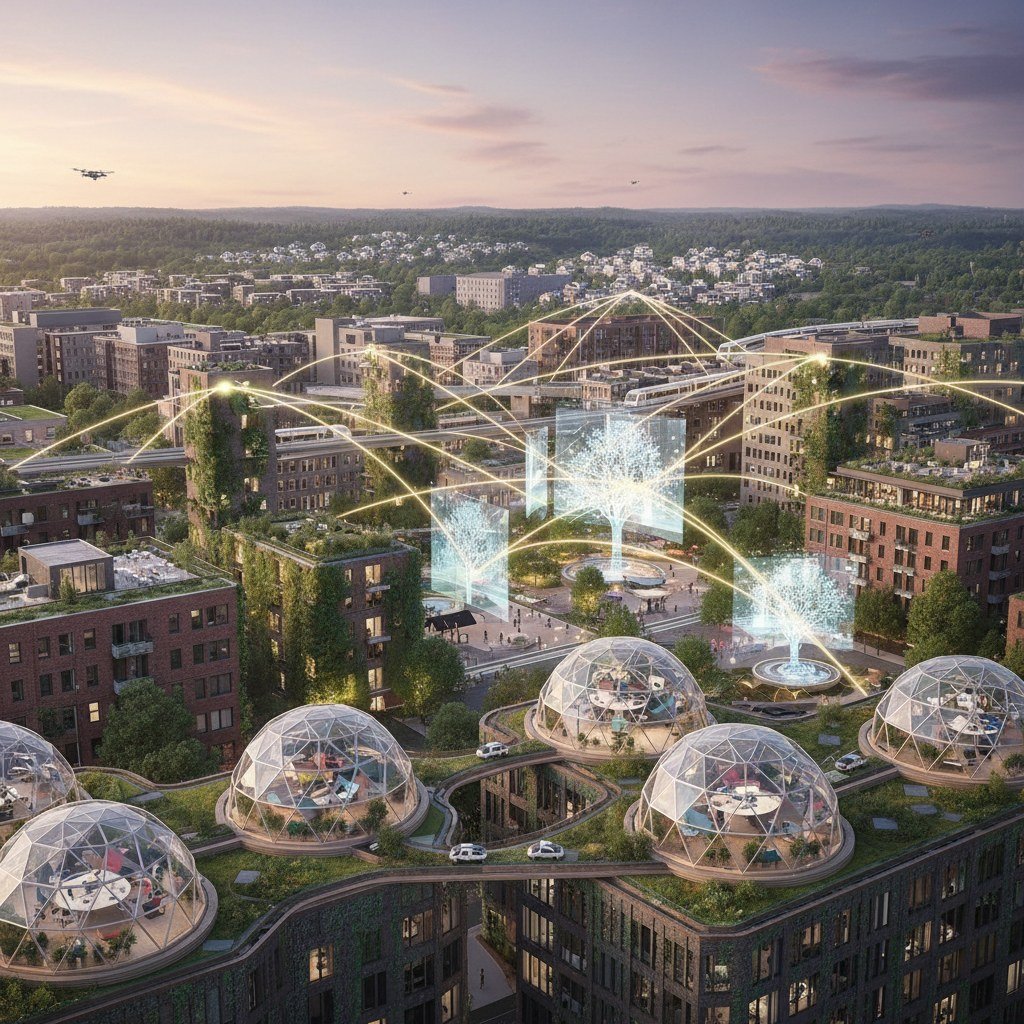
By mid-2026, remote work has evolved from a pandemic-era adaptation into the defining feature of the global labor market. What began as an emergency response in 2020 has become a permanent structural shift, reshaping not just how people work but where they live, how cities function, and how communities form. The hybrid model — combining office and remote days — has emerged as the dominant arrangement, but its ripple effects are being felt far beyond office walls.
This article examines how the remote work revolution is transforming urban geography, housing markets, transportation systems, and social relationships in 2026, and what these changes mean for the future of work and community life.
The hybrid model becomes the new normal
Data from major workforce surveys conducted in early 2026 paint a clear picture: hybrid work has solidified as the standard arrangement for knowledge workers globally. According to the Global Workplace Analytics 2026 report, 67 percent of office-eligible employees now work in a hybrid pattern, splitting their time between home and office. Only 18 percent work fully on-site, and 15 percent are fully remote. This represents a dramatic reversal from the pre-2020 baseline, when less than 8 percent of workers had any remote flexibility.
The hybrid model varies significantly by industry and geography. Technology companies lead the way, with many offering fully flexible policies where employees choose their in-office days. Financial services and professional services firms have adopted more structured approaches, often requiring two to three fixed office days per week for collaboration and team meetings. Manufacturing, retail, and healthcare — industries where in-person presence is essential — have seen the least change, though even these sectors have adopted hybrid arrangements for administrative and management roles.
The adoption of hybrid work has been enabled by a technological ecosystem that barely existed five years ago. Virtual collaboration platforms have matured beyond simple video calls to include persistent virtual workspaces, AI-powered meeting assistants, and asynchronous communication tools that reduce the need for real-time coordination. Companies like Microsoft, Google, and Zoom have integrated AI features that automatically summarize meetings, generate action items, and translate conversations across languages, making distributed teamwork more seamless than ever before.
The urban transformation: Downtowns struggle, suburbs thrive
The most visible impact of the remote work revolution is the transformation of urban downtowns. In 2026, office vacancy rates in major global cities remain elevated, with many central business districts experiencing vacancy rates between 25 and 35 percent. Cities like San Francisco, New York, London, and Sydney have seen a hollowing out of their commercial cores, with once-bustling office towers standing partially empty and ground-floor retail spaces shuttered.
But the story is more complex than simple decline. Downtowns that have diversified their economies — adding residential units, entertainment venues, cultural institutions, and green spaces — are faring better than those that remain overly dependent on office workers. Cities like Amsterdam, Copenhagen, and Melbourne have been leaders in the “15-minute city” concept, where residents can access most daily needs within a short walk or bike ride from home. These cities have seen office-to-residential conversion projects accelerate, with tax incentives and zoning reforms making it easier to repurpose underused commercial buildings.
In contrast, suburbs and smaller cities have experienced a renaissance. The migration of remote workers from expensive coastal metros to more affordable inland and suburban areas has reshaped housing markets across Europe and North America. Commuter towns once dismissed as “bedroom communities” are now vibrant hubs of daytime activity, with new coffee shops, co-working spaces, and community centers emerging to serve the work-from-home population.
Property prices in suburban rings around major cities have risen by 15 to 30 percent since 2022, while some downtown apartment prices have stagnated or declined in real terms. This reversal of decades-long urbanization trends has significant implications for municipal finances, as local governments that relied on commercial property taxes face revenue shortfalls while residential suburbs grapple with infrastructure demands from new populations.
Transportation in the hybrid era: Peak car, changing transit
Transportation patterns have been fundamentally altered by remote work. The traditional rush hour — that concentrated surge of commuters moving into and out of city centers twice daily — has given way to a more dispersed pattern. Public transit agencies report that peak ridership is down 30 to 50 percent compared to 2019 levels, but midday and weekend ridership has increased. The midday plateau, with steady but moderate ridership throughout the day, has become the new normal for many systems.
This shift creates challenges for transit agencies that built their business models around capturing a concentrated peak. Fare revenue is down, and many systems are rethinking schedules, route networks, and fare structures. In response, several European cities have introduced flexible fare models, including capped daily fares and subscription services that offer unlimited off-peak travel at reduced rates.
Car usage has also changed. While total vehicle miles traveled in many regions has declined slightly, the pattern of travel has shifted from the daily commute to a wider variety of shorter, more dispersed trips — school runs, errands, social visits, and recreational travel. Bike and e-bike usage has surged, particularly in European cities that invested in cycling infrastructure during the pandemic. E-bike sales in the Netherlands, already the cycling capital of the world, grew by 24 percent in 2025 alone, with many new buyers citing their hybrid commute as a primary motivation.
The social dimension: Connection, isolation, and community
Beyond the economic and urban impacts, remote work has profound social consequences. For many workers, the elimination of the daily commute has freed up significant time — an average of 55 minutes per day according to a 2026 Stanford University study — that is being redirected toward family, exercise, hobbies, and community involvement. Parents report spending more time with their children, and overall life satisfaction scores among hybrid workers are modestly higher than those of fully on-site workers.
But remote and hybrid work has also exacerbated social isolation and loneliness. Young professionals, particularly those early in their careers, report missing the informal mentoring, spontaneous collaboration, and social bonding that happens in office environments. Entry-level employees at fully remote companies have been slower to advance, with fewer opportunities to build relationships with senior colleagues and absorb organizational culture through osmosis.
Companies have responded with deliberate social interventions: scheduled virtual coffee chats, in-person retreats, mentorship programs, and co-working stipends. Some firms have adopted a “remote-first, office occasionally” model where the entire team gathers for one week per quarter for intensive collaboration and team building. Employee resource groups and virtual communities have proliferated, connecting workers around shared interests — cooking, gaming, parenting, fitness — that cut across reporting lines.
What the remote work revolution means for 2026 and beyond
The remote work revolution is far from complete. As artificial intelligence continues to automate routine knowledge work tasks, the nature of office work itself is changing. AI-powered agents now handle scheduling, note-taking, reporting, and data analysis, freeing human workers for higher-value activities that require creativity, judgment, and emotional intelligence. These hybrid work models — blending human and artificial intelligence, physical and virtual presence — represent the next frontier of workplace transformation.
Policy challenges remain. Tax systems designed for an era when work was tied to a physical office have not adapted to the reality of distributed workforces. Cross-border remote work raises questions about tax jurisdiction, social security contributions, and labor law compliance. The European Union has begun work on a common framework for remote workers, but progress is slow, and individual countries have adopted widely different approaches.
One thing is clear: there is no going back to the pre-2020 world of work. The hybrid model is not a temporary arrangement but a permanent feature of the labor market, and its effects on cities, communities, and human relationships will continue to unfold for years to come. For more on how digital shifts are reshaping society, read our article on the digital detox movement and why millions are reclaiming their attention in 2026.
Related: How Digital Nomads Are Reshaping Global Economies in 2026
Also read: The Digital Detox Movement: Why Millions Are Reclaiming Their Attention in 2026
The Netherlands, for internationals
One email a week: the week's news for internationals in the Netherlands, new practical guides and what changed in the cities. No spam, unsubscribe any time.