


Reproducing a scientific result is supposed to be the boring part of science. It is also where a lot of science quietly falls apart. Take a published paper, follow its methods, and see whether the numbers come back the way the authors claimed. Plenty of the time, they don’t. A British AI lab called Inherent thinks it has built something that changes who does that work, and how fast.
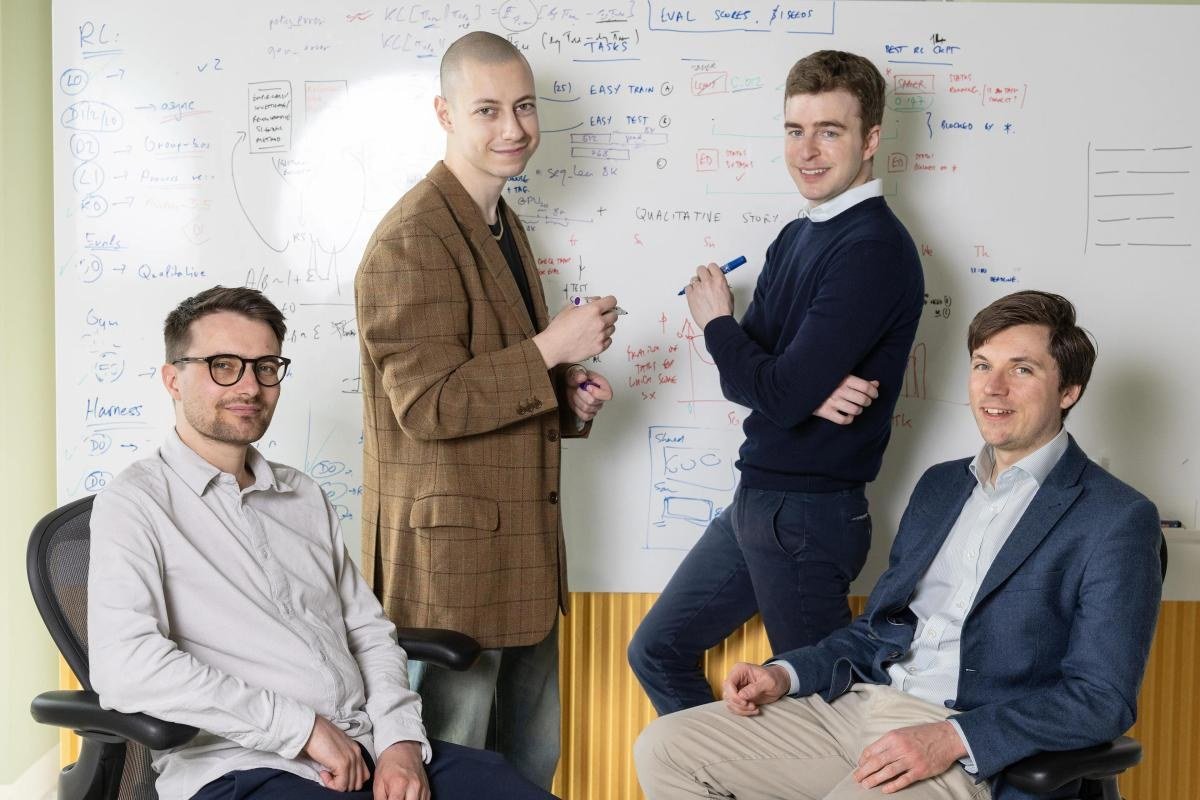
The company, founded by alumni of Google DeepMind, has released an AI agent named Faraday. Inherent describes it not as a chatbot or a search tool but as a “teammate,” and its headline claim is pointed: on the task of replicating scientific research, Inherent says Faraday outperformed systems from Anthropic and OpenAI, the two best-funded names in the field. For a young lab to lead with a direct comparison against those two is a confident opening move, and it tells you exactly which league Inherent believes it is playing in.
What replication actually asks of a machine
Replicating a paper is harder than it sounds, which is why it makes a revealing test. A model has to read a dense scientific document, understand the methodology buried in it, reconstruct the experiment, and then produce results that match what the original authors reported. That means reading, reasoning, coding, running the work, and checking the output against a target. Miss any step and the answer is wrong in a way that is easy to measure.
Whether an AI can do the same thing reliably has become one of the more interesting yardsticks in the industry, precisely because there is a correct answer to check against. You either reproduced the result or you didn’t. That makes replication a cleaner benchmark than the open-ended tasks where models can bluff their way to a plausible-sounding response. Inherent is betting that Faraday’s edge here signals something broader about the agent’s ability to handle real research work rather than demos.
Why DeepMind pedigree matters here
Founding pedigree is not everything, but in this corner of AI it counts. DeepMind is the lab behind AlphaFold, the protein-structure system that reshaped biology and eventually earned its creators a share of a Nobel Prize. People who trained inside that environment have watched, up close, what happens when a machine-learning system is aimed squarely at a scientific problem instead of a consumer one. Inherent’s team is drawing on that lineage, and Faraday is their argument that the approach travels beyond any single domain.
Inherent frames Faraday as a stepping stone rather than a finished product. Replicating existing research is the warm-up. The real prize, the company suggests, is an agent that can help push science forward, not just retrace steps that human researchers have already taken. Getting reliable reproduction right first is a sensible order of operations, because a system that cannot faithfully repeat known results has no business proposing new ones.
A crowded field, and a sharp claim
Positioning a first product against Anthropic and OpenAI is a strategy as much as a benchmark result. Both companies have poured enormous resources into agents that write code, run tools, and carry out multi-step tasks, and both market those agents to researchers and engineers. By naming them directly and claiming a win on a specific task, Inherent is inviting scrutiny it presumably welcomes. A vague boast is easy to ignore. A concrete comparison is something rivals and outside researchers can try to knock down.
The obvious caveat is that this is Inherent’s own account of its own system. Vendor benchmarks tend to flatter the vendor, and a claim like this earns its weight only when independent researchers can run the same test and see the same gap. That is the standard any replication tool, of all things, should be held to. It would be a strange irony for a product built to check other people’s results to skip that step for its own.
Still, the framing is smart. Science has a reproducibility problem that predates AI by decades, and any credible tool that lets researchers verify each other’s work faster is solving a problem the field already admits it has. If Faraday genuinely narrows the gap between a published claim and a confirmed one, the use case sells itself.
What to watch now is whether outside labs can reproduce Inherent’s reproduction claims, and whether Faraday moves from replaying known results to contributing findings of its own. The first would validate the benchmark. The second would validate the ambition. A lab founded on DeepMind’s playbook clearly wants both, and it has just told the two biggest players in AI exactly where it intends to compete.
For more coverage of AI research agents, visit Mylistingo.
Source: Original Article
The Netherlands, for internationals
One email a week: the week's news for internationals in the Netherlands, new practical guides and what changed in the cities. No spam, unsubscribe any time.