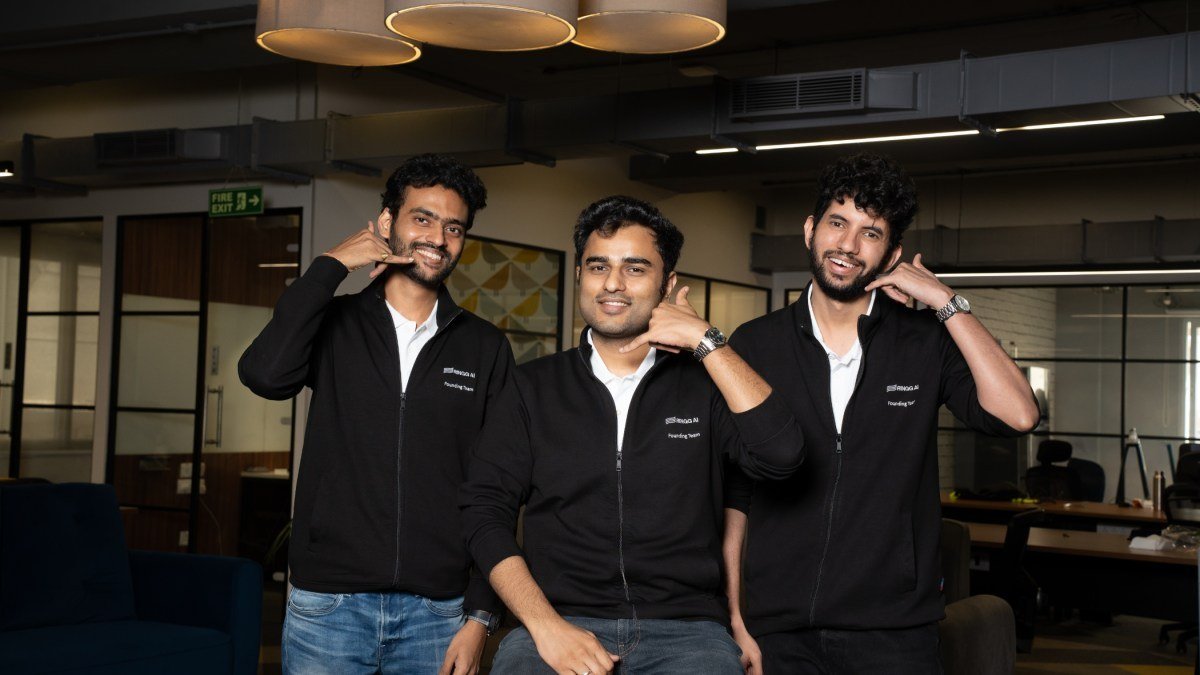
A voice-AI startup that wants to leave the call center behind
Ringg, an Indian voice-AI company, just pulled in $10 million from Peak XV as an extension of its Series A. The check itself is not what makes the round interesting. The pitch behind it is. Ringg is betting that synthetic voice has outgrown the customer-support call, the place most people still assume it lives, and that the next act happens everywhere else a machine might reasonably talk to a human.
Peak XV, the firm that used to operate as Sequoia Capital India and Southeast Asia before splitting off under its own name, does not spray money at voice startups for sport. Its backing signals a view that Ringg has found a wedge worth widening. For a company still at the Series A stage, an extension led by an investor of that weight buys more than runway. It buys a stamp that the thesis is real.
Why “past the phone call” is the whole point
For most of the last decade, voice AI meant one thing: the automated agent you reached when you called a bank, an airline, or a delivery service. It answered in a flat cadence, misheard your account number, and eventually surrendered you to a human. That reputation stuck. When people hear “AI voice,” they picture the hold music.
Ringg’s framing rejects that ceiling. Pushing voice past the phone call means treating spoken interaction as an interface that belongs inside products, workflows, and devices rather than bolted onto a support line as a cost-cutting measure. Think of the difference between a switchboard and a colleague. One routes you. The other talks with you, remembers the thread, and gets something done. That is a harder engineering problem and a far larger market, and it is the ground Ringg is trying to claim.
India is a shrewd place to build this. The country runs on dozens of languages and a staggering range of accents, and its consumers reached the internet through voice and video long before they trusted a keyboard. A voice system that works cleanly across Indian speech patterns is not a nice-to-have. It is the difference between a product people actually use and one they abandon after the first misunderstanding. A startup that solves for that complexity at home has already trained on a harder problem than most Western competitors ever face.
The company Ringg is choosing to keep
Voice has become one of the most crowded corners of the AI boom. The frontier labs are racing to make their models speak and listen in real time, with latency low enough that a conversation stops feeling like a walkie-talkie exchange. Speech synthesis specialists have made machine voices convincing enough to unsettle. Every large cloud vendor now sells a voice layer. So when a Series A company raises to compete here, the obvious question is what it has that the giants do not.
The answer, usually, is focus. General models are built to do everything adequately. A company like Ringg wins by doing one class of interaction unusually well, tuning for the languages, the workflows, and the failure modes that a horizontal platform treats as edge cases. Investors backing voice startups in 2026 are mostly betting on that gap between good-enough infrastructure and a product that feels genuinely reliable in the messy conditions of real use.
Money is the easy part of that bet. Voice is unforgiving in a way text is not. A chatbot that stumbles gives you a beat to reread and retype. A voice agent that talks over you, mangles a name, or freezes mid-sentence breaks the illusion instantly, and trust does not come back cheaply. Whether Ringg’s capital translates into something people willingly speak to, rather than tolerate, is the question that decides the next round.
What the round actually signals
Extension rounds get read two ways. Sometimes they are a bridge for a company that missed its numbers and needs time. Sometimes they are a top-up for one that is moving faster than planned and wants fuel before a bigger raise. Peak XV writing the $10 million here reads far more like the second. You extend into strength when a serious investor wants a larger position before the price climbs.
The broader signal points beyond one company. Capital is flowing toward voice as a primary interface rather than a support-desk afterthought, and it is flowing toward teams building for markets the incumbents underserve. India, with its linguistic sprawl and its voice-first users, is fertile ground for exactly that kind of company. Ringg is now funded to prove the thesis holds outside a pitch deck.
The number to watch is not the raise. It is where these agents show up next, and whether people keep talking to them once the novelty wears off. That is the test no funding round can pass on a startup’s behalf.
For more coverage of voice AI, visit Mylistingo.
Source: Original Article
The Netherlands, for internationals
One email a week: the week's news for internationals in the Netherlands, new practical guides and what changed in the cities. No spam, unsubscribe any time.