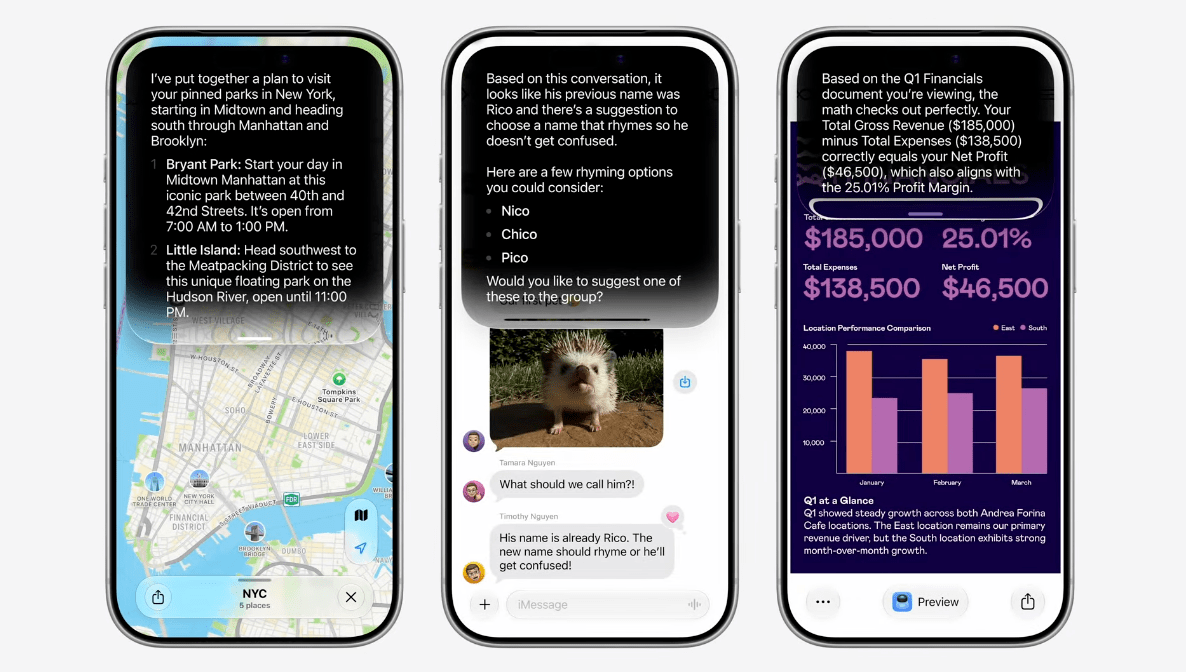
Apple’s annual Worldwide Developers Conference (WWDC) in June 2026 delivered a sweeping update to the company’s artificial intelligence strategy, headlined by iOS 19 and a significantly more capable version of Apple Intelligence. After a rocky rollout of the initial AI features in iOS 18, Apple is repositioning its AI platform as a deeply integrated, privacy-first assistant that spans every corner of the iPhone experience.
The centrepiece of iOS 19 is a revamped Siri that Apple executives describe as “truly conversational.” Building on the on-device large language model introduced last year, Siri now maintains context across multiple requests, understands follow-up questions, and can complete multi-step tasks without requiring the user to phrase everything perfectly. In a demonstration at WWDC, an Apple engineer asked Siri to “find the photos from last Saturday’s barbecue, pick the best group shot, and send it to Mum” — and Siri executed all three steps without further prompting.
“We’re not racing to be first with AI. We’re racing to be the most trusted,” said Craig Federighi, Apple’s senior vice president of software engineering, during the keynote. The privacy architecture remains Apple’s key differentiator: most AI processing runs on-device using the A18 and M4 chips’ Neural Engines, while more complex queries are routed through Apple’s Private Cloud Compute infrastructure, which the company says ensures that no user data is stored or accessible to anyone — including Apple.
New AI-powered features in iOS 19 include real-time translation during phone calls, AI-generated summar
ies of group chats in Messages, and a “Clean Up Pro” tool in Photos that can remove objects and people from images with a single tap. The Mail app now uses on-device AI to prioritise messages and draft replies in the user’s writing style, while Notes can transcribe and summarise voice recordings in real time.
Apple also announced a partnership with OpenAI that brings ChatGPT capabilities to Siri as an optional fallback for queries that exceed on-device capabilities. However, Apple emphasised that ChatGPT integration requires explicit user permission each time and that OpenAI receives no user data by default — a stark contrast to the data-hungry approaches of some competitors.
The developer beta of iOS 19 is available now, with a public release expected in September 2026 alongside the iPhone 18 lineup. Early reviews from developers suggest that while the AI features are more polished than last year’s release, the on-device processing imposes noticeable latency on older iPhone models — a challenge Apple will need to address as it brings Apple Intelligence to its entire ecosystem.
The Netherlands, for internationals
One email a week: the week's news for internationals in the Netherlands, new practical guides and what changed in the cities. No spam, unsubscribe any time.