This guide is for families who have moved to London from abroad and want to plan a free day at the Natural History Museum with dinosaur-mad children, though adults visiting on their own will find it useful too. It covers how entry works, how to avoid the queues, where to find the dinosaur content, and the free activities that keep the interest going once you are home.
- Planning a free visit
- The dinosaurs: what to look out for
- Getting children ready before you go
- For older children and adults
- Free activities at home and outdoors
- FAQ
Planning a free visit
The Museum sits on Cromwell Road, London, SW7 5BD, in South Kensington. According to the Museum’s visit page, it opens daily from 10:00 to 17:50, and last entry is at 17:30. It closes from 24 to 26 December, and it also shuts now and then for one-off reasons. On 9 October 2026, for example, the South Kensington site closed for a charity gala. Check the visit page before you set off, particularly if you are crossing London with small children.
The galleries are free to explore. Entry has one catch that newcomers often miss. The Museum gets busy at weekends and during school holidays, and you may have to queue to get in. You have three ways to guarantee entry: book a free entry ticket, become a member, or buy a ticket for one of the exhibitions or events listed on the What’s on pages. Members and ticket holders skip the queue. If you are planning a Saturday or a half-term day, booking the free ticket costs you nothing and saves a lot of waiting.
Your bags may be searched on arrival, so pack light and leave extra time at the entrance. The visit page does not list exhibition or membership prices. The Museum’s own site has the current details.
The dinosaurs: what to look out for
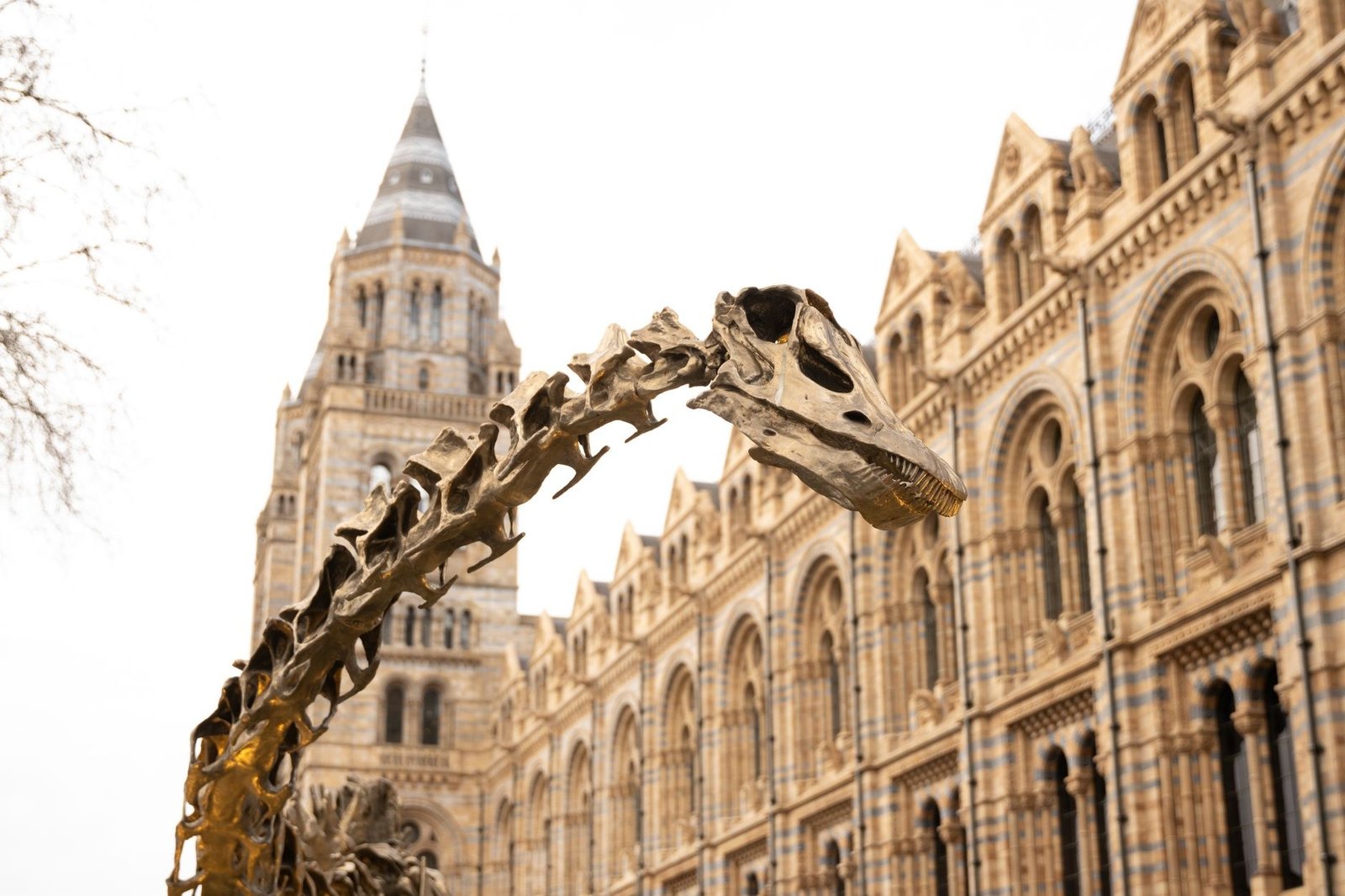
The Museum describes its dinosaur collection as one of the most important in the world, and its scientists still study fossils here and in collections around the world. Its dinosaurs hub includes stories about fossils on display at the Museum. One is about Fern the Diplodocus. Another explains how palaeoartist Robert Nicholls brought the Museum’s Stegosaurus specimen back to life. Reading these together before a visit gives children something specific to hunt for, which tends to work better than wandering.
Galleries open and close, so check the Museum’s map and attractions information on the visit page before you go. It shows which galleries are open and lists self-guided tours, audio guides and the best things to do for families and kids. The Museum also has a downloadable map of its gardens and galleries. It is worth having on your phone so you can plan a route around the dinosaurs and work in breaks before little legs give out.
Getting children ready before you go
The dinosaurs hub works as a free activity pack in its own right. Younger children usually like the two quizzes best. “Is it a dinosaur?” tests what they already know. “What dinosaur are you?” tells them whether they are more like the terrifying T. rex or the placid Plateosaurus. The Dino Directory, an A to Z of more than 300 dinosaurs, lets them browse by name, shape, or when and where the animals lived.
There are short videos and an animation showing how dinosaur fossils formed. For children who like to draw, there is a guide to drawing a cartoon T. rex, alongside dinosaur crafts and activities that the Museum says are for kids “and big kids”. Ten minutes on one of these the evening before can turn a crowded gallery into a treasure hunt.
The hub also answers the big questions children tend to ask at the worst possible moment. Short explainers cover what dinosaurs are, when they lived, and what killed them. The page puts the mass extinction at 66 million years ago and explains why birds are the only dinosaurs still with us.
For older children and adults
Teenagers and adults will get more from the longer articles. Some are about the science: why titanosaurs grew so big, how T. rex may have used its tiny arms, and whether dinosaurs were good parents. Others have a British angle that suits anyone new to the country. There is the story of the Crystal Palace dinosaurs, the Victorians’ first dinosaur park, and a feature on the Isle of Wight as “Dinosaur Island”. Another piece explains how a 31-centimetre claw found in the UK in 1983 changed what scientists knew about spinosaurs.
If you have a would-be scientist at home, read the piece in which Dr Susie Maidment describes life as a dinosaur researcher and gives advice for budding palaeontologists. There is also a profile of Xu Xing, the palaeontologist who has named the most dinosaurs. Adults who like trivia can look up how the word “dinosaur” came about. It was not coined until 1842.
You can also sign up for the Museum’s email updates on news, science, exhibitions and events. The visit page says you must be over 13 to subscribe, so a teenager can sign up with their own address.
Free activities at home and outdoors
The Museum’s Activities for all page collects simple things to try at home or in your local area. These are not events at the Museum. For those, the page points you to What’s on. They suit the rainy weekends every new London resident soon gets used to.
For dinosaur fans, the obvious pick is the origami Tyrannosaurus rex. You print the pattern and follow the instructions. The page does not say how long it takes, so let children go at their own pace. Other indoor ideas include growing a cress caterpillar, which you can eat once the cress has grown, and cross-stitching a dodo. The dodo is a long project better suited to patient older children or adults.
Outdoors, there is a guide to the birds you are likely to see in your garden in spring and summer, and instructions for a Sun print that needs only construction paper and a sunny day. Notes from Nature introduces nature journalling as a mindfulness exercise. It is a good way for adults to get to know a new neighbourhood park. Youth workers and educators can download a free toolkit for exploring nature in cities with young people, and there are educational resources to use at home.
FAQ
Is the Natural History Museum free for families?
Yes, the galleries are free to explore. Some exhibitions and events are ticketed. The Museum’s own site has current prices, because the visit page does not list them.
Do I need to book a ticket in advance?
You do not have to, but you may have to queue at busy times such as weekends and school holidays. Booking a free entry ticket guarantees entry, and ticket holders and members skip the queues.
What are the opening times?
The Museum opens daily from 10:00 to 17:50, with last entry at 17:30. It is closed from 24 to 26 December and sometimes shuts for one-off events, so check the visit page before you travel.
Are there free dinosaur activities for children at home?
Yes. The dinosaurs hub has quizzes, videos, the Dino Directory and a guide to drawing a cartoon T. rex. The Activities for all page includes an origami T. rex you can print and fold.
Official sources: nhm.ac.uk · nhm.ac.uk · nhm.ac.uk
Last checked: 12 October 2026 against the pages linked above. Prices, opening hours and programmes change; the venue’s own site always has the current details.
Sources
- nhm.ac.uk: Visit | Natural History Museum, accessed 12 October 2026 (archived copy)
- nhm.ac.uk: Dinosaurs | Natural History Museum, accessed 12 October 2026 (archived copy)
- nhm.ac.uk: Activities for all | Natural History Museum, accessed 12 October 2026 (archived copy)
London, for internationals
One email a week: what changed for internationals in London, the week's news from the UK, and one guide worth reading. No spam, unsubscribe any time.