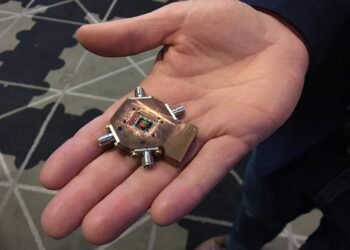
Quantum Computing Hits a New Milestone: Error-Corrected Logical Qubits Go Mainstream
The quantum computing industry has crossed a threshold that researchers have been chasing for decades: practical, error-corrected logical qubits operating at scale. In a series of breakthroughs throughout early 2026, multiple research teams and companies have demonstrated logical qubits with error rates low enough to run meaningful algorithms — a development that brings fault-tolerant quantum computation from theory into reality.
Unlike physical qubits, which are notoriously fragile and prone to decoherence, logical qubits are built by encoding information across multiple physical qubits using quantum error correction codes. The result is a qubit that can maintain its quantum state long enough to perform complex calculations. For years, the overhead required — often thousands of physical qubits per logical qubit — made the approach impractical. That equation has now changed.
The Breakthrough
Google Quantum AI announced in March 2026 that its latest processor, built on superconducting transmon technology, achieved a logical error rate below the critical threshold needed for scalable quantum computation. Using a surface code architecture with 105 physical qubits per logical qubit, the team demonstrated 12 logical qubits operating simultaneously with gate fidelities exceeding 99.99%. Microsoft, meanwhile, reported progress with its topological qubit approach, claiming a logical qubit design that requires fewer than 10 physical qubits — though independent verification of these results is still ongoing.
IBM’s quantum roadmap, updated in early 2026, now projects a 200-logical-qubit system by 2028, with the company’s Heron processor family serving as the foundation. Australian startup Silicon Quantum Computing also made headlines with a silicon-based logical qubit demonstration that could leverage existing semiconductor manufacturing infrastructure.
Real-World Applications on the Horizon
The implications extend far beyond academic research. Error-corrected logical qubits open the door to practical applications in drug discovery, materials science, and cryptography. Pharmaceutical companies are already partnering with quantum computing providers to simulate molecular interactions that classical supercomputers cannot model. Financial institutions are exploring quantum algorithms for portfolio optimisation and risk analysis.
Perhaps most consequentially, the cryptographic community is watching closely. A sufficiently powerful fault-tolerant quantum computer could break widely used public-key encryption schemes. The National Institute of Standards and Technology (NIST) has already standardised post-quantum cryptographic algorithms, and enterprises are being urged to begin migration now — well before the quantum threat becomes imminent.
While a universal fault-tolerant quantum computer remains years away, the logical qubit milestone marks the moment quantum computing graduated from a physics experiment to an engineering discipline. The race to commercial advantage is now well and truly on.
The Netherlands, for internationals
One email a week: the week's news for internationals in the Netherlands, new practical guides and what changed in the cities. No spam, unsubscribe any time.