



This guide is for internationals who have recently moved to the United Kingdom and want to understand the family visa for a partner or spouse. After reading it, you will know who can apply, what evidence is needed, what it costs and how long the visa lasts.
- Who can apply as a partner or spouse
- Proving your relationship
- English and the financial requirement
- How to apply and decision times
- Fees and the healthcare surcharge
- How long you can stay and when you can settle
- FAQ
Who can apply as a partner or spouse
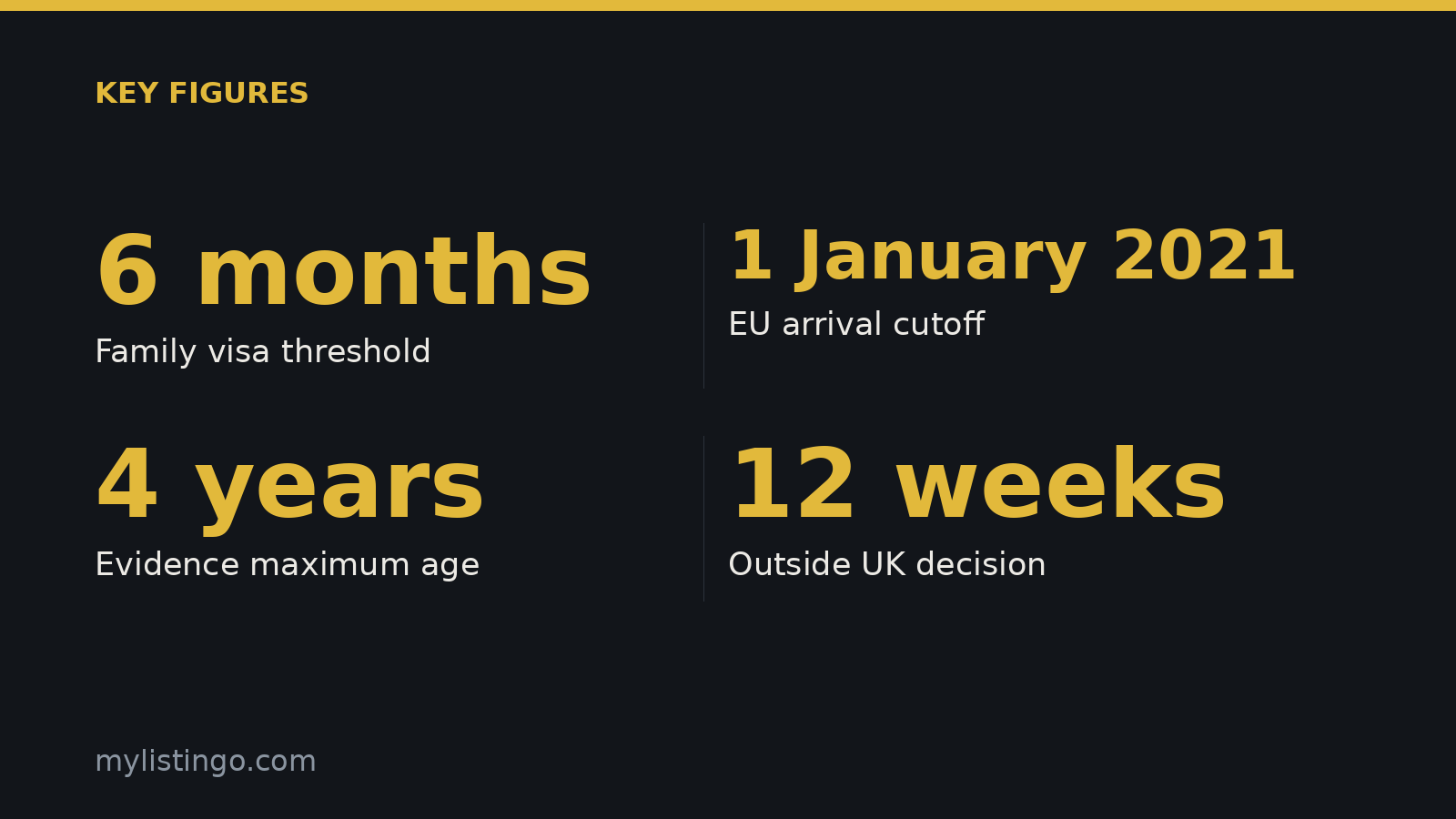
You need a family visa to live with a family member in the UK for more than 6 months, according to the GOV.UK family visa overview. Under the partner and spouse rules, you and your partner must both be 18 or over, and your partner must:
- be a British or Irish citizen
- be settled in the UK, for example with indefinite leave to remain, settled status or proof of permanent residence
- be from the EU, Switzerland, Norway, Iceland or Liechtenstein with pre-settled status, having started living in the UK before 1 January 2021
- hold a Turkish Businessperson or Turkish Worker visa
- have protection status, or permission to stay as a stateless person granted before you became their partner
You must both intend to live together permanently in the UK. Where the partner has settled or pre-settled status, the free EU Settlement Scheme may be an alternative.
If your partner is in the UK temporarily on a work or student visa, a family visa is not available. In that case the route is to apply as their dependant. Visitors, and people on a visa of 6 months or less, usually need to leave the UK to apply.
Proving your relationship
You must prove one of these: a marriage or civil partnership recognised in the UK; at least 2 years living together in a relationship; an engagement, with marriage or civil partnership in the UK within 6 months of arriving; or at least 2 years in a relationship without living together, for example because of work, study or culture.
Evidence must come from the government, a bank, a landlord, a utility provider or a medical professional. It must confirm the relationship and be less than 4 years old. Examples include:
- a marriage or civil partnership certificate
- a tenancy agreement, utility bills or Council Tax bills showing the same address
- a statement from a joint bank account
- a letter from a doctor or dentist confirming you live at the same address
Council Tax applies in England, Scotland and Wales. Northern Ireland has domestic rates instead, and the page does not say how rates bills are treated. Couples who do not live together must show an ongoing commitment, such as regular communication, financial support and time spent together.
Fiancés and proposed civil partners must also prove that any previous marriages or civil partnerships have ended.
English and the financial requirement
Applicants must prove a good knowledge of English and meet the financial requirements. The official pages this guide draws on do not state the income threshold or which English tests are accepted, so the current figures need to be checked on GOV.UK.
Without this proof, an application or extension may still be possible in two cases. The first is where there is a child in the UK who is a British or Irish citizen, or who has lived in the UK for 7 years, and it would be unreasonable for them to leave. The second is where refusal would breach human rights. Whether either applies in a particular case is a question for an OISC-registered adviser or an SRA-regulated solicitor.
How to apply and decision times
Applications are made online, through the outside-UK or inside-UK service depending on where you are. Children can be added as dependants if they do not live an independent life and are under 18 when you apply, or were under 18 when first granted leave.
Usual decision times are:
- outside the UK: usually within 12 weeks
- inside the UK, meeting the financial and English requirements: usually within 8 weeks
- inside the UK, not meeting them: currently about 12 months
Inside the UK, you may be able to pay an extra £1,000 for the super priority service. There is also a free service for people in the UK who have no internet access or are not confident using a computer or phone. It helps with completing the form but gives no immigration advice.
Fees and the healthcare surcharge
The fee depends on who you are joining and how you apply. The GOV.UK fee table for partners and children lists £2,064 and £1,407 per person, and the table shows which amount applies to each route. GOV.UK advises telling your bank about the large payment, as the bank might otherwise cancel it.
You might also need to pay the healthcare surcharge. For each adult (18 or older) it is £3,105 for 2 years and 9 months, £2,587.50 for 2 years and 6 months and £5,175 for 5 years. For each child (under 18) it is £2,328, £1,940 and £3,880 for the same periods.
You can apply for a fee waiver if you cannot pay because you have no place to live and cannot afford one, or you cannot afford essentials such as food or heating. You can also apply if you have a very low income and paying would harm your child’s wellbeing.
How long you can stay and when you can settle
A partner visa lasts up to 2 years and 9 months. Extending, or switching into this visa, gives up to a further 2 years and 6 months, and you can extend more than once. If you extend to stay with the same partner, no more than 28 days left on your current stay are added to the new visa. A fiancé visa lasts 6 months. After the marriage or civil partnership, you apply to extend.
Some partners have protection status and claimed asylum after 2 March 2026. If their permission ends before yours would, your permission ends at the same time as theirs.
The earliest you can apply for indefinite leave to remain is after 5 years living in the UK continuously on a family visa as a partner. Time on any other visa, or as a fiancé, does not count. Different rules apply if you applied before 9 July 2012.
FAQ
Can I switch to a partner visa without leaving the UK?
You can switch from another visa before your current permission expires. Visitors and people on a visa of 6 months or less usually need to leave the UK to apply. The exceptions are people on a 6-month fiancé, fiancée or proposed civil partner visa, and people with permission to stay for the outcome of a family court case or divorce.
What if unmarried partners get engaged before extending?
GOV.UK says they should not extend as a fiancé, fiancée or proposed civil partner. They extend with the visa status they already hold.
Can someone on a fiancé visa work or study?
No, not during the engagement. After the marriage or civil partnership they apply to extend, and if that is approved they have the right to work or study.
What happens after domestic abuse or a partner’s death?
People who had permission to stay in the UK as a partner might be able to apply to settle if they were a victim of domestic abuse or their partner died. Questions about a specific situation are for an OISC-registered adviser or an SRA-regulated solicitor.
Official sources: gov.uk · gov.uk
Last verified: 27 October 2026 against the official pages linked above. Rules and fees change; the official page always wins.
This is general information, not legal or immigration advice. Immigration advice in the UK may only be given by advisers regulated by the OISC or by solicitors regulated by the SRA.
Sources
- gov.uk: Family visas: apply, extend or switch, accessed 27 October 2026
- gov.uk: Family visas: apply, extend or switch, accessed 27 October 2026
The UK, for internationals
One email a week: the week's news for internationals in the UK, new practical guides and what changed in the cities. No spam, unsubscribe any time.








Comments 1