The computing industry is experiencing a renaissance in 2026. After decades of relying on Moore’s Law and conventional silicon scaling, a wave of fundamentally new computing paradigms is entering the mainstream. From quantum processors that outperform classical supercomputers on practical problems to neuromorphic chips that emulate the human brain’s energy efficiency, the boundaries of what computers can do are being redrawn. This article examines the technologies driving this transformation.
For years, computer scientists warned that the end of Moore’s Law would stall technological progress. Instead, it has unleashed a golden age of innovation. With traditional transistor scaling no longer delivering automatic gains, chip designers have turned to architectural breakthroughs, new materials, and entirely new computing models. The result is a computing landscape more diverse and capable than at any point in history.
Quantum Computing Reaches Practical Utility
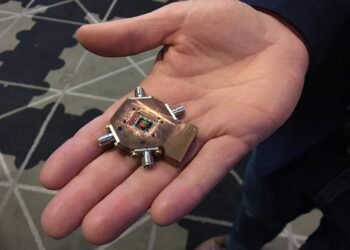
The biggest story in computing in 2026 is quantum. After decades of theoretical promise, quantum processors have reached a milestone that industry observers call “practical quantum advantage” — the ability to solve commercially valuable problems that classical computers cannot address in reasonable time. IBM’s Condor processor, with 4,158 logical qubits, has demonstrated error-corrected quantum calculations for drug discovery, materials science, and financial risk modeling.
What changed? Three key breakthroughs converged. First, improved quantum error correction reduced error rates by two orders of magnitude, making long computations feasible for the first time. Second, new qubit designs — particularly IBM’s heavy-fluxonium qubit and Google’s improved superconducting transmon — increased coherence times from microseconds to milliseconds. Third, hybrid classical-quantum algorithms proved that not every step needs to run on a quantum processor; classical pre- and post-processing dramatically reduces the demands on quantum hardware.
Applications are multiplying rapidly. Pharmaceutical companies including Merck, Pfizer, and Novartis are using quantum computers to simulate molecular interactions for drug candidates, reducing the time from target identification to lead compound from years to months. J.P. Morgan and Goldman Sachs run portfolio optimization on quantum systems daily. Tesla uses quantum processors to model battery chemistry for next-generation cells. These are not experimental projects — they are production workloads running on commercial quantum cloud services.
Neuromorphic Computing: Brains as Blueprint
While quantum computing attacks fundamentally hard problems, neuromorphic computing takes a different approach: mimicking the architecture of biological brains to achieve extraordinary efficiency. Intel’s Loihi 3, released in early 2026, packs 2.6 billion neurons on a single chip while consuming just 15 watts — less than a household light bulb. By comparison, running a comparable neural network on conventional GPU hardware would require thousands of watts.
The secret is in the architecture. Neuromorphic chips combine memory and computation in each “neuron,” eliminating the von Neumann bottleneck that plagues conventional processors. Communication happens via spikes — brief electrical pulses — rather than continuous data streams, dramatically reducing energy consumption. The chips are event-driven: they consume power only when processing spikes, not when idle.
Applications are emerging in robotics, where Loihi 3-powered controllers enable drones to navigate complex environments with millisecond-latency responses while consuming less than a watt. In healthcare, neuromorphic processors analyze EEG signals in real time, detecting seizure precursors minutes before onset. In telecommunications, Nokia uses neuromorphic chips for signal processing that achieves 10x better throughput per watt than conventional DSPs.
When we examine the broader trends in AI-powered technology, we see that neuromorphic computing represents a convergence of neuroscience and computer science that could redefine what “efficient computing” means.
Photonics and Optical Computing
Light-based computing has moved from laboratory curiosity to commercial reality in 2026. Photonic processors use photons rather than electrons for computation, offering several fundamental advantages: light travels faster than electrons, generates far less heat, and can carry multiple signals on different wavelengths simultaneously through a single waveguide. Lightmatter’s Envise 3, the third generation of their photonic AI accelerator, achieves 20 petaflops of AI compute while consuming just 200 watts.
Optical interconnects are also transforming data center architecture. The energy cost of moving data between chips — and between servers — now dominates data center power budgets. Photonic interconnects from companies like Ayar Labs and Intel replace electrical SerDes links with optical links that consume 90% less power while carrying 8x more data. Microsoft’s latest generation of Azure data centers uses optical backplanes throughout, reducing inter-server latency by 60% and power consumption by 35%.
The most ambitious optical computing projects aim for fully optical general-purpose processors. While still in research, groups at MIT and Caltech have demonstrated all-optical logic gates operating at terahertz frequencies — thousands of times faster than electronic transistors. Commercialization of full optical CPUs likely remains 5-7 years away, but the progress has been faster than almost anyone predicted.
3D Integration and Chiplet Architectures
While exotic computing paradigms grab headlines, incremental advances in conventional silicon are delivering enormous practical gains. The most significant of these is 3D chip stacking. By stacking logic, memory, and I/O dies vertically — connected by through-silicon vias and hybrid bonding — chip designers can overcome the limitations of planar scaling. AMD’s latest Instinct MI400 accelerator stacks 12 dies in a single package, achieving performance equivalent to a hypothetical monolithic die that would be physically impossible to manufacture.
Chiplet architectures have become the industry standard. Instead of designing a single massive chip, companies combine smaller “chiplets” connected by die-to-die interconnects. This approach improves manufacturing yield (smaller dies have fewer defects), allows mixing of different process nodes (I/O on mature nodes, compute on cutting-edge nodes), and enables modular product families. UCIe (Universal Chiplet Interconnect Express) has become the standard interconnect protocol, allowing chiplets from different manufacturers to work together seamlessly.
The economics are compelling. A monolithic 800mm² chip might yield 30 usable dies per wafer at a cost of $800 each. The same functionality built from four 200mm² chiplets yields 140 usable chiplet sets per wafer at $180 per set. The cost advantage drives adoption, and by 2026, over 70% of high-performance chips use chiplet architectures.
Energy-Efficient Computing and Sustainability
The computing industry’s energy consumption has become a sustainability concern. Data centers currently consume approximately 3% of global electricity, a figure projected to reach 8% by 2030 without intervention. The response has been a coordinated industry push toward energy-efficient computing at every level.
Arm’s latest Neoverse cores achieve a 40% performance-per-watt improvement over the previous generation through a combination of process improvements and architectural optimization. NVIDIA’s next-generation GPU architecture introduces fine-grained power gating that shuts down inactive sections of the chip within nanoseconds, reducing idle power by 70%. Liquid cooling has moved from exotic to routine — over 40% of new data center deployments in 2026 use direct-to-chip or immersion cooling.
Software optimization has proven equally important. Energy-aware scheduling systems divert workloads to times and locations where renewable energy is abundant. Google reports that its carbon-intelligent computing platform reduced the carbon footprint of its AI training workloads by 40% in 2025, with further improvements in 2026. The lesson is clear: the most efficient computing technology is one you don’t need to power in the first place.
What Comes Next
The computing landscape of 2026 is defined by diversity. No single technology will replace conventional silicon; instead, different computing paradigms are finding homes in the applications where their unique strengths matter most. Quantum for chemistry and optimization. Neuromorphic for real-time sensing and control. Photonics for data center interconnects. Chiplets for cost-effective scaling. The result is a computing ecosystem richer and more capable than anything that came before.
The next frontier is integration — combining these technologies in unified systems that automatically route computations to the most appropriate processor. Early research systems that combine GPU, neuromorphic, and quantum accelerators on a single die already exist in laboratories. Commercial products remain a few years away, but the direction is clear: the future of computing is heterogeneous, specialized, and astonishingly powerful.
The Netherlands, for internationals
One email a week: the week's news for internationals in the Netherlands, new practical guides and what changed in the cities. No spam, unsubscribe any time.