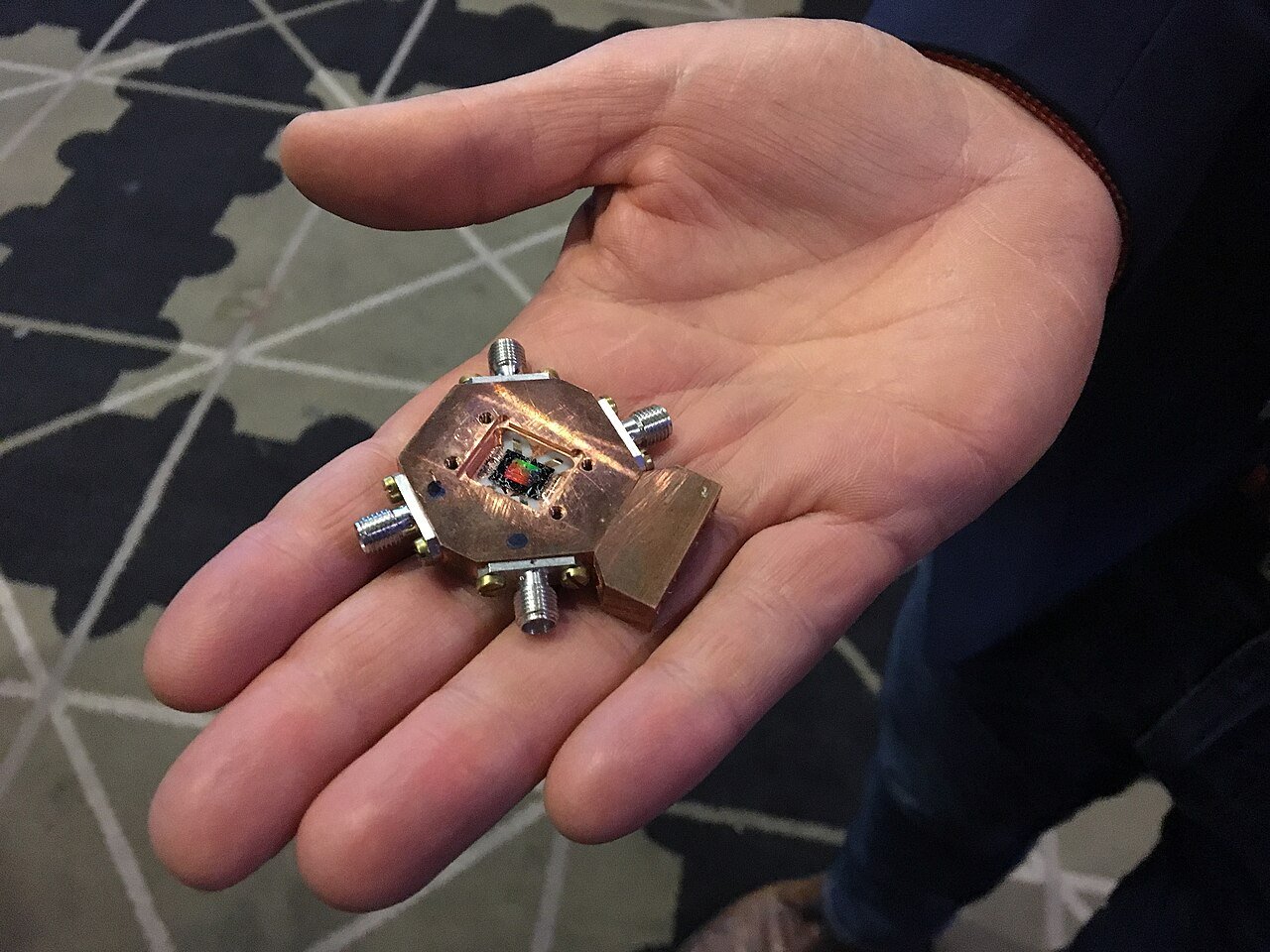
Eighty million dollars is not a lot of money in the technology industry. It is roughly what a mid sized software company turns over in a quarter without anyone writing about it. But when IonQ reported $80.1 million in second quarter revenue this month, up 287 percent on the same period last year, it marked something the quantum computing sector has been promising for a decade and rarely delivering: customers who pay.
The company raised its full year outlook to between $280 million and $290 million on the back of it, and said the results support roughly 100 percent organic revenue growth across 2026. Remaining performance obligations, the industry’s shorthand for contracted work not yet recognised as revenue, rose 297 percent year on year. That is the number that matters more than the headline, because it describes demand that has already been signed rather than demand that has been forecast.
The numbers behind the noise
IonQ was not alone. IQM Quantum Computers, the Finnish superconducting hardware maker, filed its first set of earnings as a public company, showing 8.9 million euros of revenue in the first half and an order backlog above 102 million euros. D-Wave reported first half bookings of $35.5 million, an increase of 1,120 percent on the year before.
Percentages that large are a function of tiny starting points, and nobody should read them as evidence that quantum computing has arrived. A sector that collectively books a few hundred million dollars is still smaller than a single large enterprise software contract. What has changed is the shape of the growth. Backlogs and contracted obligations are boring, unglamorous numbers, and they are exactly the ones that separate a research programme from a company.
Who is actually paying
IonQ’s breakdown is the most revealing disclosure of the quarter. Roughly half of its revenue came from international customers, and around 60 percent came from commercial buyers rather than governments and national labs. Products outside its core quantum computing systems accounted for about a quarter of the total.
That last figure deserves attention. For years the quantum business model was simple and fragile: sell machine time to researchers, or sell a machine to a government. A company earning a quarter of its revenue from adjacent products has started to look less like a laboratory with a sales team and more like an infrastructure supplier. IonQ also closed its acquisition of SkyWater Technology during the period and pointedly excluded any contribution from it in the raised guidance, which suggests confidence in the base business rather than a need to dress it up.
The physics did not stop
Commercial traction has not come at the expense of the science. Researchers at Hefei Guizhen Chip Technology and the University of Science and Technology of China demonstrated a 16 qubit on chip photonic system using measurement based quantum computing with high dimensional path encoding, reporting a 98.7 percent success rate running Grover’s search algorithm. Photonic approaches have long been the awkward cousin of superconducting and trapped ion designs, and results like that keep them in the conversation.
On the applications side, QC Ware ran a hybrid quantum and classical chemistry workflow on its Promethium platform paired with IBM Quantum’s 156 qubit Heron processor, calculating the electrostatic interaction energy for nitric oxide reductase. Computational chemistry has always been the most credible near term use case for quantum hardware, and enzymes are exactly the sort of molecule where classical methods start to strain.
The gap that has not closed
None of this means error corrected, fault tolerant quantum computing is close. The machines being sold today are noisy, the useful problems they solve are narrow, and the industry’s own roadmaps still put meaningful logical qubit counts several years out. A backlog is a promise about the next few quarters, not a proof that the physics will cooperate.
What has shifted is the burden of proof. For most of the past decade, quantum companies were asked to explain why anyone would eventually buy their product. Now several of them can point at a signed order book and ask the harder question back: what happens when this hardware is merely useful rather than revolutionary, and it is already installed?
Watch the fourth quarter results, and specifically watch whether backlogs convert on schedule. Growth rates above 1,000 percent will not survive contact with a larger base. Conversion rates will tell you whether the customers are real. For more coverage of quantum computing and emerging technology, visit Mylistingo.
The Netherlands, for internationals
One email a week: the week's news for internationals in the Netherlands, new practical guides and what changed in the cities. No spam, unsubscribe any time.