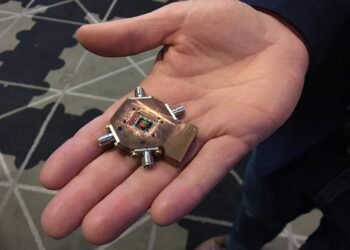
The next flagship deployment of Nvidia’s AI hardware may not be in Texas, Taiwan or a Nordic data centre. It may be in low Earth orbit. On Monday Nvidia announced that SpaceXAI will adopt its new Vera CPUs across the infrastructure behind Grok, and, more strikingly, that the company’s first-generation Starmind AI satellite will carry an optimised version of the Vera Rubin NVL72, the rack-scale system Nvidia designed for what it calls AI factories on Earth.
A CPU built for agents, not just models
The terrestrial half of the deal is significant on its own. Vera is the first CPU Nvidia has positioned specifically for AI agents, a nod to how the workload has changed. Agentic systems spend a surprising share of their time outside the model itself: orchestrating tools, executing code, processing data and running simulations between model calls. All of that lands on the CPU, and when it is slow, expensive GPUs sit idle waiting for work.
Vera’s answer is 88 Nvidia-designed Olympus cores, a technology the company calls Spatial Multithreading, and high-bandwidth LPDDR5X memory delivering up to 1.2TB/s. Nvidia claims up to 1.8 times faster task completion than comparable x86 processors across agentic AI, reinforcement learning and data processing workloads.
“Vera gives us the CPU performance and memory bandwidth to run enormous amounts of orchestration, code and data processing while keeping GPUs doing what they do best,” said Mike Nicolls, president of SpaceXAI, in the announcement. The company says it is scaling toward gigawatts of computing capacity for Grok on the Vera Rubin platform.
A server rack leaves the planet
Then there is the orbital part. SpaceXAI plans to base its first Starmind satellite on an optimised Vera Rubin NVL72 system, taking an architecture built for climate-controlled halls and putting it somewhere with no air, wild temperature swings and no technician within several hundred kilometres.
Nvidia is candid about the difficulty. Power, thermal management, bandwidth, reliability and physical integration in orbit, the company says, impose dramatically different constraints from conventional data centres. The stated engineering goal is to adapt the platform to those constraints while preserving the same architecture and software ecosystem that runs on the ground, so that code written for an AI factory in Texas runs unchanged on hardware circling above it.
“SpaceXAI is taking this architecture from massive AI factories to the next frontier of computing in orbit,” said Ian Buck, Nvidia’s vice president of hyperscale and high-performance computing.
Why orbit, and what remains unanswered
Orbital data centres have floated around the industry as a concept for years, usually pitched on uninterrupted solar power and the sheer difficulty of finding land, grid connections and cooling water for terrestrial AI build-outs. What is new here is specificity: a named satellite programme, a named rack system, and two companies with launch capacity and silicon actually committing to it.
The announcement leaves the hard questions open, and they are worth keeping in view. Radiating away the heat of a dense GPU rack in a vacuum is an unsolved engineering problem at this scale. So is servicing hardware that fails in orbit, and getting meaningful bandwidth to and from a machine that exists to process enormous volumes of data. Nvidia and SpaceXAI have not published a launch date, a power budget or a cost figure for Starmind, and until they do, this is a stated direction rather than a working system.
Still, direction matters when it comes from companies of this size. The AI build-out has already reshaped electricity markets and land use on Earth. That its next act might be extraterrestrial says a great deal about how much compute the industry believes it will need.
The detail to watch is the first Starmind launch window, and whether the orbital NVL72 flies as described or in a heavily cut-down form. For more coverage of the technology shaping the next decade, visit Mylistingo.
The Netherlands, for internationals
One email a week: the week's news for internationals in the Netherlands, new practical guides and what changed in the cities. No spam, unsubscribe any time.