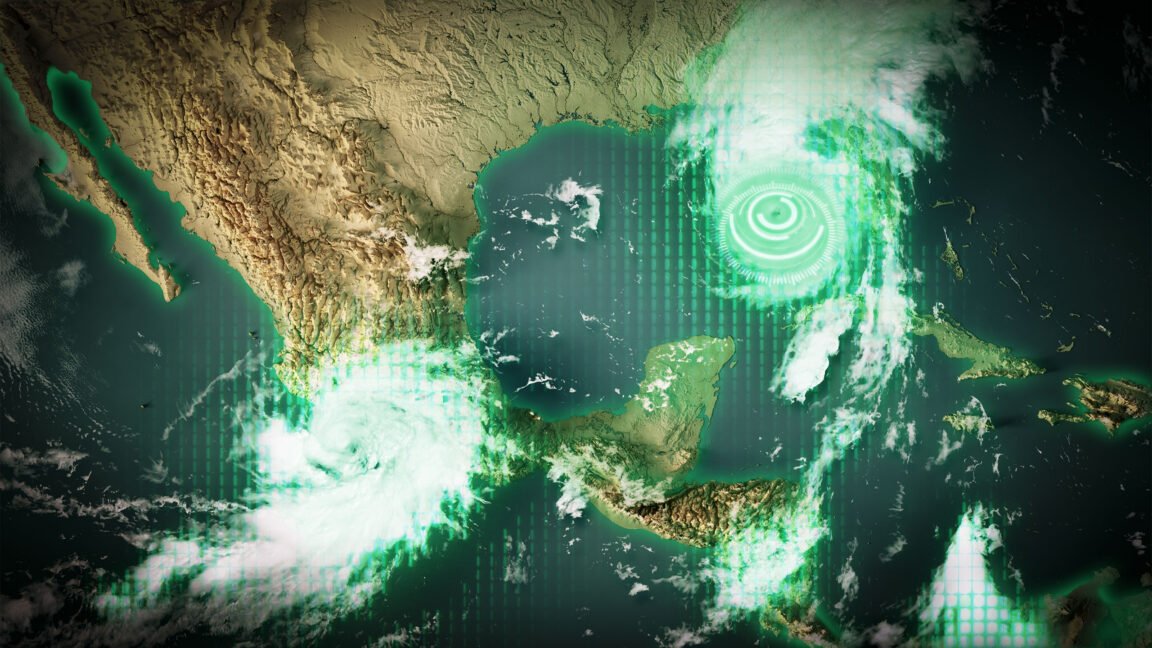
AI Revolutionizes Climate and Weather Prediction in 2026
Artificial intelligence is fundamentally reshaping how scientists predict weather patterns and model climate change, delivering accuracy gains that were unimaginable just five years ago. The latest generation of AI weather models can now produce 10-day forecasts in under a minute on a single GPU—a process that previously required hours of computation on some of the world’s most powerful supercomputers.
Google DeepMind’s FireCast v3, released in May 2026, represents the current state of the art. The system provides free, high-resolution wildfire risk predictions for every square kilometer of the Earth’s surface, updated daily. The model processes satellite imagery, weather data, and vegetation indices to identify areas at risk days before traditional methods would detect them.
From Physics to Pattern Recognition
Traditional numerical weather prediction relies on solving complex atmospheric physics equations. AI models take a fundamentally different approach: they learn patterns directly from decades of historical weather data. The result is not just faster computation but in many cases better accuracy, particularly for precipitation forecasts and extreme weather events.
The European Centre for Medium-Range Weather Forecasts (ECMWF) now runs AI models alongside its traditional physics-based systems, using the AI output as an additional input to its ensemble forecasting. Early results show that the hybrid approach reduces forecast errors by up to 15% compared to either method alone.
Climate Adaptation Gets Granular
Perhaps the most transformative application is in climate adaptation. AI models can now downscale global climate projections to individual neighborhoods, helping city planners understand exactly how rising temperatures and changing precipitation patterns will affect specific streets and buildings.
Rotterdam’s climate adaptation office has begun using AI-powered flood models that integrate real-time sensor data from the city’s extensive water management network. The system can predict which streets will flood during a heavy rain event with 92% accuracy, allowing emergency services to preposition resources hours in advance.
The Data Challenge
The biggest limitation remains data quality and availability. While wealthy nations maintain dense networks of weather stations and radar systems, large portions of the Global South lack the observational infrastructure needed to train high-quality AI models. Several international initiatives are working to close this gap, including a World Meteorological Organization program to deploy low-cost weather sensors across Africa and Southeast Asia by 2028.
The Netherlands, for internationals
One email a week: the week's news for internationals in the Netherlands, new practical guides and what changed in the cities. No spam, unsubscribe any time.