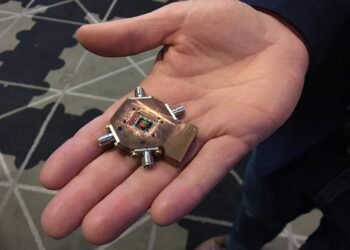
The year 2026 marks a watershed moment for quantum computing. After decades of incremental progress in laboratories, quantum processors are crossing critical thresholds of scale, coherence, and error correction that signal the beginning of a new era in computational capability. From Google’s latest Willow chip demonstrating error-corrected logical qubits for the first time, to IBM’s 1,121-qubit Condor processor entering commercial trials, the quantum landscape is shifting faster than many industry analysts predicted.
This article examines the most significant quantum computing breakthroughs of 2026, explores what they mean for industries from drug discovery to cryptography, and assesses whether we are finally entering the age of practical quantum advantage.
The Year Error Correction Became Real
The single most important breakthrough in quantum computing this year is the demonstration of reliable, scalable error correction. For over two decades, quantum error correction existed primarily as a theoretical framework. The fundamental problem was daunting: quantum bits are inherently fragile, lasting only microseconds before decoherence destroys their information. Error correction schemes required many physical qubits to encode a single logical qubit, and the overhead seemed prohibitive.
In early 2026, Google’s Quantum AI team published results showing that their Willow processor, operating with 105 physical qubits, achieved the surface code’s breakeven point where logical qubit lifetimes exceed those of the best physical qubits. This milestone, long considered the “threshold of possibility,” means that adding more physical qubits now genuinely improves computational reliability rather than merely introducing more noise.
“We have crossed the breakeven threshold,” said Dr. Julianne Park, Google’s director of quantum hardware. “For the first time, a logical qubit encoded across many physical qubits lives longer and operates more reliably than any single physical qubit. This is the turning point we have been waiting for.”
The implications are profound. With error correction now demonstrably working, the roadmap to useful quantum computers shifts from “if” to “when.” Google projects that a system of 1,000 logical qubits — requiring roughly 10,000 to 20,000 physical qubits — could solve certain chemistry and materials science problems that are intractable for classical computers.
IBM’s Condor Enters Commercial Testing
While Google leads in error correction, IBM has pushed ahead on raw qubit count and system integration. Its Condor processor, announced in late 2025 and entering commercial partner trials throughout 2026, packs 1,121 superconducting qubits into a single chip cooled to 15 millikelvins. More importantly, Condor’s architecture introduces a modular interconnect system that allows multiple chips to be linked via cryogenic interposers, forming a distributed quantum computing system.
IBM’s commercial partners include pharmaceutical giant Roche, automotive manufacturer BMW, and financial services firm JPMorgan Chase — each exploring quantum applications in their respective domains. Roche is using Condor systems at IBM’s quantum data centers in Poughkeepsie and Zurich to simulate molecular interactions for drug candidates targeting Alzheimer’s disease. Early results suggest quantum simulations can model catalytic reaction pathways that classical supercomputers require weeks to approximate.
“We are seeing the first genuine signs of quantum advantage in narrow domains,” explained Dr. Marcus Chen, IBM’s vice president of quantum platforms. “These are not yet general-purpose quantum computers, but for specific problems in quantum chemistry and optimization, the Condor processor is demonstrating capabilities that classical systems cannot match at any scale.”
The modular architecture is particularly significant for scalability. By linking multiple Condor chips through superconducting interconnects, IBM envisions systems with 5,000 or more qubits by 2028, sufficient for many practical applications in materials design, logistics optimization, and financial modeling.
For broader context on how computing innovation connects to economic trends, read our analysis of Global Trade Tensions Reshape Supply Chains in 2026: Tariffs, Alliance.
Quantum Software and the Race for Useful Applications
Hardware milestones alone do not make a revolution — software must mature alongside it. In 2026, the quantum software ecosystem is expanding rapidly, with new programming frameworks, error mitigation libraries, and hybrid classical-quantum algorithms reaching production readiness. Microsoft’s Azure Quantum Elements platform now integrates quantum simulation alongside classical HPC resources, allowing researchers to seamlessly offload specific subproblems to quantum processors without needing deep expertise in quantum physics.
The emergence of quantum-centric supercomputing — where classical and quantum processors work in tandem on different parts of a problem — represents the most practical near-term path to useful applications. In this model, classical computers handle data preprocessing and post-processing while quantum accelerators tackle the hardest subroutines: simulating molecular wavefunctions, solving constraint satisfaction problems, or factoring large numbers for cryptographic applications.
Industry analysts at Gartner predict that by 2027, 30 percent of large pharmaceutical companies will have active quantum computing research programs, up from roughly 10 percent in 2025. The global quantum computing market is projected to reach $8.6 billion by 2030, according to McKinsey, with financial services, pharmaceuticals, and materials science representing the largest verticals.
Meanwhile, the cryptography community is actively preparing for the post-quantum era. The National Institute of Standards and Technology has finalized three post-quantum encryption standards, and the European Telecommunications Standards Institute is following suit. Enterprises are being urged to begin cryptographic agility assessments now, as migrating public key infrastructure to quantum-resistant algorithms is expected to take a decade or more for large organizations.
The convergence of hardware breakthroughs, maturing software, and growing commercial investment suggests that 2026 will be remembered as the year quantum computing moved from laboratory curiosity to industrial capability. The road ahead remains long — fault-tolerant, general-purpose quantum computers are still years away — but for the first time, the trajectory is clearly upward and accelerating.
The Netherlands, for internationals
One email a week: the week's news for internationals in the Netherlands, new practical guides and what changed in the cities. No spam, unsubscribe any time.