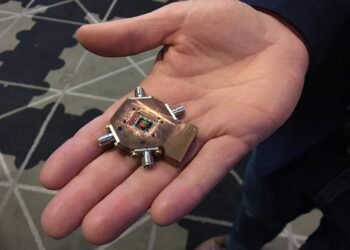
Sixty-four strands of DNA, written at the same time on a single silicon chip, using nothing more caustic than water and a trickle of electric current. A Harvard-led team published that result in Nature Electronics this month, and it undercuts the way synthetic biology has manufactured its raw material for decades.
The demonstration is modest by industrial standards. Sixty-four sequences will not supply a biotech manufacturing line. The method underneath is what matters, because it swaps a chemistry that has always demanded hazardous solvents and purpose-built facilities for one that runs in water, steered entirely by electricity.
How the chip writes
The chip’s surface carries 64 separate synthesis sites. At each one, a DNA strand is anchored at the centre and ringed by two concentric electrodes. When a given site needs to accept the next nucleotide in its sequence, the chip sends current into the inner ring. That current produces protons, the pH drops in a tiny pocket of liquid immediately around the strand, and the enzymatic reaction that adds the next building block goes ahead.
The clever part is the addressing. Every site sits in the same shared pool of liquid, yet each can be switched on or off independently because the acidity change stays confined to a region only microns across. Electricity does the job that plumbing used to do. No separate wells, no reagent lines feeding individual chambers, no mechanical valves deciding which strand gets what.
The work was a multi-institution effort, bringing together Harvard, the Broad Institute, the enzymatic synthesis company DNA Script, and researchers at POSTECH.
The solvent problem
Commercial DNA synthesis today leans on a chemical process built around hazardous organic solvents. The consequences run past environmental accounting. Solvent-based synthesis has to happen inside specialised centralised facilities kitted out to handle and dispose of those chemicals safely, which is a large part of why ordering custom DNA still means sending a request to a vendor and waiting for a vial to arrive in the post.
Enzymes do not need any of that. They evolved to work in water at moderate temperatures, which is the whole appeal of enzymatic synthesis and why several companies have been chasing it. The persistent difficulty has been control: if the reaction happens in water, and all your strands sit in the same water, how do you tell strand 17 to accept an adenine while strand 18 waits? The Harvard group’s answer is that you do it with a wire and a voltage rather than with fluid handling.
What portable synthesis would change
The researchers frame the payoff in two directions. One is portability. Strip out the solvents and the reason for centralisation disappears with them, which opens the door to DNA writing hardware that could sit in an ordinary lab rather than a specialised plant. The other is data storage, a field that has spent years treating DNA as the densest archival medium available in principle and the most impractical one in practice, largely because writing it is slow and expensive.
Neither follows automatically from a 64-site chip. The team is candid that new chemistry will be needed before the approach scales to the sequence counts that either application would require. Commercial arrays already write DNA at far higher densities using the solvent-based method, and matching that throughput is a different engineering problem from proving the mechanism works.
A semiconductor answer to a biology question
What makes the result worth watching is where it came from. This is a silicon chip doing biology, fabricated with the same electrode-patterning techniques the semiconductor industry has refined over half a century. That matters for scaling in a way that bespoke lab apparatus does not. If the path to writing more DNA per chip runs through adding more electrode sites, then it runs through an industry that has been very good at exactly that for a long time.
The immediate question is throughput. Watch for the next paper to report a site count in the thousands rather than the dozens, and watch whether the enzymatic chemistry holds up when the sites get packed closer together and the pH pockets start crowding one another. That is where the approach either becomes a manufacturing technology or stays an elegant demonstration.
For more coverage of breakthroughs reshaping biotechnology and computing, visit Mylistingo.
The Netherlands, for internationals
One email a week: the week's news for internationals in the Netherlands, new practical guides and what changed in the cities. No spam, unsubscribe any time.