Every hour that sepsis treatment is delayed, a patient’s chance of survival falls by roughly 8 percent. That single number explains why this week’s decision by the Food and Drug Administration matters: for the first time, an artificial intelligence system that flags sepsis before a clinician suspects it has been cleared for use in American hospitals.
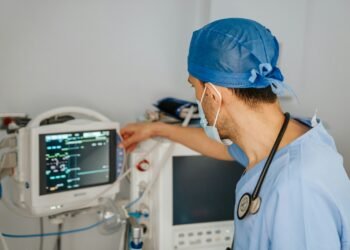
The system is called the Targeted Real-Time Early Warning System, or TREWS. Developed by researchers at Johns Hopkins University and commercialized by Bayesian Health, it plugs into a hospital’s electronic health records and continuously monitors patients, scanning the vital signs, lab results and clinical notes already flowing through the record for the subtle patterns that precede sepsis. When those patterns appear, it raises an alert, up to 48 hours before a clinician would typically suspect anything is wrong.
Why sepsis keeps killing
Sepsis is the body’s immune system overreacting to an infection, a chain reaction that leads to tissue damage, organ failure and death. It is brutally common. At least 1.7 million adults in the United States develop sepsis each year, along with more than 18,000 children. At least 350,000 of those adults and more than 1,800 children die during their hospitalization.
The disease is hard to catch early because its opening symptoms are ordinary. Fever and an elevated heart rate could be flu, dehydration or a reaction to medication. Effective treatment depends almost entirely on speed, yet the signals that would justify urgency hide inside noise. “Catching sepsis before a clinician suspects it is a needle-in-a-haystack problem,” said Neri Cohen, head of clinical enterprise at Bayesian Health, in the company’s announcement.
Evidence most medical AI does not have
TREWS arrives with a stronger evidence base than almost any clinical AI tool on the market. A 2022 study published in Nature Medicine examined more than 764,000 patient encounters across five American hospitals and found that when clinicians acted on the system’s alerts, sepsis patients were 18 percent less likely to die in the hospital. That is a mortality result, measured in real hospitals at scale, not an accuracy score from a retrospective test set.
The distinction matters more than it might seem. An analysis published this month found that of 1,357 AI-based medical devices authorized by the FDA for use in patient care, only three had been tested on whether they actually improve the outcomes patients care about, such as survival. Many of the underlying studies were small, and often excluded pregnant patients, children, older adults and non-English speakers. Regulatory clearance, in other words, has rarely meant proof of benefit. TREWS is one of the exceptions.
The clearance itself came through the FDA’s 510(k) pathway, which requires a manufacturer to show its device is substantially equivalent to one already on the market. Bayesian Health says the platform is the first FDA-cleared AI device that detects sepsis before clinical suspicion, a claim that sets it apart from the many alert systems that fire only once a patient is already visibly deteriorating.
The regulator is catching up
The FDA knows it has a validation problem. Rick Abramson, the agency’s head of digital health policy, said in late August that guidance on generative AI-enabled medical devices is on the way, and the agency has been collecting public input on how to regulate the technology. The timing is not accidental. Hospitals are adopting AI tools far faster than the evidence base is growing, and the gap between what is cleared and what is proven keeps widening.
Against that backdrop, a sepsis system with published mortality data becomes something of a benchmark. It demonstrates that outcome studies for clinical AI are possible, which makes their absence elsewhere harder to excuse.
The bedside is the real test
An alert is only useful if clinicians trust it enough to act on it. The 18 percent mortality reduction in the Hopkins research came specifically from cases where staff engaged with the warning, which means the system’s real-world value will depend on how hospitals integrate it into daily practice, and whether the alerts stay accurate enough to be taken seriously on a busy ward.
The larger hope is that TREWS sets a precedent, making patient outcomes the standard that medical AI is measured against rather than the exception to it. Watch how quickly hospitals adopt the system, and whether the FDA’s coming guidance pushes the rest of the field in the same direction. For more on how AI is reshaping medicine, visit Mylistingo.
The Netherlands, for internationals
One email a week: the week's news for internationals in the Netherlands, new practical guides and what changed in the cities. No spam, unsubscribe any time.