This guide is for international employees who are moving to the Netherlands, or have just arrived, and want to know whether their employer can pay part of their salary tax free under the 30% facility. After reading it, you will know the conditions, how you and your employer apply together, how long the benefit lasts and how the phased reduction works.
- What the 30% facility is
- Who qualifies: employment and salary conditions
- The recruitment-from-abroad condition
- How employer and employee apply together
- How long it lasts and the phased reduction
- FAQ
What the 30% facility is
The Tax Administration calls the 30% facility the Expat Scheme. According to the Tax Administration’s page on the Expat Scheme, it lets your employer give you an untaxed allowance for “extraterritorial costs”, the extra costs of coming to work in the Netherlands from another country. Instead of reimbursing those costs one by one, your employer may pay up to 30% of your salary, including the allowance, to you untaxed.
Your employer is not obliged to pay the full 30%. The allowance may be lower, so the Tax Administration advises you to agree with your employer in advance on the allowance you will receive when you apply.
Extraterritorial costs include extra living costs, a familiarisation trip, fees for residence permits, visas and driving licence conversion, medical examinations and vaccinations, double housing costs, travel to your home country, language training for you and family members staying with you, and the cost of applying for a social security exemption such as an A1 certificate. Costs that do not count include expatriate allowances and bonuses, capital losses, the costs of buying and selling a house, and compensation for higher tax rates. Furniture generally cannot be reimbursed untaxed. Separately from the scheme, your employer can reimburse fees for an international school, or the international department of a regular school, tax free.
There is also a ceiling. As of 2026, the maximum untaxed allowance is €78,600, which applies if your salary is €262,000 or more and you use the scheme for the whole year. If you use it for part of the year, the maximum is calculated time-proportionally.
Who qualifies: employment and salary conditions
You must meet all of the conditions. The first is that you are in paid employment with an employer. The second is that you have a specific expertise that is hardly found on the Dutch labour market. The Tax Administration measures this through your salary, not including the tax-free allowance.
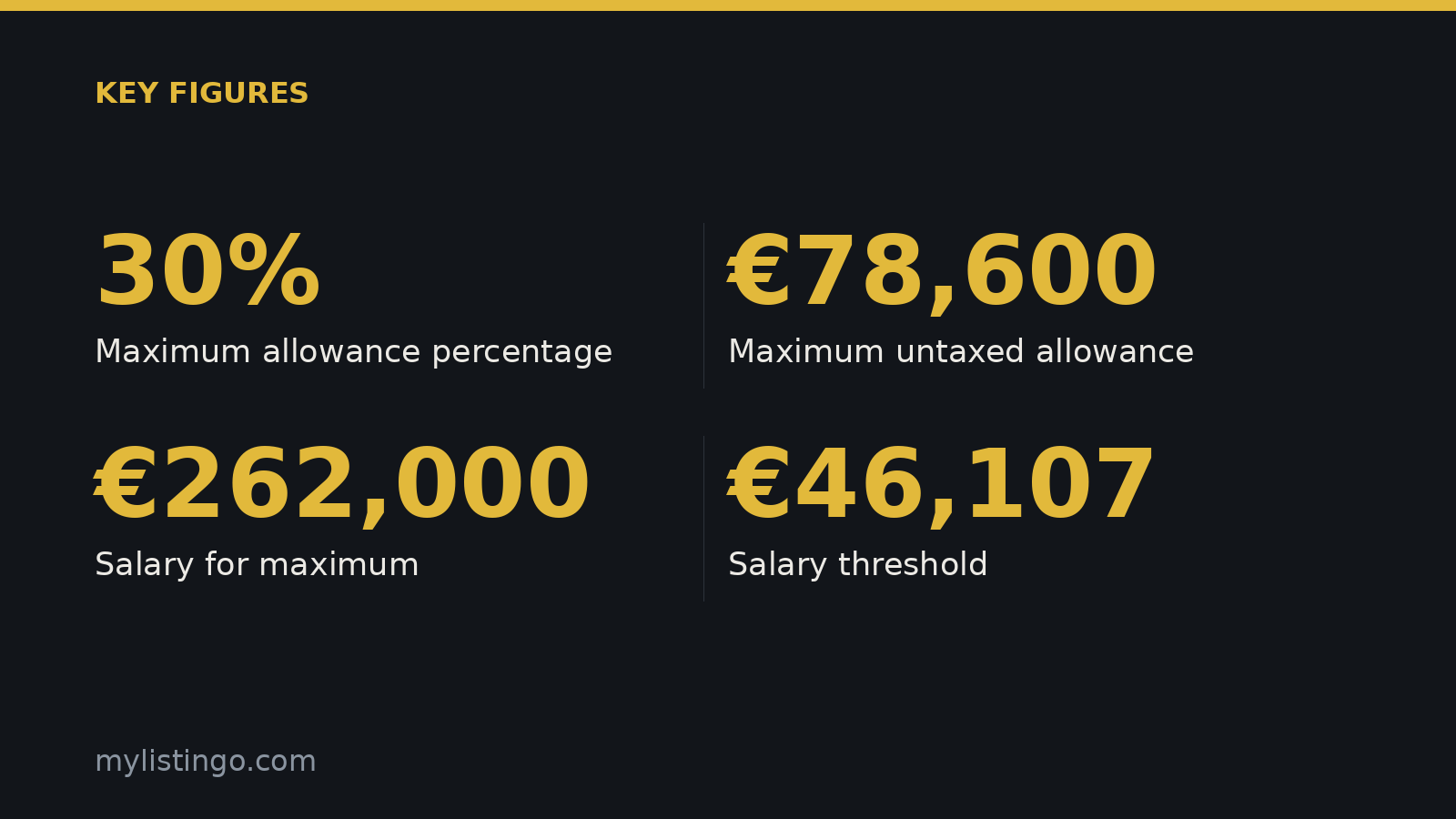
- Standard threshold: your annual salary must be more than the amount in the Tax Administration’s table. The table lists €48,013, €46,660 and €46,107 for different years. Government.nl describes the scheme as being for foreign employees who earn more than €46,107 a year. Check the Tax Administration table for the amount that applies to your start year.
- Younger than 30 with a master’s degree: if you are younger than 30 and hold a Dutch academic master’s degree, or an equivalent title from another country, a lower threshold applies. The table lists €36,497, €35,468 and €35,048.
- Researchers and medical specialists in training: if you conduct scientific research at a designated research facility, or you are a doctor training to become a specialist, you can always use the scheme. Your salary amount is not important.
For situations the official pages do not describe, such as how a specific job title or contract structure is assessed, the Tax Administration decides case by case.
The recruitment-from-abroad condition
You must be recruited outside the Netherlands. People living on Aruba, the BES islands, Curaçao or Sint Maarten also count as recruited outside the Netherlands.
The key test is distance. In the 24 months before your first working day in the Netherlands, you must have lived more than 150 kilometres from the Dutch border, as the crow flies, for more than 16 months. This excludes people who lived in Belgium, Luxembourg and parts of Germany, France or the United Kingdom.
If you worked in the Netherlands before. If you previously qualified for the scheme and then moved abroad again, your new home does not have to be more than 150 kilometres from the border, provided all of the following apply:
- your previous work period started no more than 5 years ago;
- when that previous work started, you had lived more than 150 kilometres from the border for more than 16 of the previous 24 months;
- during that previous period you had a valid decision for the scheme, or you can make it plausible that you met the conditions that applied at the time.
If you did a PhD in the Netherlands. You can use the scheme if, in the 24 months before your PhD research started, you lived more than 150 kilometres from the Dutch border for more than 16 months. Living in the Netherlands or near the border during your PhD, and between your PhD and your new job, does not count against you.
How employer and employee apply together
If you meet all the conditions, you complete the application form together with your employer. Government.nl states that the employer must apply to the Tax Administration and arranges the tax exemption. The Tax Administration will inform you within 8 weeks.
A practical order of steps:
- Agree on the allowance percentage with your employer before you apply, ideally in your employment contract.
- Gather evidence of where you lived in the 24 months before your first working day, and any diploma or research appointment that affects your salary threshold.
- Complete the application form together with your employer.
- Wait for the decision, which shows your end date.
The official pages do not list the exact supporting documents for a first application or a general deadline for it. The Tax Administration decides case by case, so ask your employer’s payroll team or the Tax Administration before you start.
Changing employers. If you move to an employer within the same connected group of withholding agents and still meet the conditions, your decision stays valid and you do not need a new application. In other cases, your decision can remain valid if you start with your new employer within 3 months of leaving your old job. You must then submit your application within 4 months of starting with the new employer, and you can use the scheme from your first working day there.
How long it lasts and the phased reduction
A decision lasts up to 5 years, and the end date is shown on it. The Tax Administration reduces this by any period you previously worked or lived in the Netherlands. It does not reduce it if:
- that earlier period ended more than 25 years before your current work started;
- in the past 25 years you worked in the Netherlands only occasionally, for less than 20 days a year in total, for example on business trips;
- in the past 25 years you stayed in the Netherlands only occasionally, for holidays, family visits or other personal reasons, for no more than 6 weeks a year in total or one period of 3 consecutive months.
The phased reduction. Since 1 January 2024, Government.nl states that the benefit is scaled back in three steps:
- 30% tax free for the first 20 months;
- 20% tax free for the next 20 months;
- 10% tax free for the last 20 months.
Employees who used the facility in 2023 keep the 30% allowance for the full 5 years. Government.nl also notes that the allowance applies to salaries up to €233,000 a year (the 2024 amount), and that people who have received the allowance since 2022 became subject to this upper limit from 1 January 2026.
Government.nl reports that the government plans to partially reverse the scaling back as of 2027. The effective date is not final, and the measure must pass both houses of parliament. Check the official page for the current status before you plan around it.
FAQ
Can I apply for the 30% facility on my own?
No. The Tax Administration says you complete the application form together with your employer, and Government.nl says the employer must apply. The employer also pays the allowance and arranges the tax exemption.
Is my employer required to give me the full 30%?
No. Your employer is not obliged to pay 30% of your salary untaxed, and the allowance may be lower. The Tax Administration advises agreeing on the amount with your employer in advance.
What income do I report in my Dutch tax return?
You report the annual salary on the annual statement you receive from your employer. The scheme has already been taken into account in that figure, so you do not calculate it yourself, even if the scheme ends during the year.
Can I still choose partial foreign tax liability?
No. According to the Tax Administration, from the 2025 tax return onwards you can no longer opt for partial foreign tax liability.
Official sources: belastingdienst.nl · government.nl
Last verified: 21 October 2026 against the official pages linked above. Rules and fees change; the official page always wins. General information, not legal or tax advice.
Sources
- belastingdienst.nl: Can I apply for the Expat Scheme (30% facility)? | Tax Administration, accessed 21 October 2026
- government.nl: 30% facility for highly educated foreign employees (expats) | Government.nl, accessed 21 October 2026
The Netherlands, for internationals
One email a week: the week's news for internationals in the Netherlands, new practical guides and what changed in the cities. No spam, unsubscribe any time.