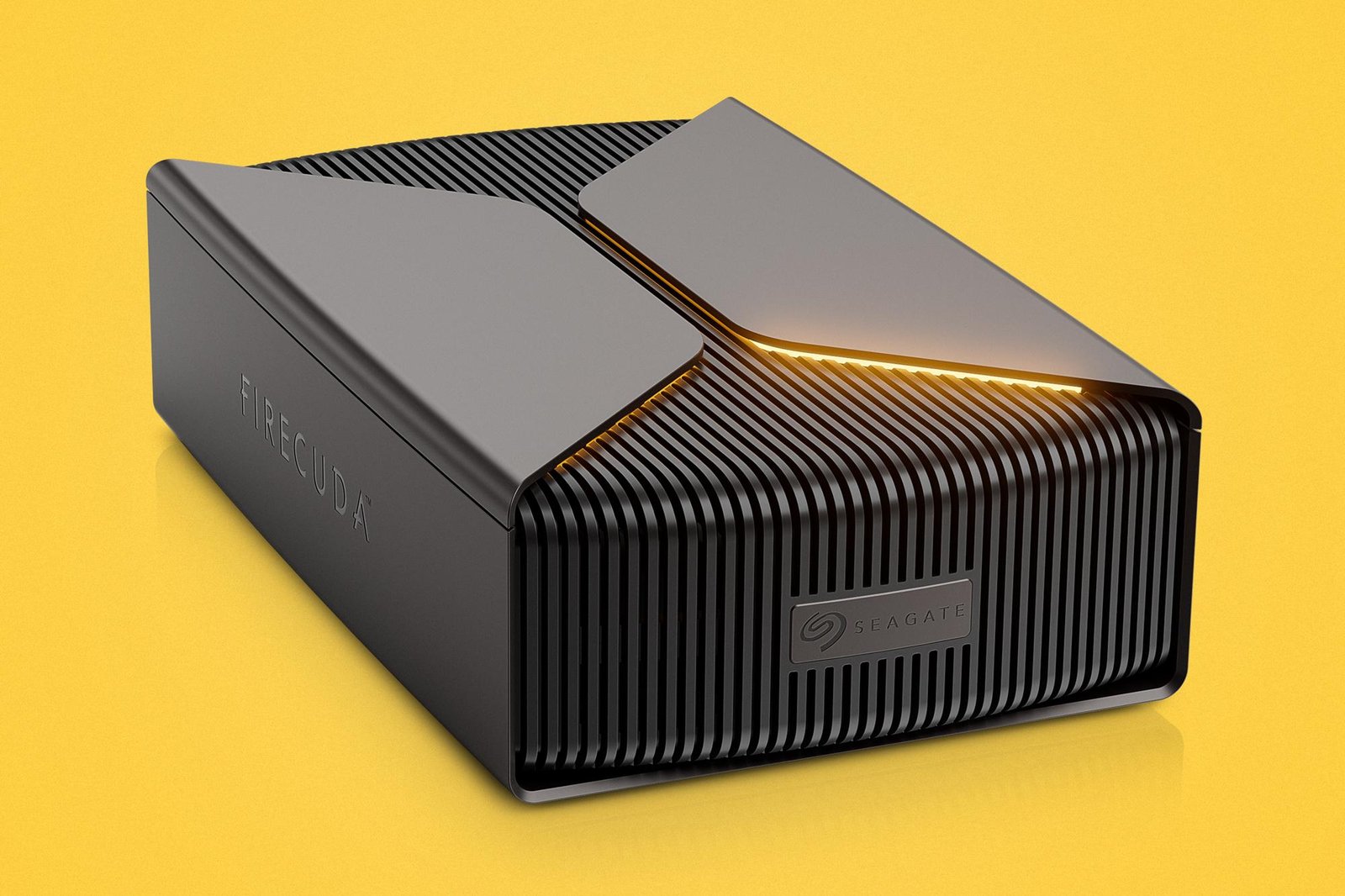
Seagate has a new external drive that tries to behave like an SSD while costing closer to a hard disk. It is called the FireCuda Forge, and it ships with a hard drive installed and a slot waiting for the flash storage you supply.
The idea is straightforward. Most people have a large, slow library of files and a small, fast set of files they touch every day. The Forge puts both in one enclosure and lets software decide what belongs where.
That software is Seagate’s new Alkemi platform. The company says it learns how your data is used and moves the files you are working with, or open most often, onto the SSD. The rest stays on spinning platters where capacity is cheap.
Seagate is selling two versions through its online store. The 8TB model costs $699, and the 20TB model costs $899. Both hard drives are user-replaceable. The NVMe SSD is not included, and that omission matters during a year of memory shortages.
Performance claims depend on your computer. Seagate quotes read speeds up to 2,500MB/s and write speeds up to 2,000MB/s, but only on machines running Windows 11 or macOS 26. Older systems will see less, since the tiering logic needs modern storage APIs to move data quickly.
Hybrid drives are not new. Seagate has shipped hard drives with a small flash cache for decades. The difference here is choice. You pick the SSD, and you can swap either half of the pair later, The Verge reported.
How it differs from a NAS
Network attached storage devices also mix flash and spinning disks. They use the SSD as a cache for data that other machines request over the network. Seagate says Alkemi works differently, moving data based on patterns it learns locally rather than fixed cache rules.
That distinction will decide whether the Forge earns its price. A cache is predictable. A learned model can adapt to a video editor’s project files or a photographer’s active shoot folder, but it can also guess wrong.
The math is awkward for buyers with a spare drive drawer. An 8TB external hard disk costs a fraction of $699, and a 2TB NVMe stick adds speed for the files that need it. Paying a premium for automatic tiering only makes sense if the software genuinely removes the manual sorting.
Seagate has not published independent benchmarks, and there is no word on whether Alkemi will spread to other products. For now the Forge is a bet that people will pay for convenience instead of managing two drives themselves.
Who this is for
The obvious customer is someone with a large media library who wants faster access without buying a NAS or rebuilding a desktop. Laptop owners with fast Thunderbolt ports are the second group, since external storage is their only expansion path.
Everyone else should wait for reviews. A tiering system is only as good as its predictions, and no third party has tested those yet.
Related: Apple’s new Intelligence usage packs for creators and Anthropic’s Claude Fable 5.2 launch.
The Netherlands, for internationals
One email a week: the week's news for internationals in the Netherlands, new practical guides and what changed in the cities. No spam, unsubscribe any time.