This guide is for internationals who are moving into a Dutch home and need to choose an energy supplier for the first time. After reading it, you will know what to have ready before you compare offers, how fixed, variable and dynamic contracts differ, how the monthly payments and the yearly bill work, and what your rights are when you sign, cancel or move.
- What to have ready before you compare
- Fixed, variable or dynamic tariffs
- Monthly payments and the yearly bill
- Signing a contract and the cooling-off period
- Cancellation fees and notice periods
- What to arrange when you move
- Compare current offers
- FAQ
What to have ready before you compare
In the Netherlands you choose your own energieleverancier (energy supplier). The Dutch consumer regulator ACM advises in its tips for choosing an energy supplier that you first find out how much energy you use per year and what you currently pay. The usual source is your latest jaarafrekening (the yearly settlement bill). If you are new to the country and have no Dutch bill yet, you will not have this figure, so ask the supplier how it estimates your usage. ACM does not set a method for that, so the supplier decides case by case.
A few other points to settle before you look at offers:
- Whether you want green energy. Suppliers must state the source of the energy they supply.
- Whether you want electricity and gas from one supplier or from two. You do not have to buy both from the same company.
- Whether the home has solar panels. If it does, compare the supply tariff and the terugleverkosten (charges for feeding electricity back into the grid), which are stated in your contract.
- Whether you are buying directly from a supplier or through a wederverkoper (reseller). A reseller has no licence of its own and works with a licensed supplier, whose name appears on your contract.
ACM also advises against agreeing to a contract during a sales call. Take time to compare, and call the supplier yourself if you decide to become a customer.
Fixed, variable or dynamic tariffs
ACM’s page on fixed and variable supply costs describes three types of contract. Which one suits you depends on how much certainty you want.
Fixed tariff
Your price per kWh of electricity and per m3 of gas stays the same for the full term of the contract. Prices that rise do not affect you, and prices that fall do not help you either. Other parts of the bill, such as taxes and network costs, can still change during the term. If you cancel before the end date, the supplier may charge an opzegvergoeding (cancellation fee). When the fixed term ends, your tariff becomes variable, and the supplier must tell you the new rates in advance.
Variable tariff
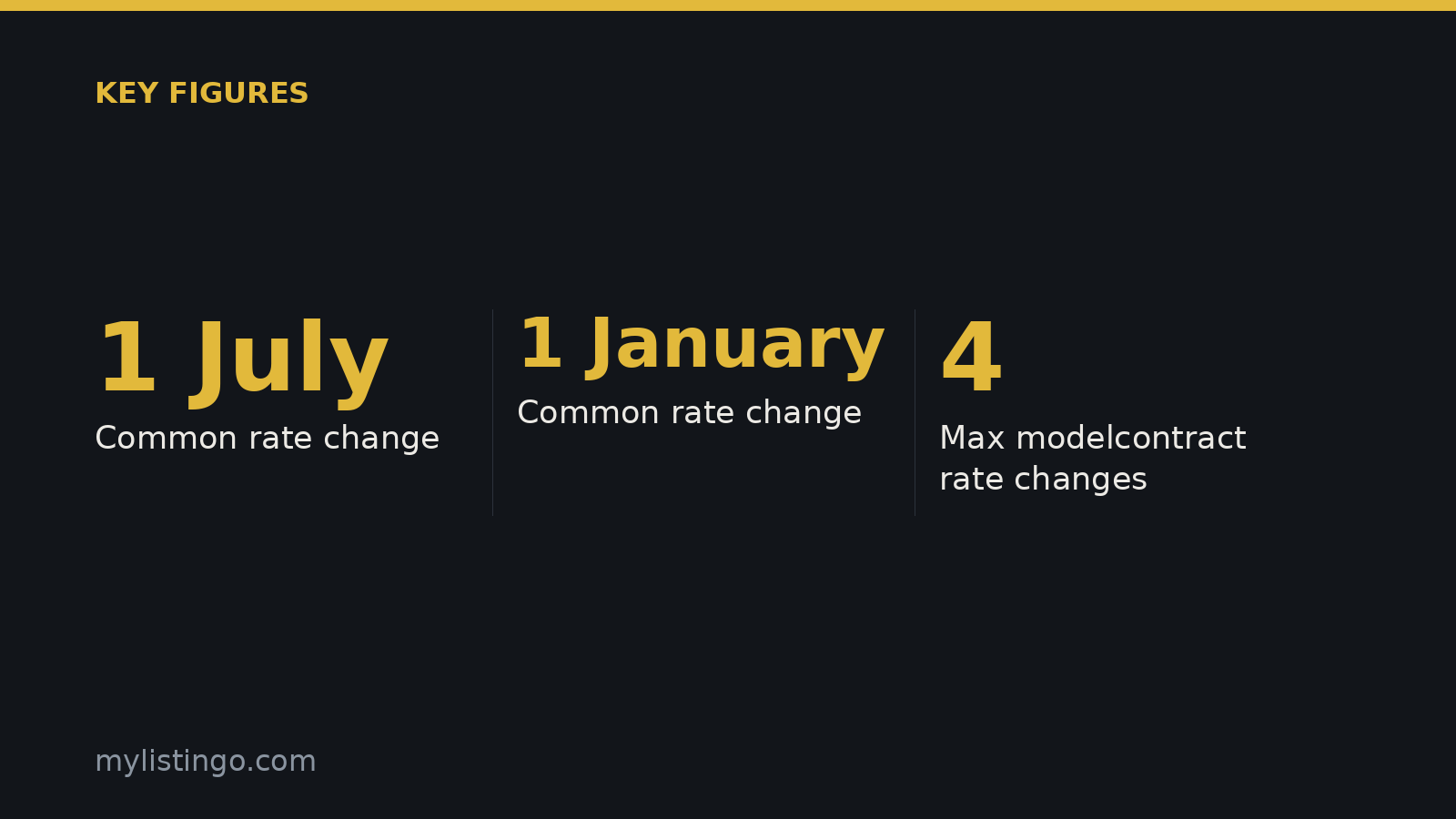
The supplier may change the price per kWh and m3, usually at set moments that are listed in your contract terms. ACM notes that many suppliers change their rates around 1 July and 1 January. The supplier must tell you about new rates in advance. You pay no cancellation fee when you leave. A modelcontract (standard contract with uniform terms) with a variable tariff may not change its rates more than 4 times a year.
Dynamic tariff
The electricity price changes every quarter hour, every hour or every day, and the gas price changes daily, because both are linked to wholesale market prices. This can work in your favour when prices are low, but you pay more when they rise. The supplier must explain the risks in advance and cannot reliably predict what you will pay over a year. You pay no cancellation fee when you leave.
Whatever you choose, you also pay vaste leveringskosten (fixed supply charges) that do not depend on your usage, and these differ per supplier. Some suppliers combine high fixed charges with low usage prices, which suits households that use a lot of energy but not those that use little.
Monthly payments and the yearly bill
You do not pay for energy after you use it. You pay a termijnbedrag (monthly advance payment) every month. ACM’s page on the monthly advance payment explains that the supplier estimates your yearly costs from the energy price and your past usage and divides that by 12.
Once a year you receive a jaarafrekening that compares your real usage and costs with what you paid. According to ACM’s page on the energy bill, you get a refund if you paid too much and a further bill if you paid too little. The first page shows your usage, total costs, the advance payments made and the balance.
You can often adjust the monthly amount yourself in the supplier’s app or website. ACM warns that setting it too low can leave you with a large bill at the end of the year. A supplier may only raise your monthly amount for a good reason, for example because you are using more energy, or because you have a variable contract and wholesale prices rose faster than expected. If you disagree, contact the supplier first. Once you file a complaint, it must decide within 8 weeks.
Signing a contract and the cooling-off period
ACM’s page on cancelling or annulling an energy contract sets out two protections.
- Written consent for phone sales. A contract agreed by phone is only valid once you confirm it in writing: on paper, by email or online. Without that, no contract exists and you owe the supplier nothing.
- Bedenktijd (cooling-off period). You always have 14 days to withdraw, even after giving written consent, without giving a reason. Send the new supplier a letter or email within 14 days of signing. You then stay with your previous supplier and pay no cancellation fee. The supplier must tell you about this right and explain how to use it. If it does not, the cooling-off period is extended, as ACM’s page explains.
Be careful with a volmacht (power of attorney), where a reseller asks to sign a contract on your behalf. ACM advises you to check which suppliers the reseller works with and what exactly you are authorising. You can withdraw a power of attorney at any time by email or letter.
Cancellation fees and notice periods
ACM’s page on cancellation fees and notice periods says you only pay a cancellation fee if three conditions are all met: you have a contract for a fixed term, that term has not ended when you cancel, and both points are in your contract. This also applies if you cancel because you are moving, emigrating or moving in with a partner.
You pay no cancellation fee if the term has ended, if you have a variable or dynamic contract, or if the supplier ends your contract (unless it does so because of unpaid bills, when a fee is sometimes allowed). The fee equals the loss the supplier makes because you leave early, so you pay nothing if energy has become more expensive in the meantime. Ask your current supplier for an estimate before you switch. A calculation it gives you stays valid for 2 months.
If you received a welkomstpremie (cash welcome bonus), the supplier may ask for it back if you cancel within 6 months of the contract starting. A welcome gift that is not money never has to be returned.
The opzegtermijn (notice period) is stated in your contract. It is at most 1 month for every energy contract, and it starts on the day after you cancel.
What to arrange when you move
When you move out, your supplier sends an eindafrekening (final bill) for the old address within 6 weeks. ACM’s page on energy contracts when moving says some suppliers let you take your current contract to your new address. Check your contract terms or ask the supplier. Sometimes you can use the contract at both addresses for a short period, and the supplier decides whether that is possible. If gas and electricity come from different suppliers, contact both.
Give your supplier your new address so that any open bills and reminders reach you. In the month you switch, your old supplier may still collect an advance payment while it updates its records. If it is still collecting after 2 months, or you have no final bill after 6 weeks, you can file a complaint using ACM’s template letter.
Compare current offers
Prices and conditions change often, so they are not in this guide. The comparison below shows current offers and is kept up to date by its provider. Check the full conditions on the provider’s own site before you sign.
This comparison tool is provided by Daisycon. If you sign up through it, Mylistingo may earn a commission at no extra cost to you.
How to read this tool: it is in Dutch
- Postcode, Huisnr.
- postcode and house number: the tool needs your address to show real prices
- Huidige leverancier
- your current supplier
- Huishouden: Alleen, Samen
- household: living alone, living together
- Klein, Middel, Groot
- small, medium, large (estimated usage)
- Zonnepanelen
- solar panels
- Verbruik handmatig invullen
- enter your own usage (from your jaarafrekening)
- Vast
- fixed tariff (prijs staat vast = the price is fixed)
- Variabel
- variable tariff
- Dynamisch, Uurprijzen
- dynamic tariff, hourly prices
- Looptijd
- contract length
- Groene stroom (uit NL / uit EU)
- green electricity (generated in the Netherlands / in the EU)
- Prijzen per maand / per jaar
- prices per month / per year
- Vergelijken / Bekijk / Meer info
- compare / view the offer / more details
- Laagste prijs, Uitgelicht, Meer contracten
- lowest price, featured, more contracts
The comparison loads from Daisycon (energie.whitelabeled.nl), a third-party service. Loading it sends your IP address and browser details to Daisycon, and clicks on offers are tracked by Daisycon. See our privacy policy.
Questions about this tool or an offer in it? Contact us. You chose to load this tool; .
FAQ
Can I take my energy contract with me when I move within the Netherlands?
Some suppliers allow it and others do not. Check the terms of your contract or ask your supplier directly. If your contract ends because of the move, you will receive a final bill for your old address within 6 weeks and can choose a new supplier for your new home.
Will I pay a cancellation fee if I leave the Netherlands?
Only if you have a fixed-term contract, the term has not ended, and both points are written in your contract. ACM states that this also applies when you cancel because you are emigrating. With a variable or dynamic contract, you pay no cancellation fee.
My supplier raised my monthly payment. Is that allowed?
Only for a good reason, such as higher usage or, on a variable contract, wholesale prices rising faster than the supplier expected. Contact your supplier first. If you are not satisfied, send a complaint using ACM’s template letter. The supplier must then decide within 8 weeks.
I agreed to a contract on the phone. Is it valid?
A contract agreed by phone only becomes valid once you give written consent on paper, by email or online. Even after that, you have a 14-day cooling-off period in which you can withdraw without giving a reason and without paying a cancellation fee.
Official sources: consument.acm.nl · consument.acm.nl · consument.acm.nl · consument.acm.nl · consument.acm.nl · consument.acm.nl · consument.acm.nl
Last verified: 16 November 2026 against the official pages linked above. Rules and fees change; the official page always wins. General information, not legal or tax advice.
Sources
- consument.acm.nl: Tips bij een energieleverancier kiezen | ACM ConsuWijzer, accessed 16 November 2026
- consument.acm.nl: Vaste en variabele leveringskosten energie | ACM ConsuWijzer, accessed 16 November 2026
- consument.acm.nl: De energierekening | ACM ConsuWijzer, accessed 16 November 2026
- consument.acm.nl: Het termijnbedrag bij mijn energiecontract | ACM ConsuWijzer, accessed 16 November 2026
- consument.acm.nl: Energiecontract opzeggen: alles over opzegvergoeding en opzegtermijn | ACM ConsuWijzer, accessed 16 November 2026
- consument.acm.nl: Energiecontract vernietigen of annuleren | ACM ConsuWijzer, accessed 16 November 2026
- consument.acm.nl: Energiecontract bij verhuizen | ACM ConsuWijzer, accessed 16 November 2026
The Netherlands, for internationals
One email a week: the week's news for internationals in the Netherlands, new practical guides and what changed in the cities. No spam, unsubscribe any time.