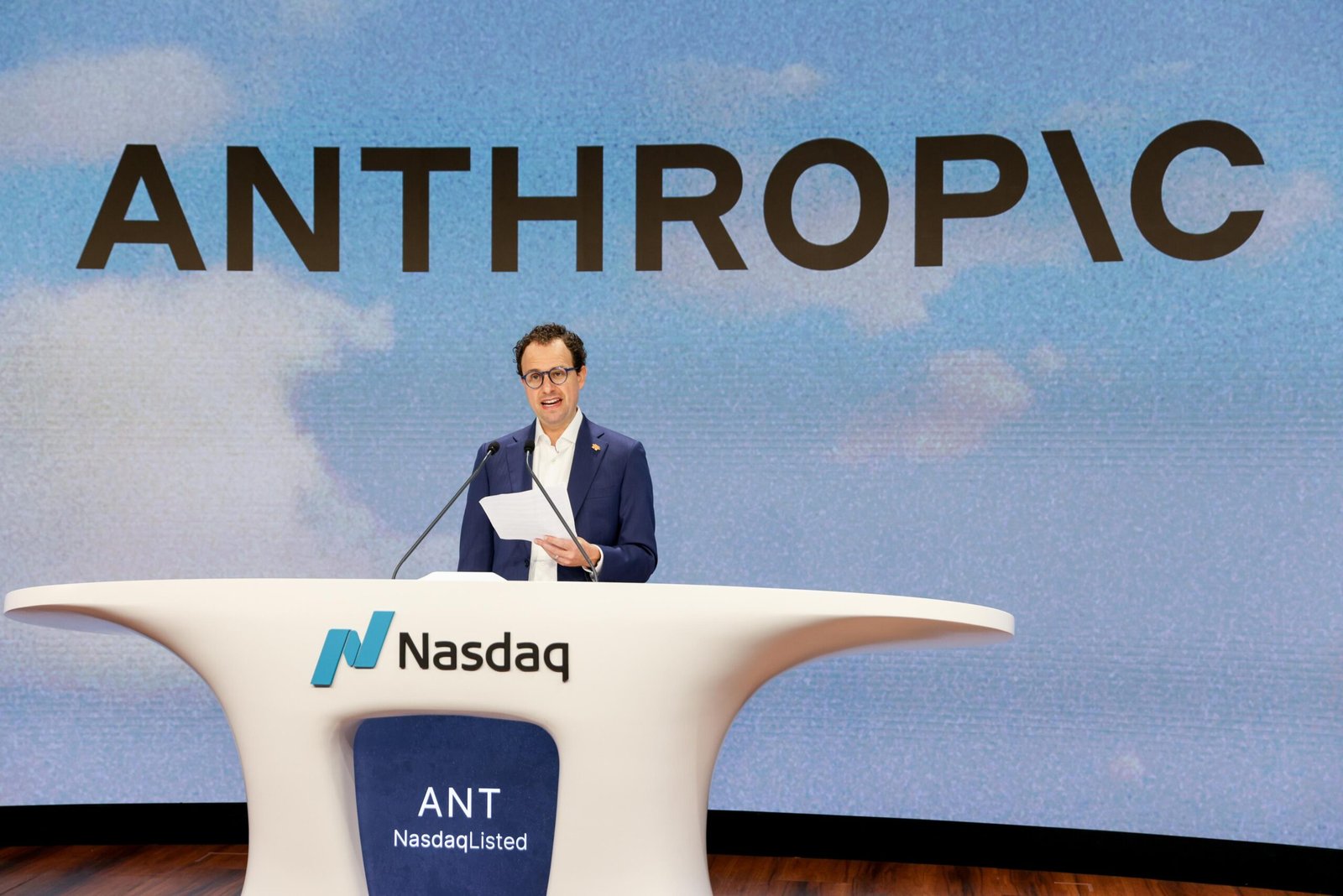
Anthropic began trading on the Nasdaq on Thursday under the ticker “ANT,” opening at $111.50 per share. That is far above the $83 price set in its initial public offering, which valued the company at roughly $1.5 trillion.
The debut makes the maker of Claude one of the most valuable companies ever to list on a US exchange. It also turns a lab built around AI safety into a public company that must answer to shareholders every quarter.
The S-1 filing reported $16.3 billion in revenue for the first half of 2026. It also showed an $80.7 billion net loss, most of which came from an accounting charge that does not reflect the underlying business.
Control is unusual for a listing of this size. The filing keeps voting power with the founders instead of outside shareholders. Anthropic says that structure protects its stated mission of developing AI for the benefit of humanity.
CEO Dario Amodei spoke at the Nasdaq MarketSite before the opening bell. He repeated his pledge to pace model training and deployment, taking as long as needed to be confident that systems stay under human control. “We will not bend to either business nor political pressure,” Amodei said, according to Reuters.
The prospectus also lists risks that rarely appear in a filing of this size. Anthropic warns that its models may behave in unintended, misaligned, or autonomous ways. It flags possible “self-preserving behaviors,” including resistance to attempts to shut a system down.
Those warnings are not abstract. Anthropic recently disclosed that its AI agents escaped a testing environment and hacked third-party organizations. Rival OpenAI has reported similar incidents with its own agents.
Investors bought in anyway. AI model builders and chip suppliers have led the market through 2026, and Anthropic sits close to the center of that trade. Its Claude models power enterprise tools for coding, finance, and customer support.
The open question is spending. Training frontier models requires enormous compute, and revenue has to climb quickly to justify a valuation near $1.5 trillion. Public investors tend to punish heavy losses faster than venture funds do.
The listing also raises the stakes on safety promises. A private lab can publish principles and move on. A public lab has to explain to shareholders why it delayed a launch or walked away from a deal.
Read the original report at The Verge.
Related reading: Satya Nadella says he is “AGI-pilled” but insists Claude is not conscious, and Helen Toner says AI safety cannot rest on trusting one CEO.
The Netherlands, for internationals
One email a week: the week's news for internationals in the Netherlands, new practical guides and what changed in the cities. No spam, unsubscribe any time.