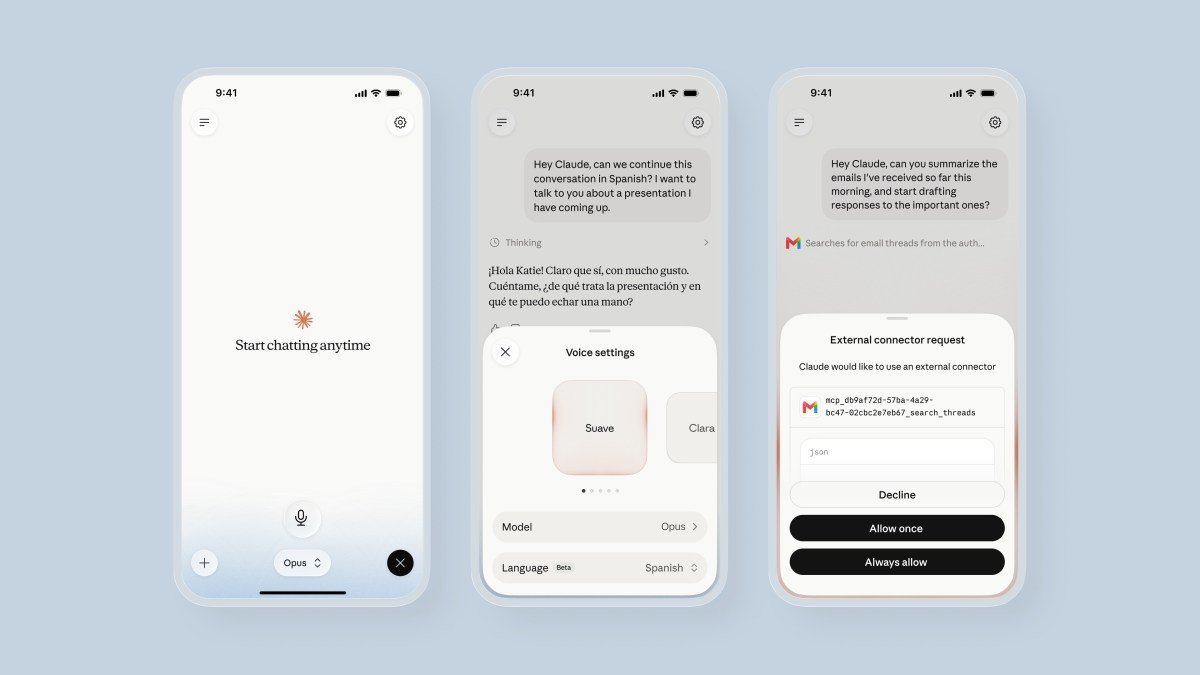
Ask a voice assistant to reschedule your 3 p.m. meeting and, until recently, you would get a shrug in synthetic form. Maybe a web search. Maybe a cheerful non-answer. Anthropic wants that era to end. On July 23, 2026, the company updated Claude’s voice mode with more capable models, and the pitch is refreshingly concrete: talk to Claude, and it can move your meeting or draft the email you were dreading.
That sounds small. It isn’t. The gap between a voice assistant that answers questions and one that actually does the task has defined the last decade of the category, and almost nobody has crossed it cleanly.
From talking to doing
For years, voice assistants have been very good at a narrow band of chores. Setting timers. Playing music. Reading the weather aloud while you rummage for your keys. Anything past that tended to collapse into “here’s what I found on the web,” which is a polite way of saying the assistant gave up and handed you a search engine.
Claude’s updated voice mode aims at the harder middle ground, the stuff that fills a working day. Rescheduling a meeting means understanding who’s involved, checking availability, and proposing a new time that doesn’t wreck someone else’s afternoon. Drafting an email means holding context, matching tone, and producing something you’d actually send rather than something you’d rewrite from scratch. These are the tasks people describe when they say they want an assistant, and they’re exactly the ones older systems fumbled.
Anthropic’s bet is that stronger underlying models change what voice can do. A more capable model reasons through a multi-step request instead of pattern-matching to the nearest canned response. Say the request out loud, keep talking, and the assistant follows the thread rather than losing it at the first clause.
Why voice is suddenly interesting again
Voice had a strange decade. The smart-speaker boom promised a hands-free future, then settled into kitchen timers and thermostat commands. The technology plateaued because the intelligence behind the microphone did. You can only build so much on top of a system that can’t reason.
Large language models scrambled that math. Once the model behind the voice can genuinely understand and plan, the interface stops being a gimmick and starts being the fastest way to hand off work. Speaking is quicker than typing, and it fits the moments when your hands are full or your screen is somewhere else. Walking between meetings, you can tell Claude to draft the follow-up before you’ve reached the next room.
Anthropic isn’t alone in noticing this. Every major AI company is racing to make voice feel less like a novelty and more like a coworker you can talk to. What separates a demo from a product is whether the assistant completes the task or just narrates its intentions. Anthropic is framing this update squarely around completion, which is the harder and more honest claim to make.
The trust problem underneath
Here’s the catch. The more an assistant does on your behalf, the more it matters that it does the right thing. Reading you the weather carries no risk. Sending an email under your name, or shuffling other people’s calendars, absolutely does. An assistant that drafts a message is helpful. An assistant that fires off the wrong message to the wrong person is a problem you’ll spend the afternoon cleaning up.
This is the tension every capable assistant now has to manage. Users want the thing done without babysitting each step, yet they also want to catch a mistake before it leaves the building. Where Claude’s voice mode draws that line, how much it confirms before acting, how easily you can stop it mid-task, will matter as much as the raw capability. Getting the reasoning right is the engineering challenge. Getting the trust right is the product one, and it’s less forgiving.
Anthropic has leaned on caution as a brand for a while, which makes voice an interesting proving ground. A talking assistant that acts in the real world is precisely where careful design either pays off or gets exposed.
What to watch next
The interesting question isn’t whether Claude can draft an email on command. It’s how far the list of doable tasks stretches from here, and how much people come to rely on speaking rather than typing to get through their day. Rescheduling and drafting are the opening moves, not the finish. If they work well, the appetite for more will follow fast.
Voice has been the interface that never quite arrived. This update is a sign the wait might finally be ending, not because the microphones got better, but because the intelligence behind them did. Whether that adds up to a habit or another abandoned smart speaker depends on the next few releases, and on whether these assistants earn the trust that doing real work requires.
For more coverage of AI voice assistants, visit Mylistingo.
Source: Original Article
The Netherlands, for internationals
One email a week: the week's news for internationals in the Netherlands, new practical guides and what changed in the cities. No spam, unsubscribe any time.