This guide is for non-EU professionals who have a job offer in the Netherlands, or expect one, and want to understand the highly skilled migrant (kennismigrant) residence permit. After reading, you will know who can apply, which salary rules apply to you, how the application runs from start to finish, and how the permit compares with the EU Blue Card.
- How the permit works through a recognised sponsor
- The core requirements
- Salary criteria by age and for recent graduates
- The application process, fees and decision times
- How it compares with the EU Blue Card
- FAQ
How the permit works through a recognised sponsor
The highly skilled migrant permit is a Dutch national residence permit for skilled employees. The most important rule is simple: you cannot apply for it yourself. According to the IND page on highly skilled migrants, only an employer recognised by the IND can apply for your permit. A recognised sponsor is listed in the public register of recognised sponsors, so you can check whether a future employer qualifies before you sign anything.
Your employer handles the application and the payment. You supply the documents your employer asks for. If you will be transferred by a company based outside the EU as a manager, specialist or trainee, you count as an intra corporate transferee, and different requirements apply.
The core requirements
The IND lists these conditions for the highly skilled migrant permit:
- You meet the general requirements that apply to everyone.
- You have an employment contract with an employer or research institution in the Netherlands.
- That employer is a sponsor recognised by the IND.
- You meet the income requirements.
- Your agreed salary is in line with the market rate, meaning you earn the same as people in the same job earn on average.
Extra rules apply in some professions. If you will work in individual healthcare in a profession listed in Article 3 and Article 36a of the BIG Act, you must be registered in the BIG register. Researchers must have a contract or appointment letter from a Dutch research institution showing a job title and job code from the University Job Classification System (UFO). Medical doctors in training must train at an organisation recognised by the RGS committee and be listed in the BIG register. Other rules may apply to Turkish citizens and their family members.
Salary criteria by age and for recent graduates
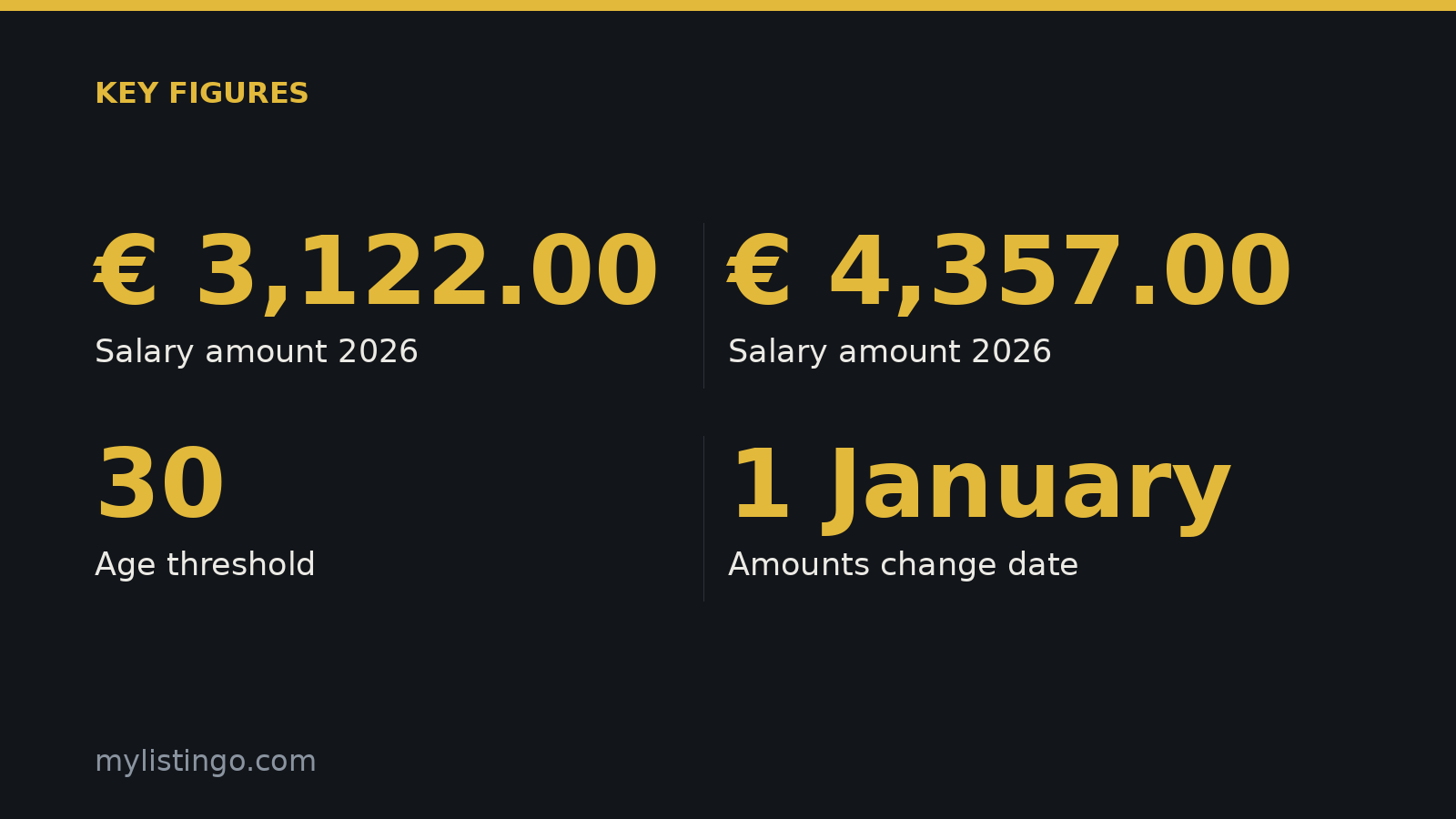
Your gross monthly salary must meet a set amount, and that amount depends on your category. The IND page on required amounts for income requirements publishes a 2026 table for highly skilled migrants and the European Blue Card. The amounts listed there for 2026 are € 3,122.00 and € 4,357.00 gross per month, with each applying to different categories. The table separates applicants by age, with a note that an amount also applies once a highly skilled migrant has turned 30, and it includes a reduced salary criterion. Recent graduates usually ask about the reduced criterion. Check which row covers your situation in the official table, and ask your employer to confirm it, because the IND assesses each application against the row that matches your circumstances.
Three timing rules matter:
- The required amounts change every year on 1 January.
- You must meet the amount that applies on the date of the application.
- If you change employer, you must meet the amount that applies on the date your contract with the new employer starts.
Researchers and medical doctors in training follow a different rule. For them, the IND says income is sufficient if the gross monthly salary is at least equal to the minimum salary.
The application process, fees and decision times
The process depends on whether you need a provisional residence permit (MVV) to enter the Netherlands.
- Check requirements. Confirm you and your employer meet the conditions above.
- Collect documents. Your employer has the list of documents you need. Foreign documents must be legalised and translated into Dutch, English, French or German.
- Apply. Your employer applies online or by post. If you need an MVV, your employer applies for the MVV and the residence permit at the same time. If you are already in the Netherlands, your employer must apply within 3 months after you arrived. Applying online requires DigiD with SMS verification and internet banking (iDEAL).
- Pay. The IND states that the application costs € 423,00, and your employer pays automatically by direct debit. For exceptions, the IND refers to its fees page.
- Wait for a decision. The IND must decide within 90 days. In some situations a shorter period applies. The IND can extend the period, for example when an application is incomplete, and will send you a letter if it does.
- Receive the decision. If the decision is negative, you can object to it.
- Travel with your MVV, if you need one. Make an appointment at the Dutch embassy or consulate named on the application within 3 months of the decision. Your passport must be valid for at least another 6 months when the MVV sticker is placed. The MVV is valid for 90 days.
- Collect your residence permit. When it is ready at an IND desk, you receive a letter and book an appointment to collect it.
If your employer said at application that you must take a tuberculosis test, make an appointment at the GGD within 3 months after you get the permit. The back of your residence document says you may work as a highly skilled migrant and as a self-employed person. Any other work needs a work permit (TWV).
How it compares with the EU Blue Card
The IND page on the European Blue Card describes it as an EU-wide work and residence permit for highly educated employees from outside the EU, the EEA and Switzerland. The main differences:
- Employer status. A Blue Card does not require a recognised sponsor. The highly skilled migrant permit does.
- Qualifications. For the Blue Card you need a higher education diploma from a programme of at least 3 years, evaluated by Nuffic if it is foreign, or at least 5 years of relevant work experience at that level. IT managers and professionals need at least 3 years of relevant experience within the 7 years before applying.
- Contract and employer. The Blue Card requires a contract of at least 6 months, an employer that carries out economic activity, and an employer with no fines in the past 5 years under the listed labour and tax laws.
- Salary. The IND states that the reduced salary criterion is higher for the Blue Card than for highly skilled migrants.
- Mobility and long-term residence. A Blue Card makes it easier to apply for a residence permit in another EU country, and in some cases lets you apply for long-term EU residency after 2 years instead of 5.
- Decision times. For the Blue Card, the IND decides within 30 days for applications from a recognised sponsor and for long-term mobility, and within 45 days if you already hold certain permits, including a highly skilled migrant permit. A 90-day period applies to all other Blue Card applications.
The Blue Card application fee on the IND page is the same € 423,00. If your employer is not a recognised sponsor, the IND sends a letter explaining how to pay.
FAQ
Can I apply for the highly skilled migrant permit myself?
No. The IND states that only an employer recognised by the IND can apply. You can check whether an employer qualifies in the IND’s public register of recognised sponsors. If your employer is not recognised, the European Blue Card may be an option, because it does not require a recognised sponsor.
Which salary threshold applies to me?
That depends on your category. The IND’s 2026 table lists amounts of € 3,122.00 and € 4,357.00 gross per month, split by age, by the reduced criterion, and by Blue Card status. Find the row that matches your situation on the official page. You must meet the amount that applies on your application date, or on your new contract’s start date if you change employer.
How long does the IND take to decide?
For the highly skilled migrant permit, the IND must decide within 90 days, and a shorter period applies in some situations. The IND can extend that period, for example when an application is incomplete, and will tell you by letter if it does. You can follow the application in My IND.
Can I do freelance work with this permit?
Yes, within limits. The residence document states that you may work as a highly skilled migrant and as a self-employed person. Any other type of work requires a work permit (TWV). If you are unsure whether a specific activity is covered, the IND decides case by case, so check with them before you start.
Official sources: ind.nl · ind.nl · ind.nl
Last verified: 18 November 2026 against the official pages linked above. Rules and fees change; the official page always wins. General information, not legal or tax advice.
Sources
- ind.nl: Highly skilled migrant | IND, accessed 18 November 2026
- ind.nl: Required amounts income requirements | IND, accessed 18 November 2026
- ind.nl: European Blue Card residence permit | IND, accessed 18 November 2026
The Netherlands, for internationals
One email a week: the week's news for internationals in the Netherlands, new practical guides and what changed in the cities. No spam, unsubscribe any time.