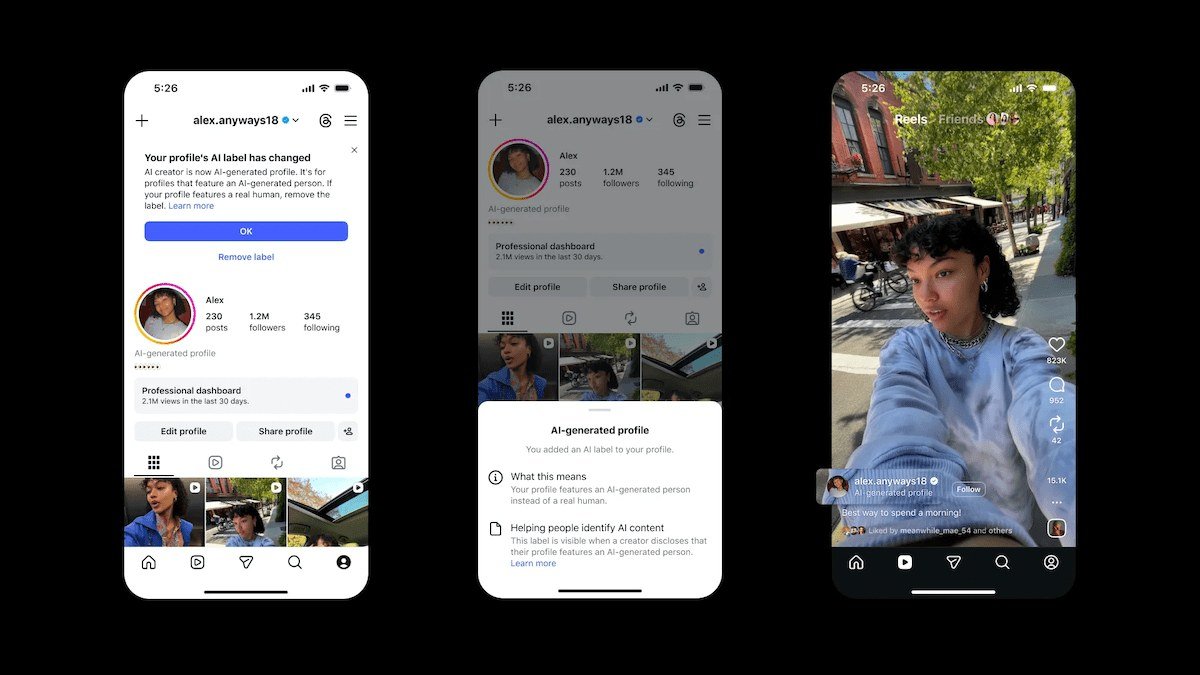
Instagram draws a line around the bots
Instagram has decided that AI accounts pretending to be human should stop enjoying a free ride. The platform is now limiting how far undisclosed AI profiles can travel across feeds, recommendations, and the discovery surfaces that turn an unknown account into a following. The move lands as frustration with AI influencers has been building for months, and it signals that the company is done treating synthetic personas as just another kind of creator.
The mechanism here matters more than the announcement. Instagram isn’t banning AI profiles outright. It’s throttling their reach when they fail to say what they are. An account that openly presents itself as AI-generated can keep operating. An account that dresses up as a real person, racks up followers, and never admits it was built by a model will find its posts surfacing to fewer people. Disclosure becomes the price of distribution.
Why the backlash reached a boiling point
AI influencers aren’t new, and for a while they were a novelty. Now they’re a nuisance to a growing share of users who feel they can no longer tell whether the face in their feed belongs to a person or a rendering. That erosion of trust is the real problem Instagram is responding to. When enough people suspect that a chunk of what they scroll past is fake, they start doubting everything, including the human creators who make the platform worth opening.
There’s a commercial edge to the frustration too. Human creators compete for the same attention, the same brand deals, and the same slot in someone’s morning scroll. An AI persona that never sleeps, never ages, and never asks for a day off is a strange kind of rival. When those personas hide their nature, they don’t just compete unfairly. They quietly rewrite what an audience thinks it’s looking at. Instagram limiting their reach is, in part, a concession to the people who actually live on the platform and were tired of being outrun by software.
Disclosure is the hinge the whole policy turns on. Label yourself and you keep your audience. Stay silent and the algorithm stops working for you. That framing is smart because it doesn’t demand that Instagram catch every synthetic account, an arms race no platform has ever won cleanly. It shifts the incentive instead. If honesty is rewarded with reach and concealment is punished with obscurity, a lot of borderline operators will choose the label on their own.
The harder question of enforcement
Detection is where policies like this usually strain. Spotting an AI-generated image is getting harder every quarter, and spotting an AI-run persona built from a mix of generated content and human management is harder still. Instagram will have to decide how it identifies the profiles it wants to limit, and how it handles the accounts that sit in the gray zone between clearly human and clearly synthetic. A creator who uses AI tools to touch up photos is not the same as a fully fabricated influencer, and any enforcement system has to tell those apart without flattening everyone in between.
The reach penalty is a clever middle path precisely because it sidesteps the messiest part of that problem. Instead of ruling on identity in absolute terms, Instagram gets to apply a graded consequence. Reduce distribution, watch behavior, adjust. It’s a softer instrument than a ban, and softer instruments tend to survive contact with edge cases better. The risk is the opposite one, that a quiet throttle is easy to under-enforce and hard for outsiders to audit. Users won’t see the posts that never reached them, so it’s tough to know how aggressively the limits are being applied.
What Instagram is really testing is whether transparency can be engineered into the incentives rather than begged for. Voluntary disclosure has failed across most of the internet because honesty carries a cost and concealment carries a benefit. Flip that equation, and behavior might actually change. Whether it changes enough to rebuild the trust that AI influencers chipped away at is the open question.
Watch what happens to the accounts that get caught in the middle, and watch whether other platforms follow. If limiting reach for undisclosed AI profiles becomes the industry default, the era of the anonymous synthetic influencer may turn out to have been short. If enforcement stays quiet and inconsistent, the labels will mean less than the announcement suggests. The next few months of how Instagram actually applies this will tell us which one we’re getting.
For more coverage of AI on social platforms, visit Mylistingo.
Source: Original Article
The Netherlands, for internationals
One email a week: the week's news for internationals in the Netherlands, new practical guides and what changed in the cities. No spam, unsubscribe any time.