Microsoft Unveils Majorana 1: The World’s First Topological Quantum Processor
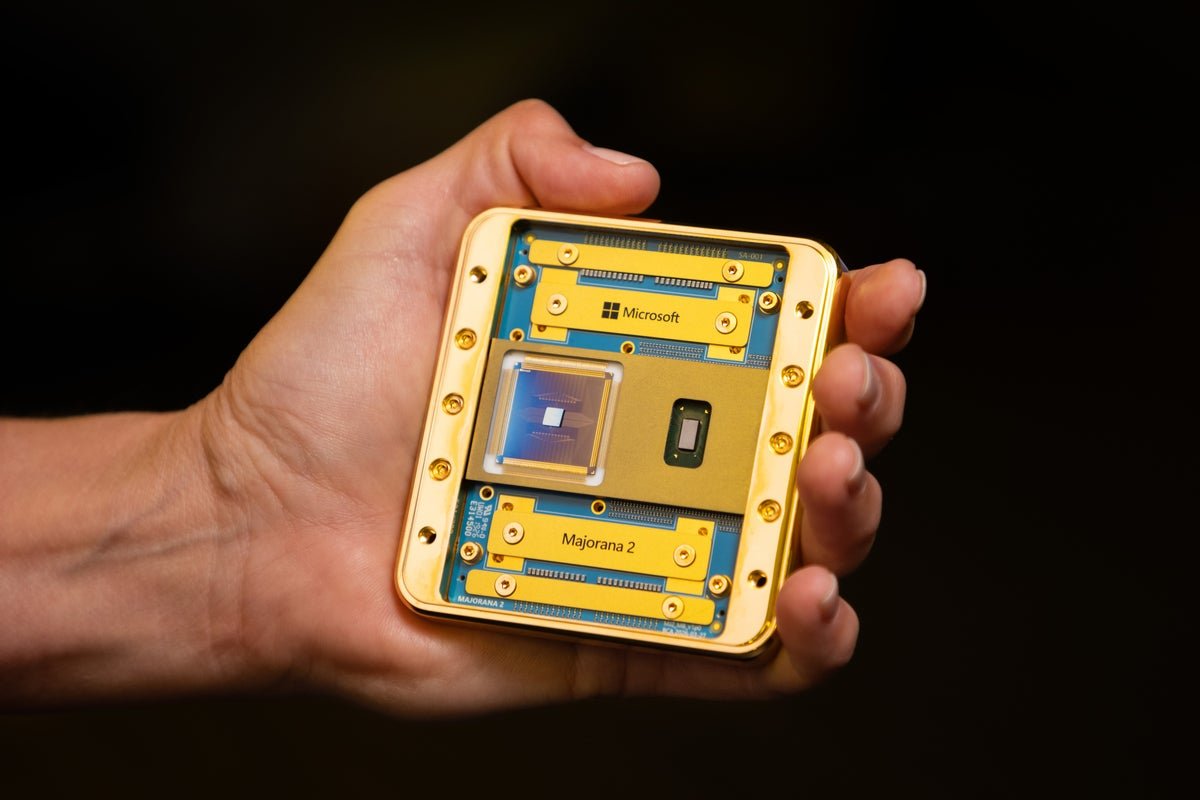
Microsoft has taken a monumental leap in quantum computing with the unveiling of Majorana 1, the world’s first quantum processor built on topological qubits. This breakthrough, years in the making, leverages exotic Majorana zero modes to create qubits that are inherently more stable and less error-prone than conventional superconducting or trapped-ion approaches.
What Makes Majorana Different
Traditional quantum computers struggle with decoherence — the tendency of qubits to lose their quantum state due to environmental noise. Error correction consumes enormous overhead, with some estimates suggesting thousands of physical qubits are needed to produce a single reliable logical qubit.
Microsoft’s topological approach flips this paradigm. By encoding quantum information in the collective behavior of Majorana quasiparticles, the qubits are protected by topology itself. The information is stored non-locally — it’s not in any single particle but in the braiding pattern of particles, making it extraordinarily resistant to local disturbances.
The Road to a Million Qubits
Microsoft claims the Majorana architecture can scale to one million qubits on a single chip, a threshold where quantum computers could solve problems that are fundamentally impossible for classical machines — simulating complex chemical reactions for drug discovery, cracking materials science challenges, and optimizing global supply chains.
The chip is fabricated using a combination of indium arsenide (a semiconductor) and aluminium (a superconductor), cooled to near absolute zero. When precisely tuned, the interface between these materials hosts the elusive Majorana zero modes that form the computational building blocks.
Industry Implications
If Microsoft delivers on its roadmap, the implications for industries in the Netherlands and across Europe are profound. Dutch quantum research hubs like QuTech in Delft and the University of Amsterdam’s Quantum Gases & Quantum Information group are closely watching this development. European quantum startups, backed by the EU’s €1 billion Quantum Flagship programme, could leverage Microsoft’s platform to accelerate their own applications in cryptography, logistics, and climate modeling.
The Majorana 1 isn’t commercially available yet — Microsoft is opening access to select research partners through Azure Quantum later this year. But the era of fault-tolerant quantum computing has moved from theoretical physics to engineering reality.
Stay tuned to MyListingo for more updates on quantum computing and European tech innovation.
The Netherlands, for internationals
One email a week: the week's news for internationals in the Netherlands, new practical guides and what changed in the cities. No spam, unsubscribe any time.