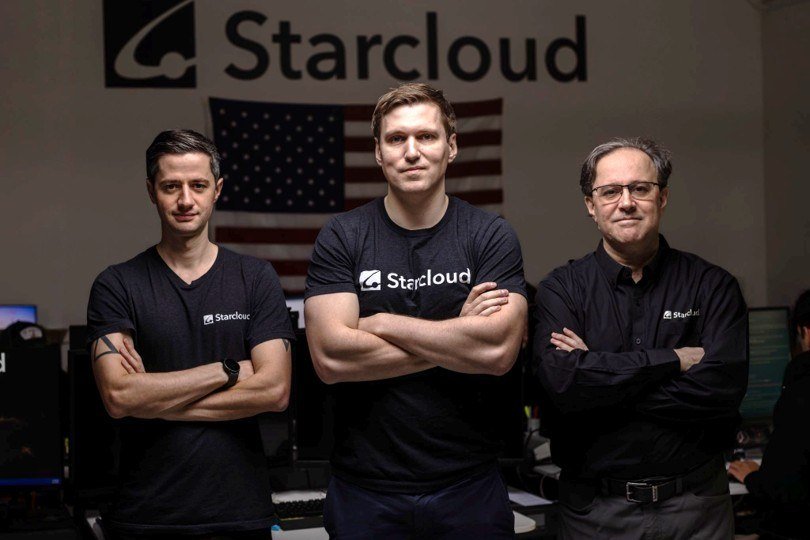
Starcloud just raised $250 million to build data centers that don’t sit on Earth at all. They orbit it. The pitch sounds like science fiction until you look at where the money is going and why, and the timing tells you something bigger is happening: the company framed the raise around a warning that launch options are drying up. Read between the lines and you get the real story. A scramble for access to space is about to begin, and the compute industry has decided it wants a seat.
Compute leaves the ground
For most of the internet’s history, a data center was a building. A big one, humming in a business park somewhere near cheap power and cold air, packed with servers and the plumbing needed to keep them from cooking themselves. Starcloud’s bet is that the building is the problem. Put the racks in orbit and the constraints that define terrestrial computing start to fall away, at least in theory.
Sunlight in orbit is constant and unfiltered by weather or nightfall. Heat can radiate straight into the vacuum instead of being pumped through water and chillers. There is no zoning board, no neighborhood fight over noise, no grid interconnection queue stretching out for years. Those are the arguments that make orbital compute worth a quarter of a billion dollars to investors, and they explain why a company would take on the enormous engineering risk of running servers where no technician can walk over and swap a failed drive.
The counterargument is just as obvious. Space is brutally hard. Radiation degrades hardware, repairs are impossible in the ordinary sense, and getting anything up there is expensive and getting more complicated by the month. Which is exactly the thread Starcloud pulled on when it tied this raise to a single uncomfortable fact about the launch market.
The bottleneck nobody solved
Launch options are drying up. That phrase, sitting inside the announcement of a $250 million round, is the part worth dwelling on. You don’t build a company that depends on getting mass to orbit unless you’re confident you can actually get there. Starcloud is signaling the opposite anxiety. The rockets, the slots, the ride-share capacity that a project like this needs are becoming scarce enough that securing them is now a strategic problem rather than a line item.
That scarcity reframes the whole venture. If you believe orbital data centers are coming, and if you believe launch capacity is tightening, then the winners won’t necessarily be whoever has the cleverest hardware. They’ll be whoever locked in the rides first. Capital, in that world, is a way to buy a place in line before the line gets impossible.
It’s a familiar pattern from earlier technology booms. When a scarce input suddenly becomes the thing standing between you and a market, the money floods toward controlling that input. Fiber routes, radio spectrum, undersea cable landing rights, and lately the GPUs that power AI have all followed this arc. Launch capacity may be the next name on that list, and Starcloud is moving as if it already is.
A land grab above the atmosphere
Here’s what makes this more than one startup’s gamble. If Starcloud is right that space is where high-density compute is heading, and right that the way up is narrowing, then a contest is coming for something that has no fixed supply on the timeline that matters. Every company with ambitions in orbit, whether it’s building satellites, constellations, or now data centers, is drawing from the same limited pool of launches.
That sets up a genuine fight. Not a marketing rivalry over who has the better spec sheet, but a real competition for physical access to space itself. The $250 million gives Starcloud the resources to compete in it early, while the field is still forming and before the price of admission climbs to whatever a saturated launch market will demand.
Whether orbital data centers ever become a serious pillar of the compute industry is still an open question, and skepticism is fair. Plenty of elegant space concepts have never survived contact with economics. What’s harder to dismiss is the strategic read underneath the raise: that the ground is filling up, that the sky is the next frontier for heavy compute, and that the door to it is starting to close.
What to watch next
The number to keep an eye on isn’t the size of the next funding round. It’s launch commitments. If Starcloud and its rivals start announcing locked-in capacity, that will tell you the fight the company predicted has already started in earnest. And if launch access keeps tightening the way this raise implies, the companies still treating space as a someday problem may find that someday arrived without them.
Starcloud has planted its flag. Now the rest of the industry has to decide whether orbit is a curiosity or the next address for the world’s servers, and how much they’re willing to pay to get there first.
For more coverage of orbital data centers and the race for space access, visit Mylistingo.
Source: Original Article
The Netherlands, for internationals
One email a week: the week's news for internationals in the Netherlands, new practical guides and what changed in the cities. No spam, unsubscribe any time.