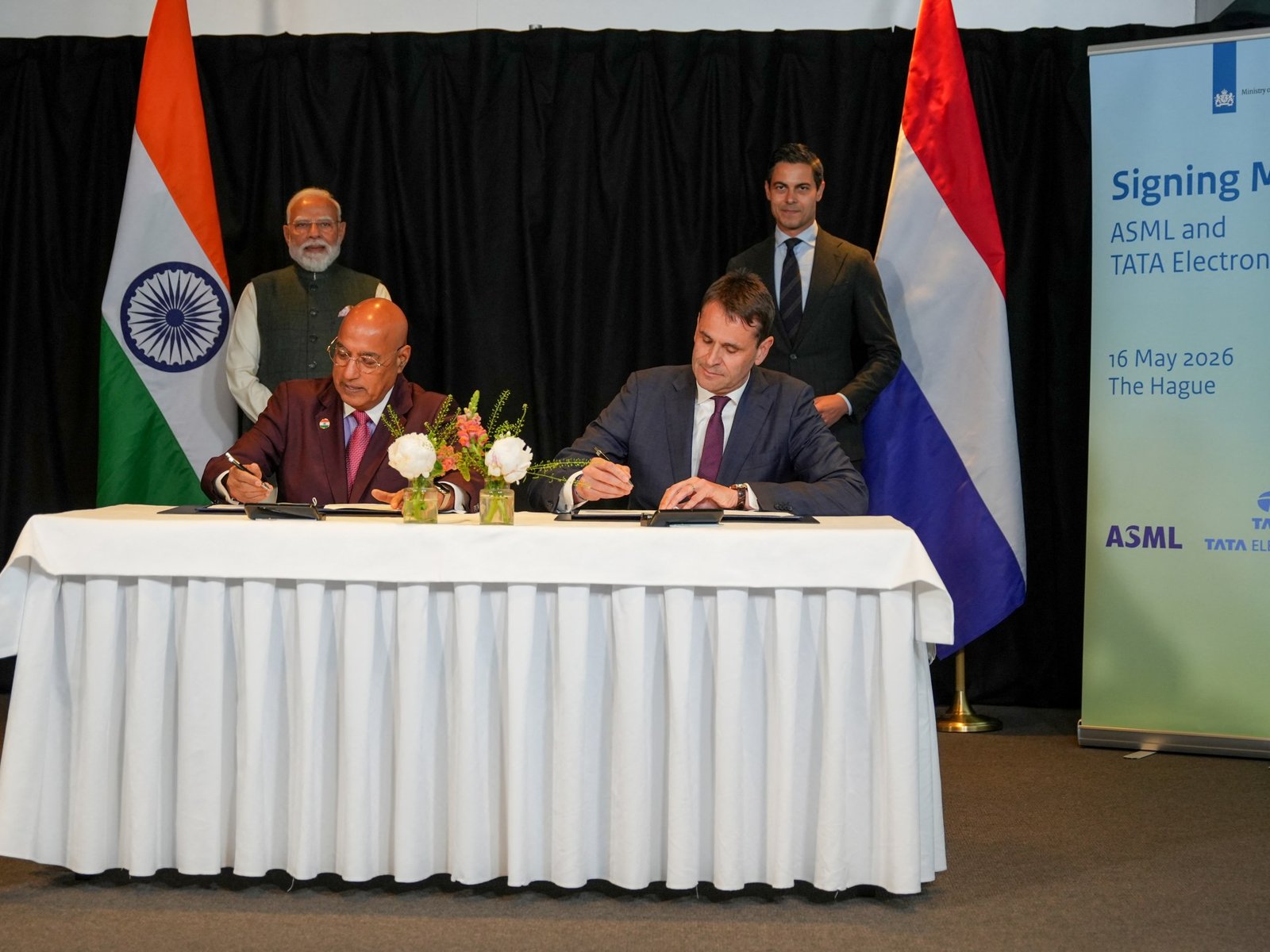
In May 2026, Tata Electronics signed a landmark agreement with Dutch semiconductor equipment giant ASML, marking one of the most significant steps in India’s ambitious push to become a global chip manufacturing hub. The deal, overseen by Indian Prime Minister Narendra Modi during his visit to the Netherlands, signals India’s determination to break into a sector dominated by just a handful of countries: Taiwan, South Korea, the United States, and China.
Why the Tata-ASML Deal Matters
ASML, headquartered in Veldhoven near Eindhoven, is the world’s only manufacturer of extreme ultraviolet (EUV) lithography machines — the multi-million-euro equipment essential for producing the most advanced semiconductors. Without ASML’s technology, manufacturing cutting-edge chips below 7 nanometers is essentially impossible. For India, securing access to ASML’s equipment is a critical piece of its semiconductor strategy, which includes billions in government subsidies under the India Semiconductor Mission.
Tata’s entry into semiconductor fabrication represents a strategic pivot for the $150 billion conglomerate, which has traditionally focused on steel, automobiles, and IT services. The company is building a massive fab facility in Dholera, Gujarat, with technology partnership from Taiwan’s Powerchip Semiconductor Manufacturing Corporation (PSMC). The ASML deal ensures that Tata’s facility will have access to the lithography tools needed for advanced node production.
The Netherlands: Europe’s Quiet Chip Superpower
While much of the global semiconductor conversation focuses on Taiwan and the US-China rivalry, the Netherlands has quietly positioned itself as an indispensable player. ASML alone gives the Dutch an outsized influence in global technology supply chains. The company’s market capitalization exceeds €300 billion, making it Europe’s most valuable technology firm.
The Dutch government has increasingly recognized the strategic importance of its semiconductor sector. In 2025, the Netherlands took the unprecedented step of blocking a US company’s attempted takeover of Solvinity, a Dutch cloud and digital identity firm. Earlier, the government seized control of Nexperia, a Chinese-owned chip manufacturer based in Nijmegen, citing national security concerns. These moves reflect a broader European push for technological sovereignty.
Global Implications
The Tata-ASML partnership has geopolitical dimensions beyond business. For the United States and its allies, strengthening India’s semiconductor capabilities serves as a counterweight to Chinese dominance in electronics manufacturing. India offers a large, skilled workforce and a democratic alternative in the global chip supply chain. For ASML, the Indian market represents a significant growth opportunity as the company faces restrictions on sales to China due to US-led export controls.
However, challenges remain. Building a semiconductor ecosystem requires more than equipment — it needs specialized talent, reliable water and power infrastructure, and a network of suppliers for chemicals, gases, and materials. India is investing heavily in all these areas, but the learning curve is steep.
The Tata-ASML deal is more than a commercial transaction. It represents a realignment of global technology partnerships at a time when semiconductor supply chains are being fundamentally reshaped by geopolitics, national security concerns, and the relentless demand for computing power driven by artificial intelligence.
Image credit: AFP via Al Jazeera
The Netherlands, for internationals
One email a week: the week's news for internationals in the Netherlands, new practical guides and what changed in the cities. No spam, unsubscribe any time.