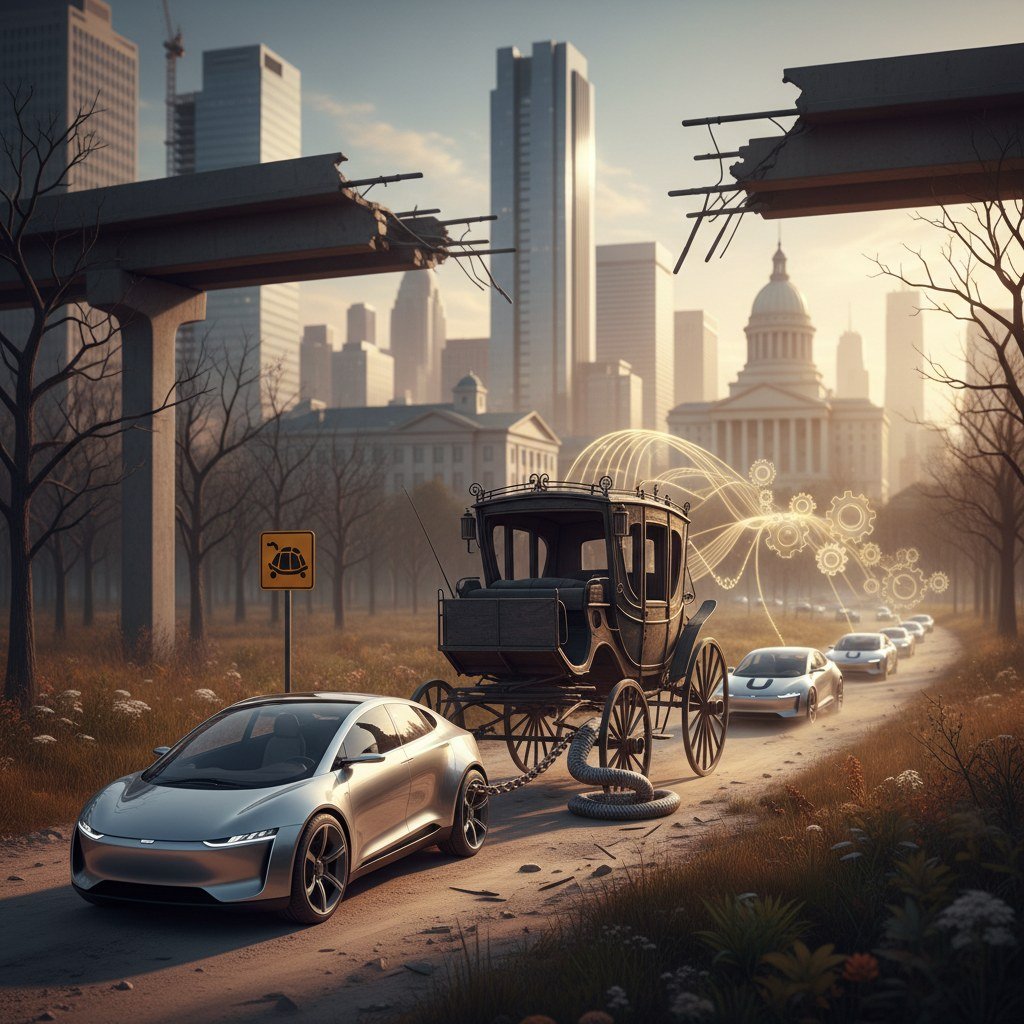
Ten years ago, Travis Kalanick called autonomous vehicles an existential threat to Uber. Today, the company has found a way to embrace driverless technology without building it. Instead of competing with robotaxi developers, Uber wants to become the central marketplace where riders can hail a human-driven car or a robot. Now it is pushing that vision into law.
Documents obtained by WIRED show Uber lobbyists are pressing lawmakers in New Jersey and Washington, DC to adopt rules that require autonomous vehicle services to operate alongside human drivers. The company calls this approach hybrid networks. In practice, the strategy could slow the adoption of fully driverless ride-hailing and force companies like Waymo and Tesla to rely on Uber’s app to reach customers.
The New Jersey proposal that limits robotaxis
In New Jersey, an Uber representative circulated legislative language that would require any platform offering driverless ride-hailing to have human drivers handle 85 percent of its rides for three years. The proposal would effectively prevent self-driving vehicle developers from launching their own standalone apps in the state. It would compel them to partner with an existing ride-hail company, most likely Uber, to operate there.
The language was pitched to state senator Andrew Zwicker, who is sponsoring a broader bill to regulate autonomous vehicles on public roads. The restrictive proposal is not currently part of that bill, which could come up for a vote this fall. The New Jersey bill would also limit Tesla’s robotaxi ambitions by requiring autonomous vehicles to use multiple sensors, not just cameras, and to retain steering wheels and brake pedals for emergency use. Purpose-built robotaxis like those from Zoox lack those controls.
DC lobbying and industry pushback
In Washington, DC, Uber lobbyist LáVita Gardner thanked a city council staffer for committing to allow ride-hail companies like Uber to participate in the district’s autonomous vehicle program. The email was sent before a bill introduced by council member Charles Allen in April. Gardner wrote that hybrid networks would be critical for a smooth transition that supports technology and human drivers. The bill has not yet been voted on.
Uber spokesperson Noah Edwardsen told WIRED that the company supports autonomous vehicle expansion but says proposals from the AV industry have been largely unworkable because they fail to address worker concerns or try to lock out competitors. He said the New Jersey proposal was a compromise given labor union opposition. Waymo spokesperson Ethan Teicher said the company does not support efforts to limit AVs to specific types of networks.
Waymo and Uber are business partners in Atlanta and Austin, where Uber offers exclusive access to Waymo rides. But tensions have surfaced. Uber’s CTO posted a video of a Waymo vehicle nearly hitting a bus. Waymo ended a limited pilot partnership with Uber in Phoenix last month. Waymo currently leads the US robotaxi race, providing 500,000 rides per week in eleven metros and planning to expand to London.
Uber’s lobbying marks a shift from its earlier approach. The company once resisted autonomous vehicle regulation while trying to build its own self-driving technology. In 2016, it moved testing cars from California to Arizona after permit disputes. Two years later, Arizona banned Uber’s self-driving cars after a fatal crash. Uber shut down its autonomous vehicle program in 2020. Uber president Andrew Macdonald acknowledged the irony in a LinkedIn post, saying the company did not engage enough with societal implications.
Uber’s push for hybrid networks is grounded in a policy paper published in May. The company argues that a phased transition protects riders, drivers, and cities. In prepared testimony for the DC City Council, Uber director Harry Hartfield said one autonomous vehicle now performs roughly the work of four drivers in California, and driver earnings have declined. The company wants to ensure that human drivers retain a role as the technology scales.
The broader regulatory landscape remains uncertain. Maryland and New York failed to pass autonomous vehicle regulations this year. Uber sees its hybrid network proposal as a way to break the gridlock. Meanwhile, robotaxi developers argue that forcing them onto Uber’s platform will reduce competition and slow innovation. The outcome of these legislative battles will shape how quickly driverless cars become a common sight on American roads. For a look at how other industries are navigating technology transitions, check our AI in education coverage.
The Broader Implications for Autonomous Vehicle Policy
The Uber lobbying campaign represents a coordinated industry effort to shape autonomous vehicle regulation at both state and federal levels. With autonomous vehicle legislation stalled in Congress, individual states have become the primary battleground for AV policy. California, Arizona, and Texas have taken markedly different approaches, creating a regulatory patchwork that industry advocates argue stifles innovation and delays life-saving technology deployment.
The debate centers on a fundamental question: should autonomous vehicles be held to a higher safety standard than human drivers, or merely to an equivalent one? Industry advocates argue that requiring autonomous vehicles to be safer than the average human driver creates an impossibly high bar, given that human drivers cause over 40,000 fatalities annually in the United States alone. Safety advocates counter that the promise of autonomous technology demands a higher standard precisely because lives are at stake.
Related: Edge AI Revolution: How On-Device Intelligence Is Reshaping the Tech Industry in 2026
The Netherlands, for internationals
One email a week: the week's news for internationals in the Netherlands, new practical guides and what changed in the cities. No spam, unsubscribe any time.