


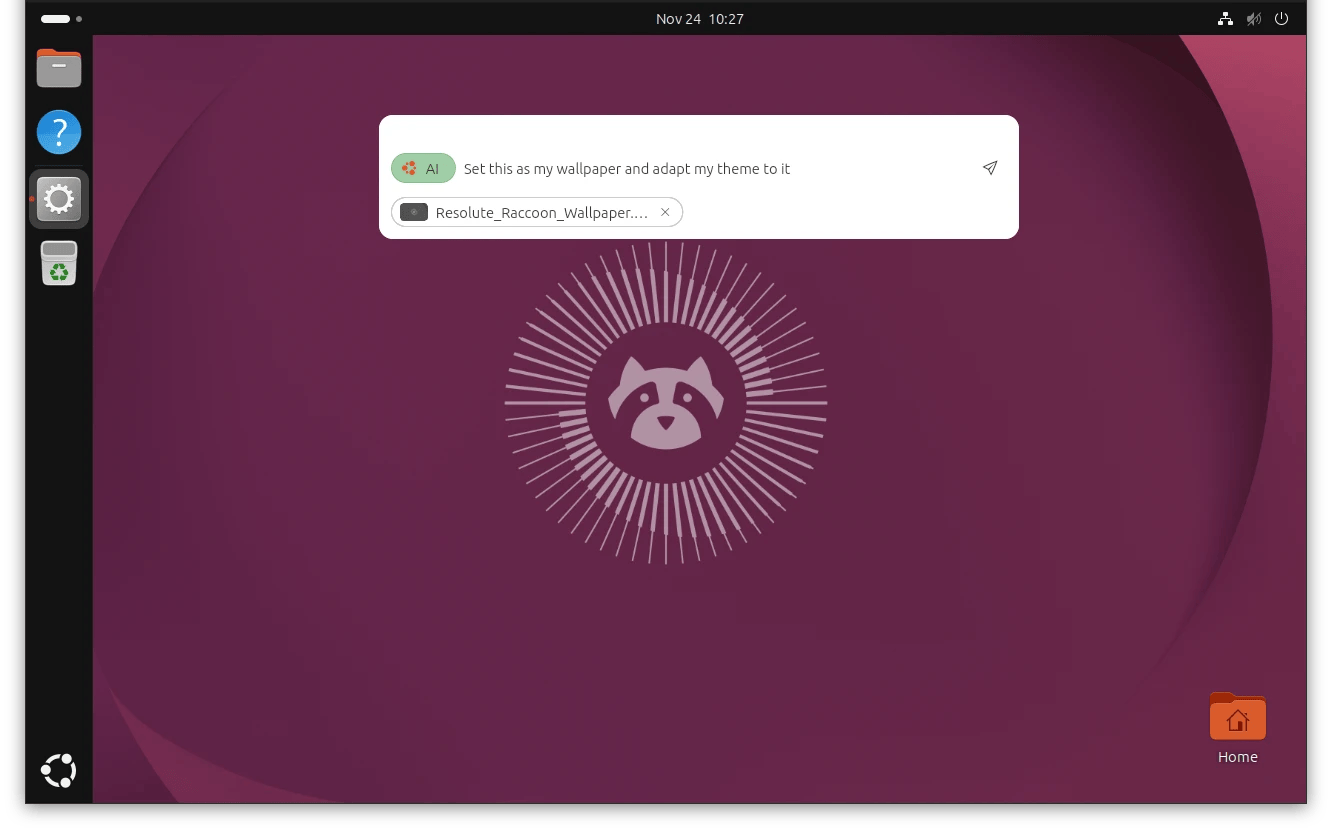
Canonical is sketching out an AI launcher for the Ubuntu desktop, and a first preview image is now public. Didier Roche, who works on the Linux distribution, shared a screenshot of the feature this week. The company is aiming to land something usable in January.
The design looks like a quick launcher at first glance. You type, and it finds files or opens applications without leaving the keyboard. Roche says the ambition runs past replacing the app grid. He describes the goal as “a unified, keyboard and speech-friendly entry point that bridges your apps, your local context, and smart assistance only when you explicitly ask for it.”
That phrase about explicit requests carries weight. Canonical has spent months arguing about how much intelligence belongs inside an operating system. The team has discussed explicit versus implicit AI features on its community forum and at recent Ubuntu Summit sessions. The launcher is their answer to a messy alternative, which would scatter small AI widgets across panels and menus.
The mockup behind the screenshot is called warty-prototype. Canonical pushed it to the Snap Store last month, and it spread quickly through Linux blogs and social feeds. Roche is direct about what that build actually was. He calls it “just an automated UI simulation” built to test ideas and start design conversations.
That candor matters, because a demo and a daily tool are different products. Roche admits that turning the vision into something people can rely on is “a significant engineering task.”
The launcher would not be Canonical’s first AI feature. The company has already introduced tools under the Myna name, and it has been unusually public about the tradeoffs. Its stated position favors assistance that waits for a request rather than one that watches everything and intervenes on its own.
Privacy is the obvious reason. A launcher that reads local context can see file names, recent documents, and app usage. Users tend to accept that access when the benefit is concrete and the trigger is deliberate. They push back when background collection arrives without a clear switch.
Ubuntu also has a specific audience to satisfy. Its users include system administrators, developers, and privacy-conscious desktop users who abandoned other platforms over telemetry. A launcher that feels like an assistant bolted onto a desktop will draw complaints. One that stays quiet until summoned could win them over.
The competitive picture is clear enough. Windows 11 has pushed search and AI deeper into the shell. macOS has Alfred and Spotlight extensions doing similar work. Linux has no default equivalent, which leaves room for Canonical to define one.
Nothing is final. The screenshot shows a direction, not a release. Canonical has invited feedback, and the January target could move. That matches how this company usually ships, in public and slowly. The same pattern showed up with Samsung’s in-progress photo tooling, which also surfaced as unreleased code before any announcement.
Source: The Verge — Ubuntu is working on an AI launcher for its Linux desktop and Canonical Discourse — Beyond a launcher
The Netherlands, for internationals
One email a week: the week's news for internationals in the Netherlands, new practical guides and what changed in the cities. No spam, unsubscribe any time.