The World Economic Forum named 100 companies to its Technology Pioneers community this month, and the 2026 cohort reads like a blueprint of where the next wave of infrastructure is actually being built. Quantum cryptography. Photonic computing. Autonomous agent platforms. In-orbit satellite servicing. These are not consumer products; they are foundations that others will build on for the next decade. The list confirms something that has been building quietly: the companies creating the physical and software scaffolding for AI are now attracting the same level of recognition once reserved for the AI model builders themselves.
Quantum earns its commercial debut
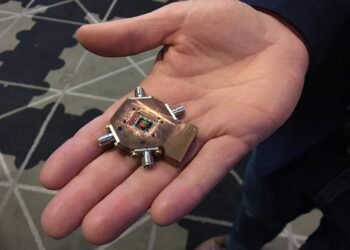
Several quantum technology companies made this year’s cohort, spanning photonic quantum computing, quantum networking, and post-quantum cybersecurity. Among them is Denmark-based Sparrow Quantum, which develops deterministic single-photon sources for scalable optical quantum technologies. The company’s inclusion reflects a shift in how the quantum sector is being evaluated: not by whether full-scale fault-tolerant computers exist, but by whether specific components are mature enough for commercial deployment. Sparrow’s photon sources are one such component.
QuSecure, which focuses on post-quantum cryptography, also received the Technology Pioneer designation. The timing is commercially significant. The US National Institute of Standards and Technology finalized its first post-quantum cryptography standards in 2024, and organizations across financial services, defense, and critical infrastructure are now under real pressure to upgrade systems before quantum computers become powerful enough to break current encryption. Companies selling that upgrade path are in a commercially useful position right now, ahead of the threat rather than reactive to it.
US Department of Energy national quantum research centers separately announced progress this year on error correction, one of the core unsolved engineering problems in building practical quantum computers. Quantum computing has accumulated more false starts than almost any technology category over the past decade. But the combination of government investment, private capital, and concrete engineering milestones is producing a different kind of credibility than the sector has had before.
Building the scaffolding for autonomous AI
Beyond quantum, the dominant theme across the 2026 WEF cohort is infrastructure for autonomous AI systems. The Forum’s own press release described this year’s class as “building the software and physical infrastructure needed to power autonomous AI systems at scale.” That framing reflects where the enterprise AI market actually is: past the stage of asking whether AI works, now focused on running it reliably at the scale of large organizations.
Foxconn’s MoMClaw system, launched in June 2026 on Nvidia’s FOX blueprint, links machine sensors across an entire manufacturing floor to hundreds of coordinating AI agents. It is not a single AI tool; it is closer to an operating system for AI at industrial scale. The infrastructure companies making systems like that possible — the orchestration platforms, the data pipelines, the monitoring and audit layers — are the ones appearing most consistently in this year’s Pioneer cohort.
Physical technology beyond software
Not every company on the list is building AI infrastructure. Several are tackling material and energy challenges with approaches that have only recently reached commercial viability. Sodium-ion batteries, which use abundant materials rather than lithium, are advancing as a serious alternative for grid storage and affordable electric vehicles. The underlying chemistry has been understood for years; what has changed is manufacturing efficiency. Several companies are now seeing cost curves that make sodium-ion cells competitive with lithium-iron-phosphate in specific applications, particularly stationary grid storage where energy density matters less than cost per kilowatt-hour.
On the computing side, scientists recently demonstrated a chip capable of generating, steering, and reading light-based information in a single device, a development with direct implications for photonic computing. The technology remains early, but its potential for ultra-fast, energy-efficient data processing has attracted attention from both research institutions and semiconductor companies increasingly focused on power consumption as AI workloads drive data center energy demand higher.
Read together, the 2026 Technology Pioneers list suggests the technology sector’s center of gravity is shifting from software to the physical systems that run it. The companies on that list are well past the concept stage. What the next 12 months will reveal is how quickly they can scale. For more coverage of emerging technologies and future trends, visit Mylistingo.