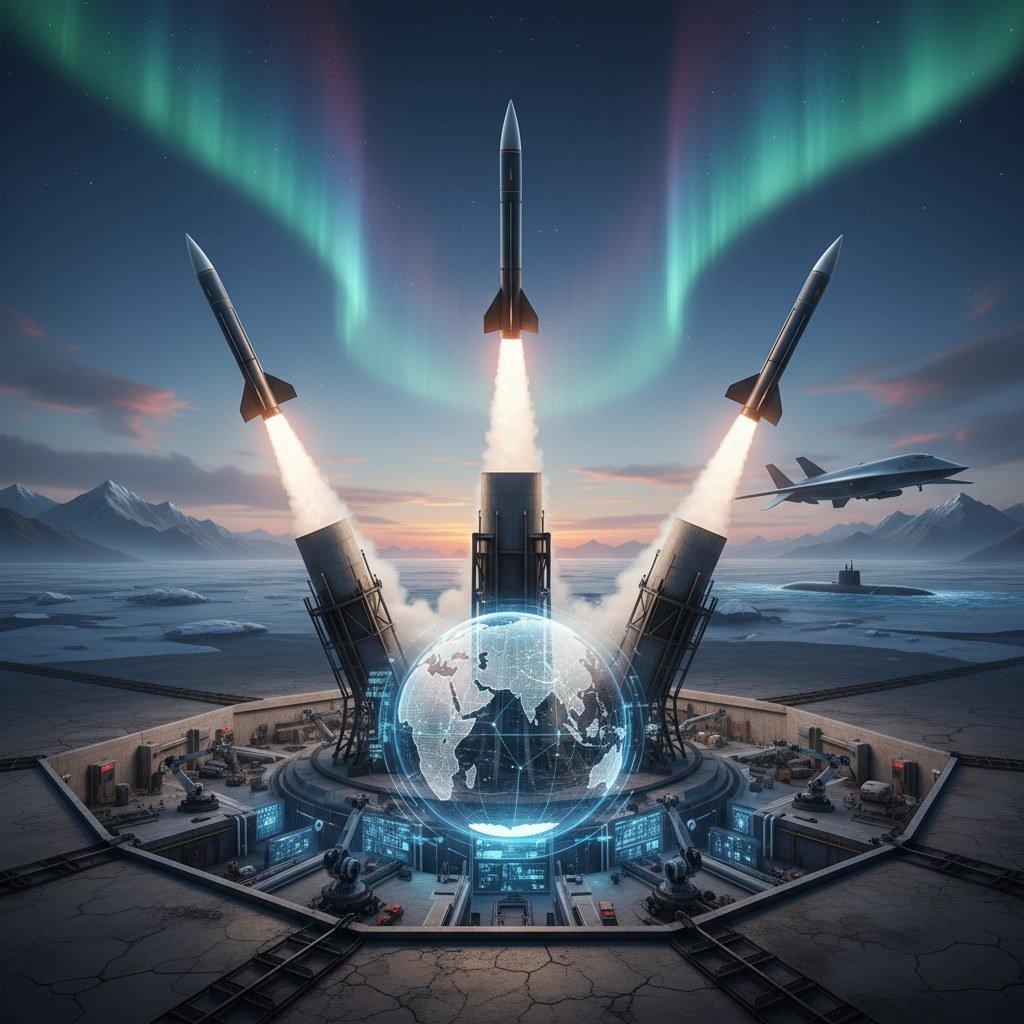
The global nuclear landscape is undergoing its most significant transformation since the end of the Cold War. In 2026, the world’s nine nuclear-armed states are collectively spending more than $100 billion annually on modernizing and expanding their arsenals, raising profound questions about international security, arms control, and the future of strategic deterrence.
The Modernization Race: Who Is Building What
The United States is in the midst of a $1.5 trillion, three-decade nuclear modernization program that encompasses every leg of its nuclear triad. The Pentagon is replacing its aging Minuteman III intercontinental ballistic missiles with the new Sentinel system, building new Columbia-class submarines, and developing the B-21 Raider stealth bomber to replace the B-2 and B-52 fleets. These programs are designed to ensure the credibility of America’s nuclear deterrent through the 2070s and beyond.
Russia, meanwhile, has been aggressively modernizing its nuclear forces at a pace not seen since the Soviet era. Moscow has deployed the Avangard hypersonic glide vehicle, which can maneuver at speeds exceeding Mach 20 and evade existing missile defense systems. Russia is also fielding the Sarmat heavy ICBM, the Poseidon nuclear-powered underwater drone, and the Burevestnik nuclear-powered cruise missile — a diverse portfolio of delivery systems designed to overwhelm any missile defense architecture.
China is expanding its nuclear arsenal faster than any other nation. According to Pentagon estimates, Beijing has more than doubled its nuclear warhead stockpile in the past five years, from approximately 350 warheads in 2021 to an estimated 800 in 2026. China is also constructing hundreds of new missile silos in the Gobi Desert and developing air-launched ballistic missiles, road-mobile ICBMs, and nuclear-capable hypersonic weapons. Chinese strategic analysts argue that these developments are a necessary response to American and allied military advancements in the Indo-Pacific region.
The Erosion of Arms Control Architecture
The nuclear modernization race is unfolding against a backdrop of crumbling arms control frameworks. The New START treaty, which limited US and Russian strategic nuclear forces to 1,550 deployed warheads each, is set to expire in February 2026. While Russia announced in 2023 that it was suspending participation in the treaty, both Washington and Moscow have continued to abide by its central limits — for now. With no successor treaty under active negotiation, 2027 will mark the first year since 1972 in which there are no legally binding limits on the world’s two largest nuclear arsenals.
The Intermediate-Range Nuclear Forces (INF) Treaty collapsed in 2019, and the Open Skies Treaty, which allowed unarmed surveillance flights over member states, was abandoned in 2021. The Comprehensive Nuclear-Test-Ban Treaty (CTBT) has still not entered into force, though no nation has conducted an explosive nuclear test since 2017. However, concerns are growing that Russia or China could resume testing as part of their modernization programs, which would trigger a cascade of responses from other nuclear powers.
North Korea continues to expand its nuclear and missile capabilities, conducting regular tests of both short-range tactical systems and intercontinental ballistic missiles capable of reaching the United States. Pyongyang is estimated to have assembled 50-70 warheads and continues to enrich uranium at multiple clandestine sites. Diplomatic efforts to denuclearize the Korean Peninsula remain stalled.
Emerging Technologies and Strategic Stability
New technologies are introducing unprecedented instability into nuclear deterrence calculations. Hypersonic weapons, capable of traveling at speeds above Mach 5 with unpredictable trajectories, compress decision-making timelines and increase the risk of miscalculation. Both the United States and Russia have deployed hypersonic systems, and China, India, and France are developing their own programs.
Artificial intelligence is being integrated into command-and-control systems, early warning networks, and targeting algorithms. While AI offers potential benefits in threat assessment and decision support, it also raises alarming possibilities. An AI-powered early warning system that incorrectly identifies a routine satellite launch as an incoming missile attack could trigger a catastrophic response. The Pentagon has stated it would never delegate nuclear launch authority to an AI, but the integration of AI into nuclear command systems creates pathways for rapid escalation that human operators may not be able to control.
Space-based missile defense systems, anti-satellite weapons, and cyber attacks on nuclear command infrastructure add further layers of complexity. China and Russia have both demonstrated the ability to destroy satellites in orbit, and the United States is developing a next-generation space-based sensor constellation for missile tracking. The weaponization of space is eroding the stability that satellite-based early warning systems have historically provided.
Regional Nuclear Dynamics: India, Pakistan, and Beyond
South Asia remains one of the most volatile nuclear flashpoints. India and Pakistan, both nuclear-armed since 1998, continue to modernize their arsenals and develop new delivery systems. India is expanding its nuclear triad with nuclear-powered submarines and long-range ballistic missiles, while Pakistan has developed tactical nuclear weapons designed to counter India’s conventional military superiority. The risk of escalation from a conventional conflict to a nuclear exchange in this region is higher than many analysts acknowledge.
The United Kingdom began construction of its new Dreadnought-class submarines to replace the Vanguard class, while France continues to modernize its sea-based and air-launched nuclear forces. Israel maintains its policy of deliberate ambiguity but is widely believed to possess an arsenal of 90-100 nuclear warheads, with modern delivery systems including air-launched cruise missiles and potentially submarine-based capabilities.
Arms Control in a Multipolar Nuclear World
Experts argue that the international community must adapt arms control frameworks to a multipolar nuclear world that includes China, India, Pakistan, and North Korea alongside the traditional US-Russia bilateral framework. Proposals include a fissile material cutoff treaty that would ban the production of weapons-grade uranium and plutonium, expanded transparency measures and data exchanges, and crisis communication channels between all nuclear-armed states.
The Nuclear Non-Proliferation Treaty (NPT), which remains the cornerstone of the global non-proliferation regime, faces increasing strain as non-nuclear-weapon states express frustration at the perceived lack of progress toward disarmament by the five recognized nuclear powers. The 2026 NPT Review Conference will be a critical moment for the treaty’s future relevance.
As nuclear arsenals grow and diversify, and as new technologies complicate the strategic calculus, the risk of nuclear use — whether by accident, miscalculation, or design — is arguably higher than at any point since the end of the Cold War. The modernization race of 2026 is not merely a continuation of historical patterns but a fundamentally new chapter in the nuclear age, one with unpredictable consequences for global security.
Related: The Geopolitics of the Arctic in 2026: How Melting Ice Is Reshaping Global Power Dynamics
Also read: Europe’s Digital Sovereignty Push in 2026: How the EU Is Reshaping Global Tech Regulation
The Netherlands, for internationals
One email a week: the week's news for internationals in the Netherlands, new practical guides and what changed in the cities. No spam, unsubscribe any time.