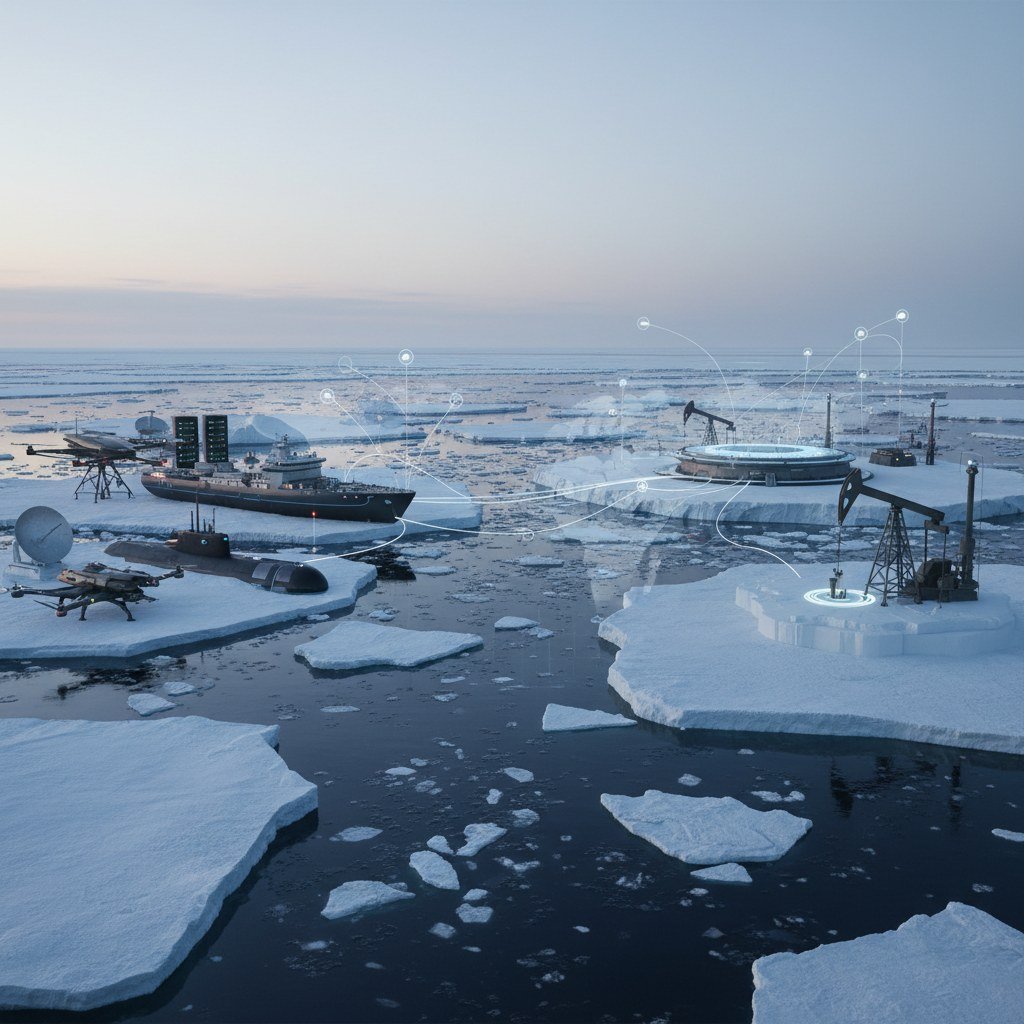
The Arctic is no longer a frozen frontier on the periphery of world politics. In 2026, accelerating ice melt driven by climate change has transformed the region into one of the most strategically contested arenas on the planet. What was once an inaccessible expanse of ice is now becoming a navigable sea, opening new shipping lanes, revealing untapped resource deposits, and triggering a race among global powers for influence, access, and control.
From the United States and Russia to China and NATO member states, nations are scrambling to assert their presence in the High North. The Arctic’s transformation is reshaping military postures, trade routes, energy security, and international law. This article examines the key players, the stakes, and what the geopolitical scramble for the Arctic means for the rest of the world in 2026.
The melting frontier: What is changing in the Arctic
The numbers are stark. Arctic sea ice extent in September 2026 reached its lowest level on record, with over 40 percent of the Arctic Ocean now ice-free during summer months. The Northwest Passage, a fabled sea route connecting the Atlantic and Pacific Oceans through Canada’s northern archipelago, is now navigable without icebreaker assistance for up to ten weeks per year. The Northern Sea Route along Russia’s coast is open for up to five months.
These changes are not gradual. Climate scientists at the National Snow and Ice Data Center report that the rate of ice loss has accelerated beyond most model projections, driven by feedback loops where darker open water absorbs more solar radiation, further warming the region. The implications for global shipping are enormous. The Northern Sea Route cuts the journey from Rotterdam to Shanghai by roughly 40 percent compared to the Suez Canal route, saving shipping companies millions of dollars in fuel and transit time. As global supply chains remain fragile in 2026, the Arctic shortcut offers a compelling alternative to chokepoint-dependent routes.
But the melting ice also reveals something else beneath the surface. The United States Geological Survey estimates that the Arctic holds 13 percent of the world’s undiscovered oil reserves and 30 percent of its undiscovered natural gas. Critical minerals essential for technology manufacturing, including rare earth elements used in batteries and electronics, are also believed to exist in significant quantities beneath the Arctic seabed.
The new great game: Key players in the Arctic
The Arctic scramble involves both traditional Arctic nations and ambitious newcomers, each with distinct strategic objectives.
Russia has the longest Arctic coastline of any nation, stretching over 24,000 kilometers. Moscow views the Arctic as both an economic lifeline and a strategic buffer zone. The Northern Sea Route is central to Russia’s economic strategy, with state-owned Rosatom operating a fleet of nuclear-powered icebreakers to keep the route open. In 2026, Russia has reopened several Soviet-era military bases along its Arctic coast, deployed advanced air defense systems, and conducted large-scale military exercises in the region. The Kremlin has also expanded its underwater surveillance capabilities, monitoring undersea cables and pipeline infrastructure that are vital to global communications and energy markets.
The United States, through its Arctic strategy update in 2025, has designated the region as a critical theater for national security. The US military has increased its presence in Alaska, deployed new ice-capable vessels, and expanded joint exercises with NATO allies in the Norwegian Sea and Baffin Bay. Washington’s primary concern is the militarization of the Arctic by Russia and the growing interest of China, which it views as a destabilizing influence on the regional order.
China declared itself a “near-Arctic state” in its 2018 Arctic policy white paper and has invested heavily in polar research, icebreaker construction, and infrastructure projects across the region. Through its Polar Silk Road initiative, part of the broader Belt and Road framework, Beijing has secured footholds in Greenland, Iceland, and Norway. Chinese state-owned enterprises have invested in mining projects, research stations, and deep-water port facilities. While China has no sovereign Arctic territory, its economic presence and scientific activities give it substantial influence over the region’s development.
Canada is asserting sovereignty over the Northwest Passage, which it considers internal waters, while simultaneously modernizing its naval and coast guard capabilities. The Canadian government in 2026 announced a $6 billion Arctic security package, including new patrol ships, surveillance drones, and satellite monitoring systems. Canada also faces the challenge of balancing Indigenous rights and northern community interests with security and economic development priorities.
NATO has designated the Arctic as a priority theater in its strategic concept, conducting regular exercises and establishing a new Joint Force Command in Norfolk, Virginia, with Arctic-specific responsibilities. Norway, as a NATO member sharing a land border with Russia in the Arctic, has become a critical frontline state, hosting allied forces and intelligence facilities.
The battle for submarine cables and underwater infrastructure
One of the most critical but least discussed dimensions of Arctic geopolitics is the competition over underwater infrastructure. The Arctic Ocean floor hosts a growing number of submarine fiber optic cables that carry global internet traffic between North America, Europe, and Asia. These cables are the backbone of the modern digital economy, and their security has become a top priority for Arctic nations.
Russia has been observed conducting submarine operations near cable landing points in the North Atlantic and Arctic Oceans. Western intelligence agencies assess that Moscow has the capability to sever or tap undersea cables in the event of a conflict. In response, NATO has established a new Maritime Centre for the Security of Critical Undersea Infrastructure, based in London, with a dedicated Arctic surveillance component. Norway and the UK have deployed specialized surveillance vessels equipped with remotely operated vehicles to monitor cable routes in the Barents and Norwegian Seas.
The race to build new cable routes through the Arctic is also underway. The Polar Express cable project, connecting Tokyo and London via the Northwest Passage, is expected to begin construction in late 2026. Meanwhile, Russia’s own Arctic Connect project, designed to link Europe and Asia via the Northern Sea Route, faces financing challenges amid Western sanctions.
Resource competition and environmental risks
As the ice retreats, the Arctic’s resource wealth becomes more accessible. Beyond oil and gas, the region holds significant deposits of nickel, copper, cobalt, and rare earth elements essential for electric vehicle batteries, wind turbines, and defense technologies. Greenland, a semi-autonomous territory of Denmark, has become a focal point of resource competition. The island’s mineral wealth has attracted investment from US, Chinese, Australian, and European mining companies.
However, resource extraction in the Arctic poses severe environmental risks. An oil spill in icy waters would be extraordinarily difficult to clean up, with containment booms and dispersants less effective in freezing conditions. Environmental groups have mounted legal challenges against several Arctic drilling projects, and Indigenous communities in Canada, Alaska, and Greenland have raised concerns about the impact of industrial activities on traditional livelihoods and fragile ecosystems.
The tension between economic development and environmental protection is nowhere sharper than in the Arctic. In 2026, the Arctic Council, the primary intergovernmental forum for the region, has struggled to maintain its consensus-based decision-making model amid growing geopolitical divisions. Russia’s chairmanship of the council, which began in 2021 and has been extended amid the Ukraine conflict, has seen Western member states boycott several meetings, paralyzing the council’s environmental protection working groups.
What it means for the rest of the world
The Arctic’s transformation has global implications that extend far beyond the region itself. Changes in Arctic weather patterns are linked to extreme weather events across the Northern Hemisphere, including the persistent heatwaves and droughts affecting Europe and North America in 2026. The melting of the Greenland ice sheet contributes to sea level rise that threatens coastal communities from Miami to Mumbai.
Strategically, the Arctic is emerging as a potential flashpoint between nuclear-armed powers. The region is home to Russian ballistic missile submarine patrol areas and US early warning radar installations. As military activity increases, the risk of miscalculation or accident grows. Diplomatic track 1.5 dialogues, bringing together retired military officials and academic experts from Arctic and non-Arctic states, have proposed confidence-building measures including a hotline for Arctic incidents and pre-notification of major military exercises, but political will to implement these measures remains limited.
The Arctic’s future will be determined by how nations balance competition and cooperation in the coming years. The region is a stark reminder that climate change is not just an environmental crisis but a geopolitical one, reshaping borders, economies, and security architectures in real time. For more analysis on how geopolitical competition is reshaping global alliances in 2026, read our deep dive into the multipolar world order.
Related: Europe’s Digital Sovereignty Push in 2026: How the EU Is Reshaping Global Tech Regulation
Also read: US and China Compete for Influence in Southeast Asia’s Technology Sector
The Netherlands, for internationals
One email a week: the week's news for internationals in the Netherlands, new practical guides and what changed in the cities. No spam, unsubscribe any time.