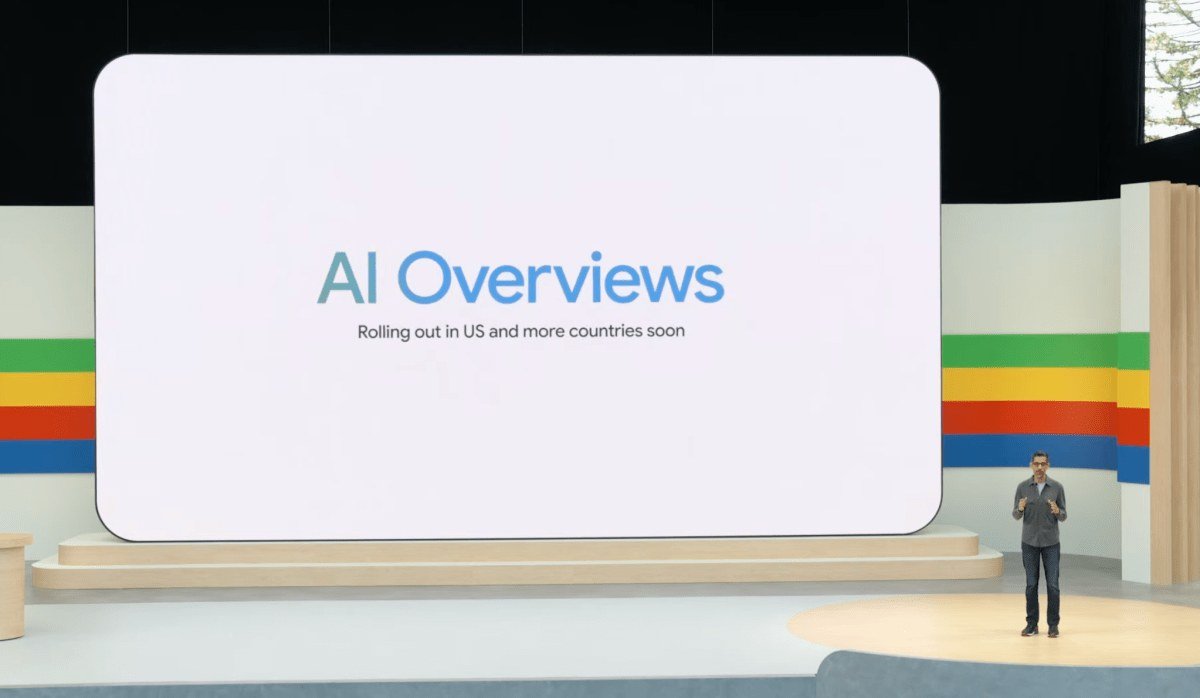
Nearly half of what people type into Google now comes back with an answer the search engine wrote itself. New data reported by TechCrunch on July 27, 2026 puts the figure at 43 percent: that is the share of searches where Google’s AI Overviews, the machine-generated summaries that sit above the familiar blue links, now appear. A feature that launched as an experiment is quietly turning into the default.
That number matters because of what it displaces. For a quarter of a century, a Google search meant a list of destinations. You typed a question, you got ten links, you clicked one, and someone on the other end got a visitor. AI Overviews change the deal. The answer arrives at the top of the page, assembled from across the web, and the user often has no reason to click anything at all.
The default is doing the deciding
Defaults are powerful precisely because most people never change them. Google did not ask its billions of users to opt into AI-generated answers. It placed them at the top of the results page, above everything else, and let inertia do the rest. When a behavior reaches 43 percent of searches without anyone having to choose it, you are not looking at a feature people sought out. You are looking at a new baseline for how information gets discovered.
The speed here is the story. AI Overviews are not a decade-old fixture that slowly crept up the page. They are recent, and they have already worked their way into nearly half of Google’s core product. For a company whose search business underpins the entire advertising machine, changing the shape of the results page is not a small bet. It is a rewrite of the thing that made Google Google.
What happens to the open web
Publishers have watched this coming with dread, and the reason is simple arithmetic. If Google answers the question on its own page, the click that used to flow to a recipe blog, a news site, or a product review never happens. The AI summary is built from that same published work, then presented in a way that removes the incentive to visit the source. Websites supply the raw material and receive less of the traffic that raw material used to earn.
There is a genuine tension inside this design. Google needs a healthy web to have anything worth summarizing. Strip away the traffic that funds independent publishing and the pipeline of fresh, reliable information starts to thin. An AI Overview is only as good as the pages underneath it. The more those pages struggle, the shakier the answers on top become.
Accuracy is the other worry riding alongside the traffic question. A summary written by a model can be confident and wrong at the same time, and when that summary sits in the most trusted real estate on the internet, the mistake carries Google’s authority with it. At 43 percent penetration, even a small error rate touches an enormous number of searches every day.
A shift with no undo button
What makes this moment feel decisive is how normal it already looks. Most users have no idea a threshold is being crossed. They ask a question, they read the answer, they move on. The habit forms without friction, and habits at Google’s scale are hard to reverse once they set. Every month AI Overviews stay in place, the expectation that search should simply tell you the answer hardens a little more.
Competitors have spent the past two years arguing that conversational, answer-first search is the future, and Google’s own data now makes their case for them. The difference is reach. A startup can build a slick answer engine, but Google can turn one on for the whole planet at once. The 43 percent figure is what that distribution advantage looks like in practice.
The open questions are the ones worth watching. Whether that share keeps climbing toward a majority, how publishers adapt when the referral traffic thins, and whether regulators start treating a self-answering search engine differently from a directory of links, all of it is still unsettled. What the data makes clear is the direction. AI-written answers are no longer a novelty bolted onto search. They are becoming search itself, and the web is being reorganized around that fact whether or not anyone voted for it.
For more coverage of AI search, visit Mylistingo.
Source: Original Article