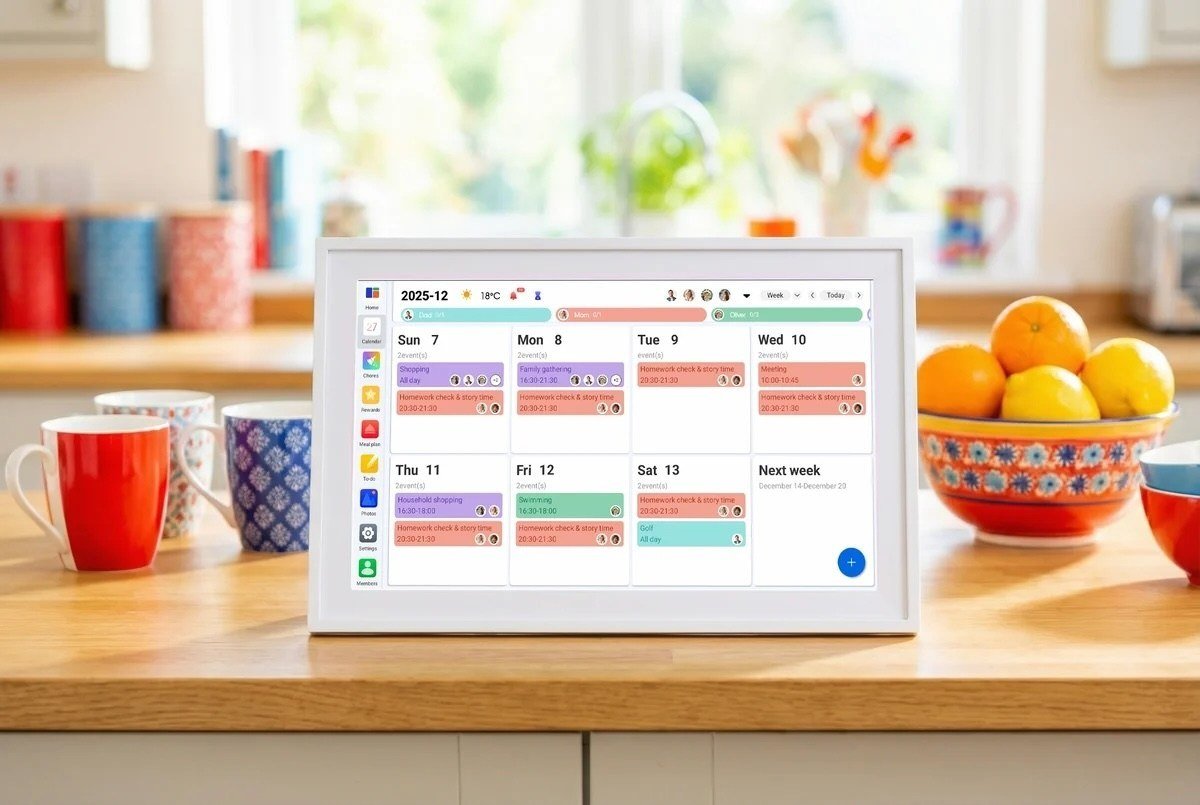
Most family calendar apps make you pay to make them useful. You download something that promises to wrangle school runs, dentist appointments, and dinner, and within a week you hit a wall: the feature you actually wanted lives behind a subscription. Linkdaze is betting that the wall itself is the problem.
The company’s smart digital calendar, covered this week by TechCrunch, is pitched not as a scheduling tool but as something closer to a household operating system. The distinction sounds like marketing until you look at how these products usually behave. A calendar tracks events. Running a home means knowing who is picking up whom, what’s for dinner on Thursday, and whether anyone remembered to defrost the chicken. Linkdaze wants to sit in that second category, and it’s giving away the parts that competitors tend to charge for.
The paywall is the product decision
What makes Linkdaze stand out, according to TechCrunch’s reporting, is what it doesn’t do. It doesn’t gate its features behind a premium tier. That includes an AI meal planner, the kind of feature that rival apps typically reserve for paying subscribers or bundle into an annual plan you forget to cancel.
Giving that away is a real choice, not a rounding error. Meal planning is one of the stickiest jobs in any household, the recurring question that never fully resolves. An app that answers “what are we eating this week” without asking for a card number is solving a genuine daily friction rather than a hypothetical one. Families don’t abandon tools because they lack features. They abandon them because the tools ask for money before proving they’re worth it.
There’s a strategic logic underneath the generosity. Household software lives or dies on adoption inside the home. If one parent installs a calendar and the other never opens it, the whole thing collapses into a single-user notepad. Removing the paywall lowers the barrier to getting everyone in the house onto the same system. Once a family’s routines, meals, and appointments all live in one place, switching away becomes its own kind of chore.
Why “run a household” is a bigger claim than it sounds
Calendars are a crowded space. Google, Apple, and a long tail of specialised family organisers have all planted flags there, and most of them are competent at the narrow task of putting boxes on a grid. The interesting frontier isn’t the grid. It’s everything that surrounds it.
An AI meal planner points at where this is heading. A scheduling app tells you Thursday is free. A household tool tells you Thursday is free, suggests a meal that fits what’s in the fridge, and drops the shopping into your week without being asked. That shift, from passive record to active assistant, is what separates a calendar you check from a calendar that actually reduces the number of decisions you make in a day.
Getting there is harder than adding a chatbot to a settings menu. Household planning is messy, personal, and full of preferences no algorithm can guess on day one. Someone is vegetarian. Someone hates Tuesdays. Practice runs late. The value of an AI meal planner depends entirely on whether it learns those textures or just spits out generic recipes. That’s the bar Linkdaze has set for itself by putting the feature front and centre and refusing to charge for it.
Free is a promise that has to hold
The obvious question hanging over any product that leads with “no paywall” is how it plans to stay that way. Free features cost money to build and run, and AI features cost more than most. Companies that give away the good stuff usually have a plan to make it back somewhere, whether through hardware, data, ads, or a premium tier that arrives once the users are locked in. TechCrunch’s framing leaves that part open, and it’s the part worth watching.
For now, the appeal is straightforward. A family can get a genuinely capable planning tool, meal suggestions included, without the usual audition-then-pay ritual. Whether that generosity is a durable philosophy or an acquisition tactic will show up in how Linkdaze behaves once people depend on it.
The households that adopt it will decide the outcome long before any spreadsheet does. Tools that quietly remove daily friction get woven into routines and forgotten, in the good way. Tools that eventually ask for money to keep doing what they already did get deleted. Linkdaze has chosen the harder, more interesting path of proving its worth first. The next move is whether it can keep the promise once the calendar is full.
For more coverage of family tech and AI-powered productivity tools, visit Mylistingo.
Source: Original Article
The Netherlands, for internationals
One email a week: the week's news for internationals in the Netherlands, new practical guides and what changed in the cities. No spam, unsubscribe any time.