This guide is for international residents of Amsterdam who want to know whether they can vote, and in which elections. After reading it, you will know which local elections are open to you, which residence conditions apply, what to bring on election day and why national elections follow different rules.
- Which Amsterdam elections you can vote in
- Who can vote: EU and non-EU residents
- Registration and your voting pass
- Election day: ID and casting your vote
- How national elections are different
- FAQ
Which Amsterdam elections you can vote in
The local elections in Amsterdam (gemeenteraadsverkiezingen) are where most international residents can take part. According to the I amsterdam guide to the local elections, they are held every four years and cover two bodies:
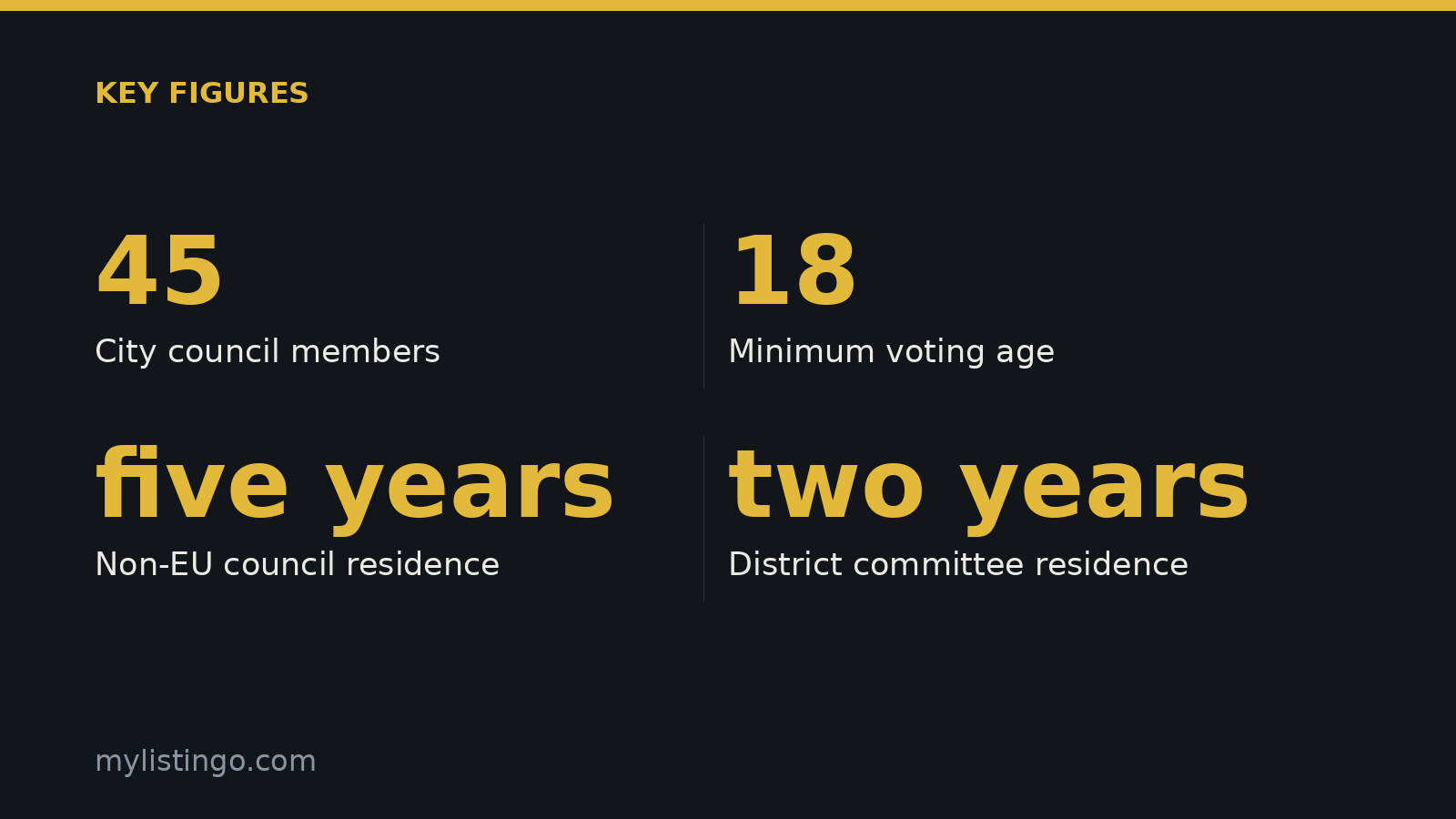
- The city council (gemeenteraad): residents elect its 45 members. It is the city’s highest governing body. It makes policy decisions and checks whether the municipal executive is carrying out municipal policy properly.
- The district committees (stadsdeelcommissie): residents also vote for the committee that manages their city district. Amsterdam has seven districts (Centrum, Nieuw-West, Noord, Oost, West, Zuid and Zuidoost), plus the administrative committee for Weesp.
District committees handle matters close to home, such as greenery and parks, household refuse collection, street design, social issues and local law enforcement. If your main concerns are your street, your bins or your local park, this vote has a direct effect on them.
Residents do not elect the mayor. The Crown appoints the mayor, and the city council selects the alderpersons (Deputy Mayors). The official pages do not say whether internationals can vote in provincial or European elections. If you want to know about those, ask the municipality.
Who can vote: EU and non-EU residents
The official guide explains that, unlike in parliamentary elections, foreign nationals who live in the Netherlands are entitled to vote in local elections. The conditions depend on your nationality and on which body you are voting for.
City council elections
To vote for the city council, you must:
- be over 18 years of age
- be registered with the municipality where you live
- be either an EU citizen, or a non-EU citizen who has lived in the Netherlands for at least five years without interruption
District committee elections
Non-EU internationals who have been registered in the city for at least two years may vote for their district committee. In practice, a non-EU resident with between two and five years of residence may be able to vote for the district committee but not yet for the city council.
The official page does not explain how breaks in residence affect the five-year count, or which records are used to calculate it. The municipality decides this case by case, so if you have lived abroad for a period, contact the City of Amsterdam before election day.
Registration and your voting pass
If you are registered in your municipality, you do not need to register separately to vote. The municipality automatically sends a poll card (stempas, or voting pass) to everyone who is eligible.
That makes your municipal registration the step that matters. If you have recently moved to Amsterdam or moved within the city, check that your registration is correct, because that is how the municipality knows to send you a pass.
If you lose or damage your poll card, you can apply in person for a new one at your District Committee office, and you must bring your ID. The official page gives no deadline or fee for a replacement and does not say what to do if a pass never arrives. Ask the municipality about these points well before election day, as it handles them case by case.
Election day: ID and casting your vote
Bring two things to the polling station:
- Your voting pass (stempas).
- An ID document. For local elections, the official guide lists a passport, a driver’s license or an ID card issued by an EU country.
You can use an expired document, but the expiry date must be less than five years ago. The local elections page does not say whether a Dutch residence permit document counts as ID for local elections. If you plan to use one, confirm with the municipality first.
If you cannot vote in person, you can nominate someone else to vote on your behalf. Use the form supplied with your voting pass. The local elections page does not say how many proxy votes one person may carry, so follow the instructions that come with your pass.
The I amsterdam guide to the parliamentary elections gives some ballot advice for national elections that is useful to keep in mind. The ballot lists all candidates from all parties, and you mark the box next to the candidate you choose. Mark only one box and add no other writing or marks, or your ballot will be spoilt and your vote will not count.
How national elections are different
The parliamentary elections (Tweede Kamerverkiezingen) decide who sits in the House of Representatives, which has 150 seats. They take place at least every four years. To vote in them, you must:
- be a Dutch citizen (have Dutch nationality)
- be 18 years or older on election day
- be registered as a resident in a Dutch municipality
- not be excluded from voting rights
The key difference is nationality. However long you have lived in Amsterdam, you cannot vote in parliamentary elections unless you have Dutch nationality. The years of residence that qualify you for local elections do not count here.
The rules on ID also differ. For parliamentary elections, the official page accepts:
- all passports, identity cards and driving licences from the Netherlands, other EU countries, Iceland, Liechtenstein and Norway
- a passport or identity card from Switzerland
- a document proving your residence permit issued by the Netherlands
The rule on expired documents is the same: the expiry date must be less than five years ago. For national elections, the page also says you can vote at any polling station in your municipality. If you are an EU citizen with dual Dutch nationality, or you become a Dutch citizen later, both sets of rules will apply to you.
FAQ
Can I vote in Amsterdam’s local elections if I am not an EU citizen?
Yes, if you meet the residence conditions. To vote for the city council, you must have lived in the Netherlands for at least five years without interruption, be over 18 and be registered with the municipality. To vote for your district committee, you must have been registered in the city for at least two years. If your residence history has gaps, the municipality decides case by case whether you qualify.
Do I need to register separately to vote?
No. If you are registered in your municipality, you do not need to register again to vote. The municipality automatically sends a voting pass (stempas) to everyone who is eligible. If yours does not arrive, contact the municipality, because the official page does not describe that situation.
What ID can I use at the polling station for local elections?
The official local elections guide lists a passport, a driver’s license or an ID card issued by an EU country. An expired document is accepted if the expiry date is less than five years ago. The local page does not say whether a Dutch residence permit document is accepted for local elections, so check with the municipality if that is your only ID.
Can I vote in the Dutch parliamentary elections as an international resident?
Only if you have Dutch nationality. Parliamentary elections are open to Dutch citizens who are 18 or older on election day, registered as residents in a Dutch municipality and not excluded from voting rights. Living in Amsterdam for many years does not give you this right without Dutch nationality.
Official sources: iamsterdam.com · iamsterdam.com
Last verified: 17 October 2026 against the official pages linked above. Rules and fees change; the official page always wins. General information, not legal or tax advice.
Sources
- iamsterdam.com: How to vote in the local elections in Amsterdam | I amsterdam, accessed 17 October 2026
- iamsterdam.com: How to vote in the Dutch parliamentary elections | I amsterdam, accessed 17 October 2026
Amsterdam, for internationals
One email a week: what changed for internationals in Amsterdam, the week's news from the Netherlands, and one guide worth reading. No spam, unsubscribe any time.