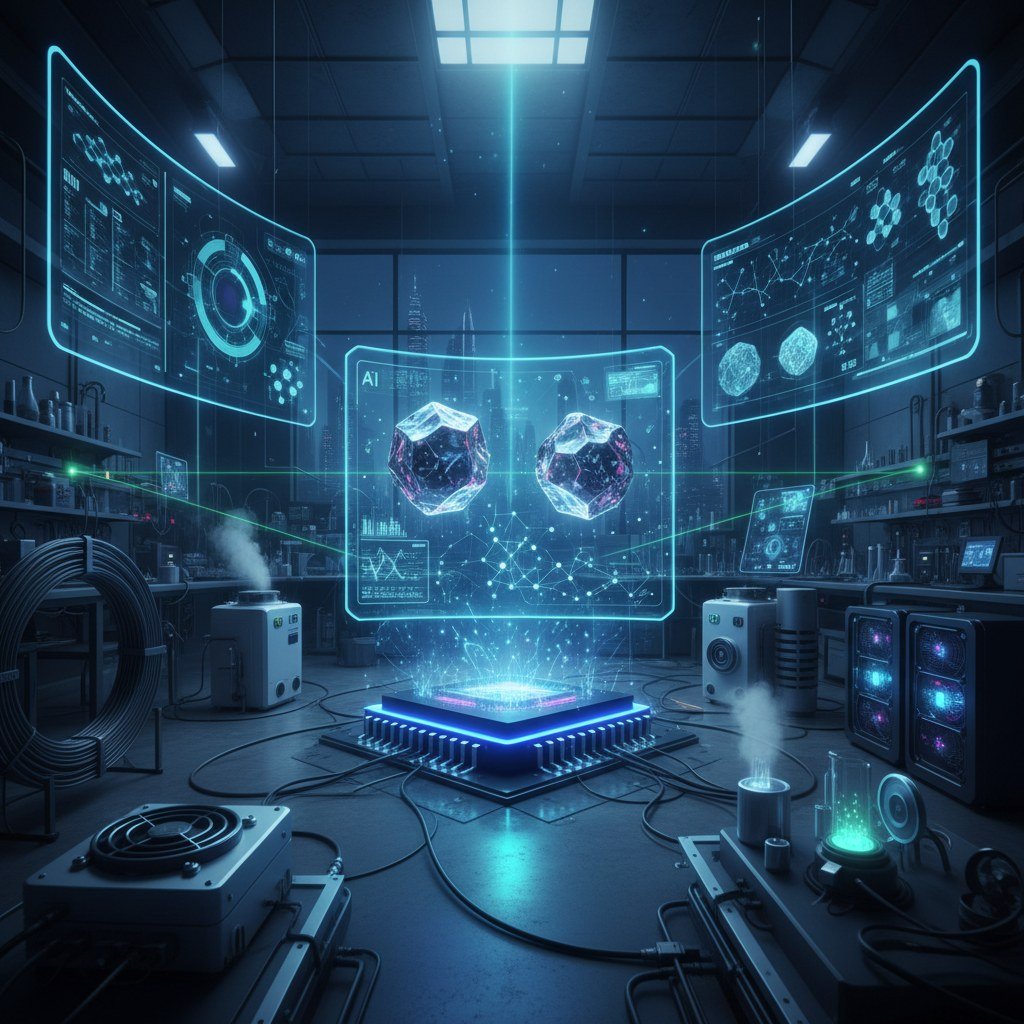
For decades, finding a new superconductor meant testing materials one at a time in the lab, a slow and expensive process of trial and error. An international team of physicists just used machine learning to skip most of that work, and in the process turned up two materials nobody had identified before.
What the team actually found
Researchers led by Aalto University in Finland, working with collaborators at Rice University, Princeton University, Ruhr University Bochum and the Donostia International Physics Center in Spain, identified two new superconductors: yttrium-ruthenium-boride, known as YRu3B2, and lutetium-ruthenium-boride, known as LuRu3B2. The findings were published in Physical Review Research on June 17, 2026. Both materials get their superconducting behavior from electrons forming what physicists call flat bands within a kagome lattice, a hexagonal atomic arrangement named after a traditional Japanese basket-weaving pattern that produces unusual electronic properties well suited to superconductivity.
What makes the discovery notable is not just the two materials themselves but how the team found them. Instead of synthesizing and testing candidate compounds one by one, the researchers combined machine learning models with quantum physics calculations to screen an enormous space of possible material combinations computationally, narrowing millions of theoretical candidates down to a small set worth testing in a real lab.
Why the old method could not scale
Superconductor research has always been bottlenecked by chemistry, not imagination. Physicists have long known, in principle, what kinds of atomic structures might produce superconductivity, but confirming any individual candidate requires synthesizing the material, cooling it to the right temperature, and measuring whether electrical resistance actually drops to zero. That process can take months per compound, and there are, practically speaking, an almost infinite number of possible atomic combinations to try.
The machine learning approach used in this study flips that ratio. By training models on the physics of known superconductors and using them to predict which untested combinations are most likely to share the right electronic structure, researchers can eliminate the vast majority of dead ends before anyone steps into a lab. The two confirmed materials in this study were not random hits. They were the output of a filtering process designed specifically to find compounds with metallized bonding patterns known to favor superconductivity.
The room-temperature question
The long-term goal driving this kind of research is a room-temperature superconductor, a material that would conduct electricity with zero resistance without the extreme cooling that current superconductors require. Today’s superconductors, including the two newly identified compounds, still need to be chilled to very low temperatures to exhibit their special properties, which limits their practical use to specialized applications like MRI magnets and particle accelerators.
Physicists have chased that goal for more than a century, since superconductivity was first observed in mercury cooled to near absolute zero in 1911. Progress has come in fits and starts, with each new class of superconductor, from classic metals to copper-oxide compounds to today’s kagome-lattice materials, pushing the usable temperature range a little higher without reaching anywhere close to room temperature. What has changed is not the physics goal but the search method, and that is precisely where machine learning is making its mark.
A true room-temperature superconductor would be transformative for power transmission, computing and transportation, since it could carry electricity with none of the energy loss that ordinary wires and circuits suffer today. Researchers involved in the Aalto-led study describe their machine learning screening method as a faster path toward that goal, not because it guarantees a room-temperature breakthrough, but because it lets scientists test far more candidates, far more quickly, than manual experimentation ever allowed.
An unusually wide collaboration
The scope of the collaboration behind the discovery is itself a signal of where materials science is heading. Bringing together a Finnish university, two American Ivy League-adjacent research powerhouses in Rice and Princeton, a German institution in Ruhr University Bochum, and a Spanish physics center is not a small undertaking to coordinate, and it reflects how machine learning is lowering the barrier to that kind of cross-border collaboration. Because the computational screening work can be shared, verified and rerun by any lab with access to the models and the underlying data, groups on different continents can contribute to the same search without needing to share physical lab space or equipment. The experimental confirmation, the step that still requires physically synthesizing and cooling the candidate materials, remains the bottleneck, but it is a far smaller bottleneck than testing every candidate blind.
What comes next
The team says its screening approach can be applied broadly across materials science, not just to superconductors, wherever researchers need to search a large space of chemical possibilities for a specific physical property. Expect more groups to adopt similar machine learning pipelines for materials discovery in the coming years, a trend already visible in battery chemistry and catalyst research. For now, YRu3B2 and LuRu3B2 join a growing list of superconductors found with AI assistance, evidence that the technology is starting to earn its place in experimental physics labs, not just data centers.
For more coverage of how machine learning is accelerating scientific discovery, visit Mylistingo.
Related: AI Data Centers Push Big Tech Emissions Sharply Higher
The Netherlands, for internationals
One email a week: the week's news for internationals in the Netherlands, new practical guides and what changed in the cities. No spam, unsubscribe any time.