



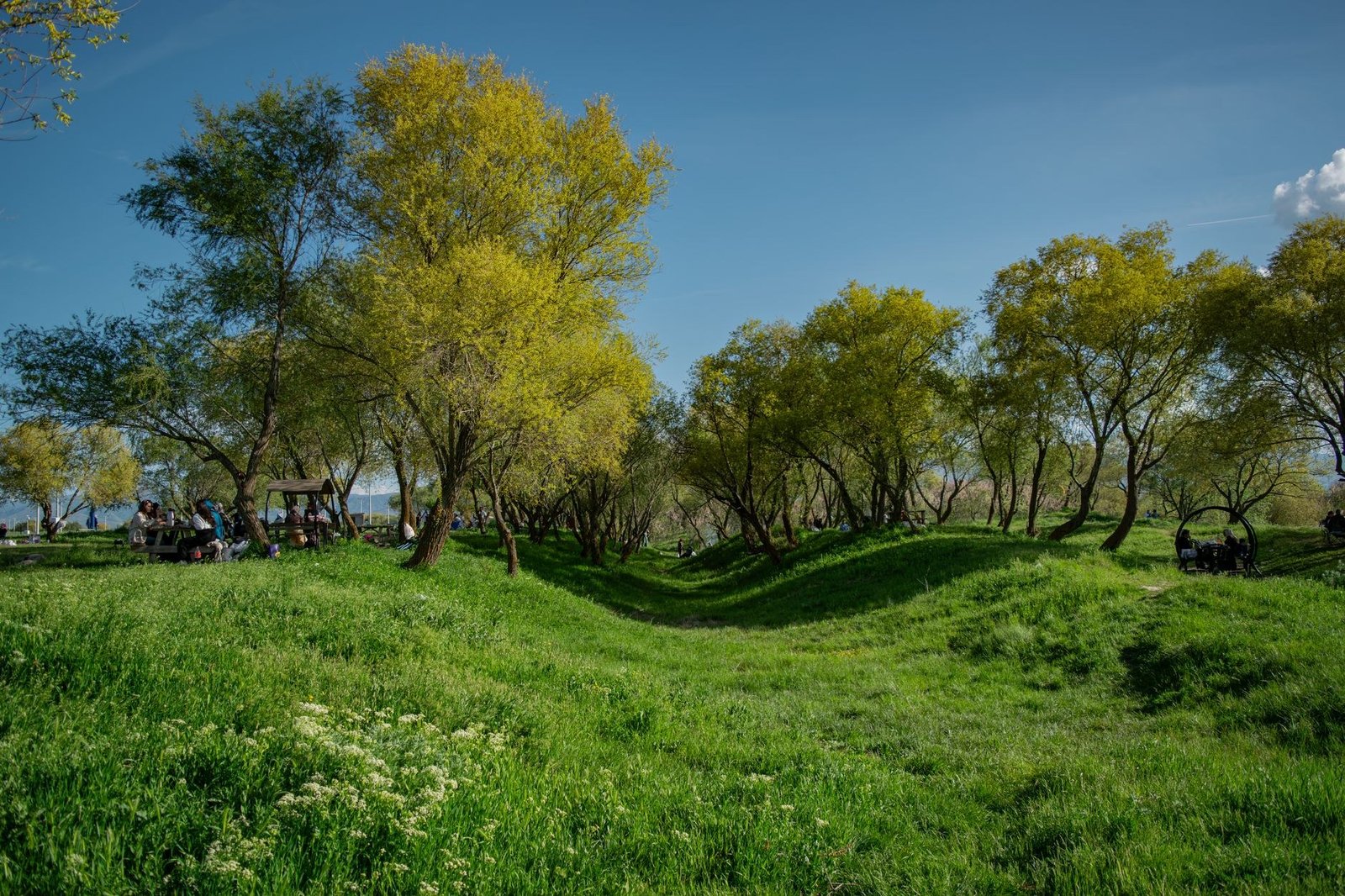
This guide is for people who have moved to Berlin from abroad and want to know where residents actually go on a free Saturday or Sunday, with or without children. It covers the big city parks, the neighbourhood favourites, the gardens worth a planned day trip, and what to check before you set off.
- Tiergarten and Tempelhofer Feld: room to spread out
- Neighbourhood parks for a lively weekend
- Wilder corners and riverside history
- Gardens worth planning a day around
- Palace gardens and central green spaces
- Before you go: barbecues, animals and growing your own
- FAQ
Tiergarten and Tempelhofer Feld: room to spread out
The city’s own overview of parks and gardens in Berlin calls the Tiergarten Berlin’s largest and most frequented inner-city park. The name translates as “animal garden”, but it is a park, not a zoo. It works for a long walk, a run or a picnic. It sits in the middle of the city, so it is an easy place to meet friends coming from different districts.
Tempelhofer Feld (literally “Tempelhof field”) feels completely different. Planes once took off from this ground, which was part of Tempelhof Airport. Today it is a large public park where people picnic, sunbathe and do sport. With children, the open space is the draw. Bring bikes, scooters or a ball and let them use the room you rarely get elsewhere in a big city.
Neighbourhood parks for a lively weekend
Görlitzer Park in Kreuzberg is a large public park with lawns for sunbathing, sport fields and playgrounds. If you live nearby and have small children, it is an easy choice that takes little planning.
Mauerpark in Prenzlauer Berg stands on a former section of the Berlin Wall. The city describes it as popular with people of all ages, and at weekends it turns into a flea market and a karaoke stage. Go for browsing and people-watching rather than peace and quiet.
Volkspark Hasenheide (a Volkspark is a “people’s park”, a public park built for everyone) has plenty of green space, an animal park, an open-air cinema and a rose garden. The animals are the obvious pull for children. Adults may want to look up the cinema’s own programme for summer evenings.
Viktoriapark is built around the Kreuzberg hill, Berlin’s highest inner-city elevation, and has a real waterfall. Schinkel’s National Monument stands at the top, so the climb ends at a landmark. Volkspark Friedrichshain is Berlin’s oldest public park, with small lakes, hills and the fountain of fairy tales, known locally as the Märchenbrunnen. It is a good place to hold the attention of children who get bored on an ordinary lawn.
Wilder corners and riverside history
Park am Gleisdreieck, close to Potsdamer Platz, suits a stroll through wild greenery without travelling far from the centre. Further south, Natur-Park Schöneberger Südgelände (a nature park in Schöneberg) brings together wild nature, modern art and forgotten technology. Older children who like exploring tend to enjoy it, and so do adults who like their art outdoors.
Treptower Park lies on the Spree river and is a popular public park. At its centre is the Soviet Memorial, the central memorial for fallen Red Army soldiers. It calls for a respectful visit, and older children will get more out of it if you explain its history beforehand.
Gardens worth planning a day around
Some green spaces work better as a planned outing than a spontaneous walk. The berlin.de overview does not list admission prices or opening times for any of them, so check each garden’s own website for current details before you travel.
Britzer Garten was laid out for the Bundesgartenschau, Germany’s Federal Horticultural Show, in the 1980s. The city says it is worth a visit at any time of year because of its variety. The Gärten der Welt (“Gardens of the World”) show gardening culture from around the world in nine themed gardens. That gives a family day an easy shape: visit one garden at a time and take breaks in between.
The Botanischer Garten (Botanical Garden) in Steglitz is one of the largest and most species-rich botanical gardens in the world, and the city recommends it in every season. For something quieter, the Späth-Arboretum, which belongs to Humboldt-Universität, specialises in trees and shrubs. It holds thousands of different trees and shrubs, as well as aquatic, alpine, medicinal and bog plants. It suits adults and curious older children who like to identify what they see.
Palace gardens and central green spaces
The gardens of Schloss Charlottenburg (Charlottenburg Palace) are described by the city as Berlin’s most beautiful baroque garden, and they draw visitors from all over the world. Come here for a slow, formal walk in a stately setting.
The Schönhausen Palace Gardens have two distinct moods: a lively public park full of trees that gradually becomes a secluded, quiet monastery garden. Families can let children run in the park section and save the quieter part for a calmer stroll. Biesdorf Palace and its palace garden are among the most important 19th-century architectural monuments in Berlin and a popular place for an outing.
If you are in the centre anyway, Monbijoupark is a green spot surrounded by sights and a good place for a break between museums. The Lustgarten on Museum Island was once part of the Berlin Palace and is now a spacious square where Berliners and visitors sit and rest. The city’s attractions and sights section also has a page on barrier-free sights for wheelchair users, blind and visually impaired people, and deaf and hearing-impaired people. It is worth reading if you need an accessible route.
Before you go: barbecues, animals and growing your own
Grilling is many Berliners’ favourite summer pastime, and the city warns that it can become expensive if you set up your barbecue in the wrong place. The parks overview links to a separate berlin.de page on grilling areas. Check that the park you have chosen is listed there before you pack the charcoal.
If animals are the main point of the day, the same overview links to a guide to zoos, animal parks, petting zoos and aquariums. And if a weekend in other people’s gardens makes you want your own, the city’s urban gardening page explains how to take part in greening the capital and grow your own fruit and vegetables without a garden.
FAQ
Which Berlin parks work best for young children?
Based on the city’s descriptions, Görlitzer Park has playgrounds and sport fields, Volkspark Hasenheide has an animal park, Viktoriapark has a real waterfall and Volkspark Friedrichshain has the fountain of fairy tales. Tempelhofer Feld gives children plenty of open space for sport and play.
Do Berlin’s gardens charge an entry fee?
The city’s parks overview does not give prices or opening times for any park or garden. For planned outings such as the Britzer Garten, the Gärten der Welt, the Botanischer Garten and the Späth-Arboretum, check each venue’s own website for current admission details and hours before you go.
Can I have a barbecue in any Berlin park?
Not necessarily. The city warns that grilling in the wrong place can be expensive. berlin.de has a page on grilling areas, linked from its parks overview, so check that your chosen spot is listed before you set up.
What is there for adults without children?
Mauerpark’s weekend flea market and karaoke stage, the open-air cinema in Volkspark Hasenheide, the modern art in Natur-Park Schöneberger Südgelände and the baroque garden at Charlottenburg Palace all suit adults. The Soviet Memorial in Treptower Park is a place for a quiet, reflective visit.
Official sources: berlin.de · berlin.de
Last checked: 2 November 2026 against the pages linked above. Prices, opening hours and programmes change; the venue’s own site always has the current details.
Sources
- berlin.de: Parks & Gardens, accessed 2 November 2026
- berlin.de: Attractions & Sights, accessed 2 November 2026
Berlin, for internationals
One email a week: what changed for internationals in Berlin, the week's news from Germany, and one guide worth reading. No spam, unsubscribe any time.





Comments 1