This guide is for internationals who have just moved to France, particularly from outside the European Union, who need to understand the titre de séjour (residence permit). After reading it, you will be able to tell the main cards apart, follow the steps for the ‘private and family life’ card and the 10-year resident card, and see where the prefecture decides.
- Who needs a titre de séjour, and the main kinds
- The ‘private and family life’ card
- The 10-year resident card
- Applying: timing, fees and documents
- Where the prefecture decides, and where to check
- FAQ
Who needs a titre de séjour, and the main kinds
The official overview on Service-Public sorts the documents a foreign national can hold in France into groups. The question of who needs one, including for stays of more than 3 months and for non-European children, is covered on separate question pages listed there.
- Carte de séjour (temporary or multi-year card): including vie privée et familiale, employee, entrepreneur, talent, visitor and retiree, among others.
- Carte de résident (resident card): the 10-year card, the EU long-term resident card and the permanent resident card.
- Autorisations provisoires de séjour (provisional permits): for example for the parent of a sick child.
- Student and trainee documents, including the au pair card.
- Specific regimes: Algerians receive a certificat de résidence (residence certificate) of 1 or 10 years, and Europeans have their own card. Other rules also apply to nationals of countries that have a migration agreement with France.
The ‘private and family life’ card
The carte de séjour “vie privée et familiale” is for non-European nationals with family ties in France. Examples are the spouse of a French national, the parent of a French child or a family member of a foreigner living legally in France. It allows the holder to live and work in France, and the employer does not need to request a work permit.
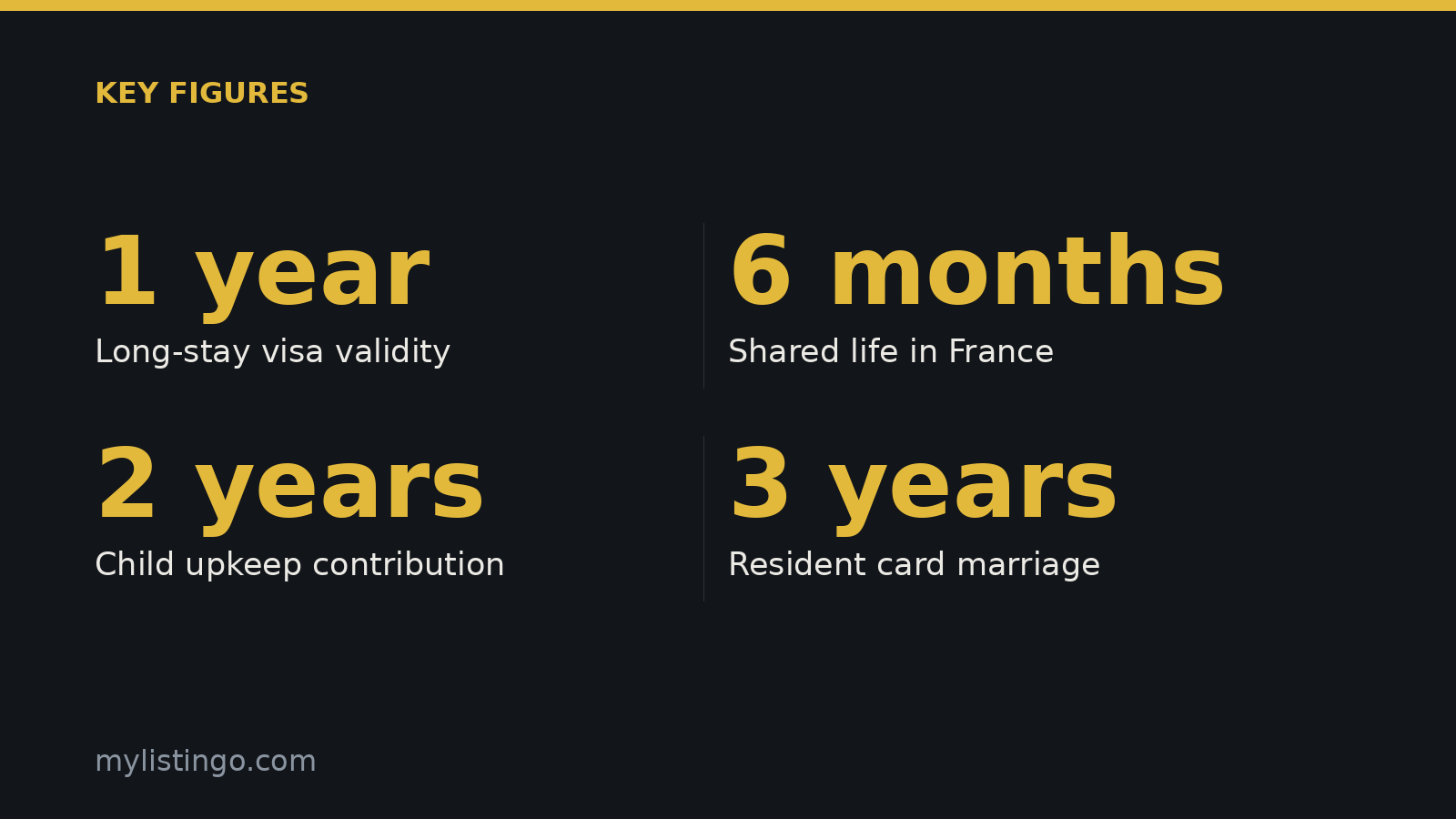
Spouse of a French national. Someone who arrived with a VLS-TS (long-stay visa serving as a residence permit, valid 1 year) can apply for the multi-year card in their second year, as a renewal. The communauté de vie (shared married life) must be real, though it may have ended through death or domestic violence. The spouse must have been French on the wedding day and kept that nationality, and the applicant must not live in polygamy. A marriage celebrated abroad must be transcribed in the French consulate’s civil registers. Someone married in France to a French national, with 6 months of shared life in France, can receive a card valid 1 year.
Parent of a French child. The card can be granted even to someone in an irregular situation. The conditions are being the father or mother of a French minor living in France, having contributed effectively to the child’s upkeep and education since birth (or for at least 2 years), and not living in polygamy.
The prefecture can refuse the card if the applicant ignored an obligation de quitter le territoire français (OQTF, order to leave France). It can also refuse it for forgery, serious offences or crimes, or violence against elected officials, public agents or security staff.
The 10-year resident card
The carte de résident is for three groups: people with family ties in France, people who have served France (for example in the Foreign Legion), and beneficiaries of international protection such as refugees. It can be a first card or a renewal, and it also allows work without the employer requesting a permit.
A spouse of a French national must have been married for at least 3 years (1 year for Tunisian nationals). The couple must share a real married life, and the spouse must have kept French nationality. For regroupement familial (family reunification), the applicant must be the spouse, or a child under 19, of a resident card holder. They must also have lived in France legally and without interruption for at least 3 years.
Both routes require intégration républicaine (integration into the Republic). This means committing to and respecting its principles. For a first card it also means French at level B1 and a pass in the examen civique (civic test) marked “carte de résident”, except for people over 65. The prefect considers the contrat d’intégration républicaine (integration contract) and asks the mayor for an opinion. Other conditions include not threatening public order and not living in polygamy in France.
The card is valid for 10 years and can be renewed, but it stops being valid after more than 3 consecutive years outside France. At renewal, the holder can request the EU long-term or permanent resident card. Renewal can be refused for a serious threat to public order. It can also be refused if the holder cannot show habitual residence: their private and family life centred in France, and at least 6 months there in the calendar year.
Applying: timing, fees and documents
Both cards are requested online through ANEF, the State’s online service for foreign nationals. The window opens 4 months and closes 2 months before the current visa, VLS-TS or card expires. A digital proof of filing is issued immediately.
The cost is 350 € (50 € stamp duty plus a 300 € tax). It is paid in timbres fiscaux (tax stamps), bought online or from a tobacconist that sells them, and proof of payment is shown when the card is collected. For the resident card, people who entered without a long-stay visa pay a further 300 € regularisation fee. 100 € of this is due at filing and is not refunded if the card is refused. A late application costs 180 € more, except in cases of force majeure or with a valid visa.
Documents vary by situation. They commonly include proof of nationality, an e-photo code, proof of address less than 6 months old, a signed commitment to respect the principles of the Republic, and a medical certificate from the Ofii (French immigration and integration office). Spouses add proof of shared life such as a lease. Resident card applicants add proof of B1 French and of the civic test. Civil status documents in a foreign language must be translated by a traducteur interprète agréé (approved translator).
Where the prefecture decides, and where to check
The préfecture (the State’s local office) tells the applicant when the card is ready. The card is then handed over by the préfecture or the sous-préfecture (its branch office), depending on where the application was filed. Most prefectures require an appointment, and their websites explain how to book one.
For the ‘private and family life’ card, the prefect must consult the commission du titre de séjour (residence permit board) when the conditions are met but a refusal is planned. The applicant gets at least 15 days’ notice and the right to a lawyer and an interpreter, and may receive aide juridictionnelle (legal aid). The prefect can still refuse after a favourable opinion.
A refusal letter usually comes with an OQTF. It can be challenged before the tribunal administratif (administrative court) within 48 hours, 15 days or 30 days, depending on the type of OQTF.
For a specific case, the prefecture is the official point of contact, and a migration advice service can explain the options.
FAQ
Can the holder of a ‘private and family life’ card work?
Yes. The card allows work in France without the employer requesting a work permit, and the 10-year resident card gives the same right.
When is the application made?
Online through ANEF, no earlier than 4 months and no later than 2 months before the current visa, VLS-TS or card expires. For the resident card, a late application costs an extra 180 €.
Is French required for the 10-year resident card?
For a first resident card, the applicant must show French at level B1 and pass the civic test marked “carte de résident”. Neither requirement applies to people over 65.
What if the prefecture does not reply?
If 4 months pass without a reply, the request counts as refused. This refusal can be challenged within 2 months with the prefect, the interior minister or the administrative court.
Sources: service-public.fr · service-public.fr · service-public.fr
Last verified: 19 October 2026 against the pages linked above. Rules and fees change; the responsible authority always has the final word.
This is general information, not legal or immigration advice. For your own situation, ask the prefecture of your département, a recognised migration advice service or a lawyer (avocat).
Sources
- service-public.fr: Titres, cartes de séjour et documents de circulation pour étranger en France, accessed 19 October 2026
- service-public.fr: Carte de séjour "vie privée et familiale" d'un étranger en France, accessed 19 October 2026
- service-public.fr: Carte de résident de 10 ans d'un étranger en France, accessed 19 October 2026
France, for internationals
One email a week: the week's news for internationals in France, new practical guides and what changed in the cities. No spam, unsubscribe any time.