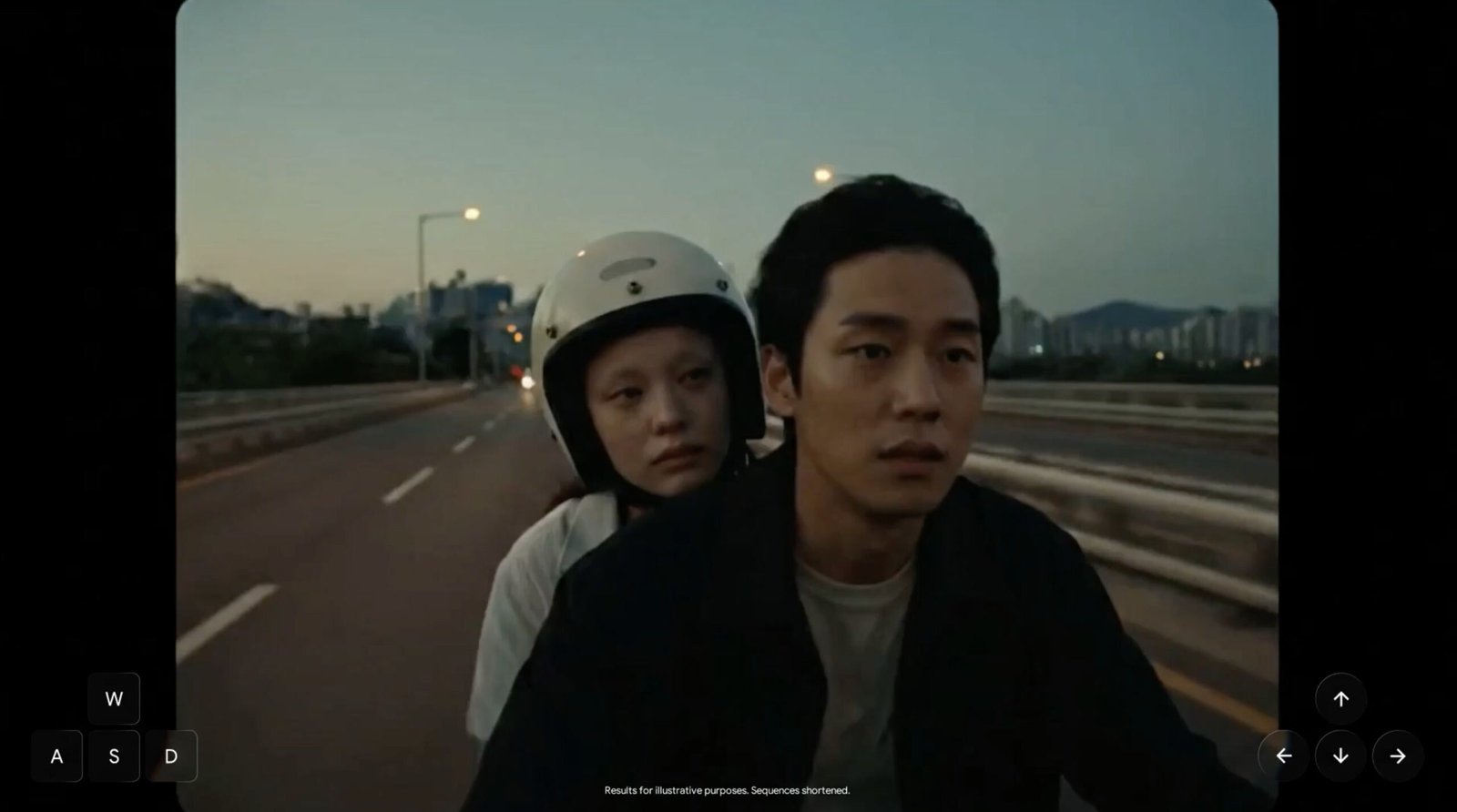
Google has a new world model, and it can keep a generated scene running for about two minutes. Genie 4 was announced on Tuesday as a research preview for trusted testers. The model builds interactive worlds from a prompt, then lets you keep playing inside them.
Google lists four main changes over Genie 3. Worlds look more realistic. You can rewrite an experience in real time with plain language. The model generates audio to match what is on screen. And it runs on Gemini 3.8 Flash, which handles the simulation work underneath.
Length is the headline number. Genie 3 held a scene together for roughly one minute. Genie 4 doubles that to two. The extra minute matters, because long runs are exactly where generated worlds tend to fall apart.
Google is careful about that limit. The company warns that details and object permanence can drift as a simulation runs longer. Objects may change shape, or a room may rearrange itself while you watch.
So who is this for? Google points at three groups. Filmmakers could use it for pre-visualization before a shoot. Game studios could prototype ideas without building an engine first. Robotics teams could generate training scenarios for machines.
None of those uses need a perfect world. A rough, responsive scene is usually enough to test an idea. That is the pitch: fast iteration rather than finished art.
The Verge has not been able to test Genie 4 yet, and nobody outside the tester pool has either. The Verge’s Jay Peters notes the comparison to Project Genie, which ran on Genie 3, is still open. People who used the older tool described the output as convincing for a moment and then strange.
The broader trend is worth watching. Google is shipping world models while most rivals stay focused on text and images. A model that simulates space and sound sits closer to a game engine than to a chatbot, and that is a different kind of product.
There is also an appetite question. Frontier labs are rethinking how they train and ship models, and access is tightening rather than opening up. A research preview behind a tester list fits that pattern.
Expect the first outside demos in the coming weeks. Until then, treat the two-minute worlds as a demo reel, not a product you can buy. Google has not shared pricing, availability dates, or a public waitlist.
What we do know is the direction. Each Genie release adds a dimension the last one lacked: sharper scenes, then live edits, now audio and longer runs. If that pace holds, the interesting question stops being whether these worlds look real and starts being what people build inside them.
The Netherlands, for internationals
One email a week: the week's news for internationals in the Netherlands, new practical guides and what changed in the cities. No spam, unsubscribe any time.