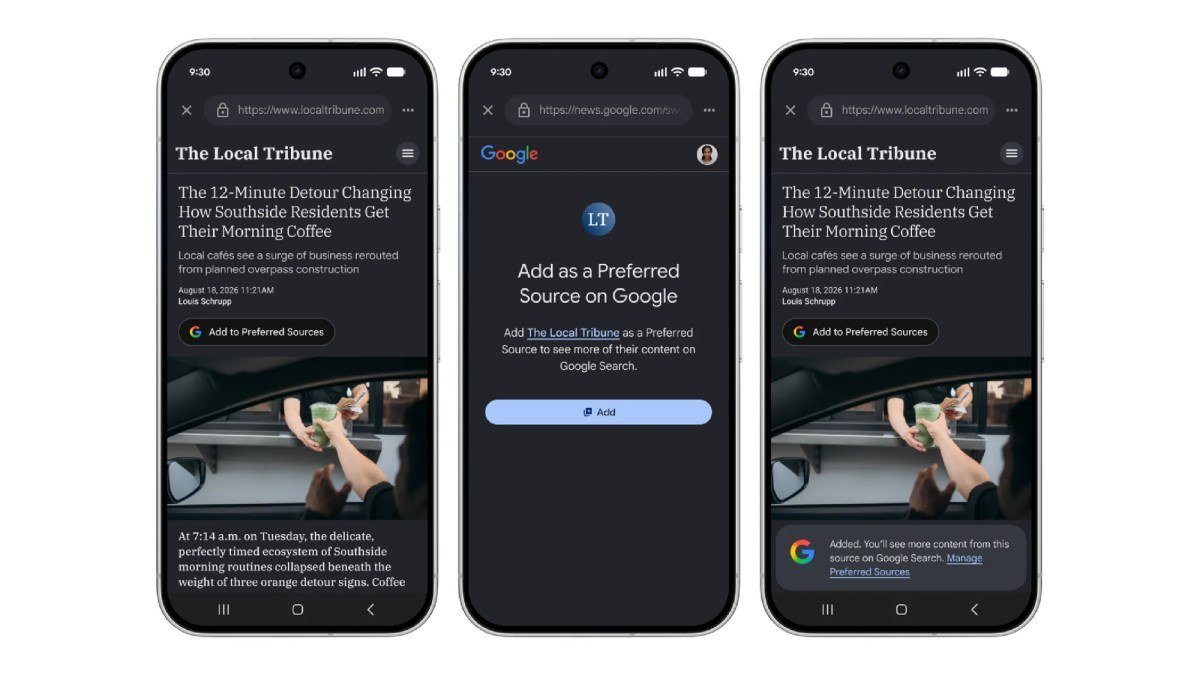
Google has spent the past two years telling publishers, in effect, to trust the process. AI Overviews would summarize their work at the top of the page, readers would get their answers without clicking through, and traffic would go where it goes. Now Google is offering something that looks a lot like an apology dressed up as a feature. The company is rolling out a button that lets readers designate a publisher as a preferred source across Search, Discover, and Google News.
The pitch is simple. Readers who like a particular outlet can tell Google to surface more of that outlet’s work, and in return those publishers stand to see more of their stories appear in front of loyal audiences. For an industry that has watched referral traffic erode as AI answers eat the click, any lever that pushes readers back toward the source is worth grabbing.
A button aimed at a bleeding wound
The context here matters more than the mechanic. Google’s move to answer questions directly in Search, rather than sending people out to the pages that hold those answers, has changed the basic bargain that built the open web. Publishers spent two decades optimizing for Google because Google sent them readers. When the search box starts answering on its own, that flow of readers thins out, and the business model built on top of it starts to wobble.
A preferred-source button does not reverse that dynamic. What it does is give committed readers a way to raise their hand. If enough of an outlet’s audience opts in, Google’s systems have a signal to weight that publisher more heavily in the surfaces where humans still browse and scroll. Discover, in particular, is a feed people open when they are not searching for anything specific, and a stronger position there can mean real, repeatable traffic rather than a one-off click from a stray query.
There is an obvious tension in the design. The publishers most likely to benefit are the ones that already command devoted readerships, the brands people would seek out by name. A local news site or a young independent outlet does not have a base of fans primed to click a button on their behalf. So the tool may reward scale and loyalty that a publisher has already earned, rather than opening a door for the outlets hit hardest by the shift to AI answers.
Who this actually helps
Think about how a reader encounters a preferred-source option in the first place. They have to be on Google, looking at a result or a feed, and care enough about a given outlet to tell the machine they want more of it. That is a high bar, and it favors names people recognize. The New York Times, the BBC, a beloved niche publication in someone’s field of obsession. These are the outlets whose readers will bother.
Everyone else is left hoping that a nudge in Google’s ranking makes up for the readers no longer arriving through the front door. It might help at the margins. It is not a substitute for the traffic that AI Overviews and their kin are quietly rerouting into Google’s own product.
Google’s framing, unsurprisingly, is one of empowerment. The company casts the feature as giving readers more control over what they see and giving publishers a fairer shot at reaching the people who value them. Both of those things can be true and still leave the underlying problem intact. Control over a smaller pie is still a smaller pie.
The trust Google is trying to rebuild
What is really on display is a relationship under strain. Publishers have grown openly hostile toward the platform that once drove their growth, and some have started blocking AI crawlers, filing complaints with regulators, or striking licensing deals that put a price on the content Google’s models feed on. A preferred-source button reads as an olive branch, a way to say that publishers still matter inside a search experience increasingly built to keep users from leaving.
Whether the branch is worth taking depends on numbers Google has not yet shown. Does opting in meaningfully change how often a publisher appears? Does that visibility translate into clicks, or just impressions that never convert into a visit? Until publishers can measure the lift against the losses, the feature lands as a gesture more than a fix.
Watch what publishers do rather than what they say. If major outlets promote the button hard to their audiences and the traffic follows, Google will have found a genuine release valve for the pressure it created. If the needle barely moves, this joins a growing list of tools offered to an industry that keeps being asked to adapt to a search engine that no longer needs it the way it once did. The web that Google helped build is being reshaped by the same company, and a single button will not decide which way that goes.
For more coverage of Google, AI search, and the future of digital publishing, visit Mylistingo.
Source: Original Article
The Netherlands, for internationals
One email a week: the week's news for internationals in the Netherlands, new practical guides and what changed in the cities. No spam, unsubscribe any time.