Light moves slower through glass than it does through air. That single fact of physics, taught in every introductory optics course, is the wedge Relativity Networks is using to pry open one of the internet’s most stubborn bottlenecks. The company just closed a $22 million round to build hollow-core fiber, a cable that guides data through a channel of air rather than solid glass, and it wants to put that cable inside the data centers now straining under the weight of artificial intelligence.
Why air beats glass
Conventional optical fiber is a marvel that has aged into a constraint. Every strand carries pulses of light through a core of ultra-pure glass, and glass, for all its clarity, slows light down. Photons bounce and drag through the dense material, arriving later than they would if nothing stood in their way. For decades that penalty didn’t matter much, because the distances and the demands were forgiving.
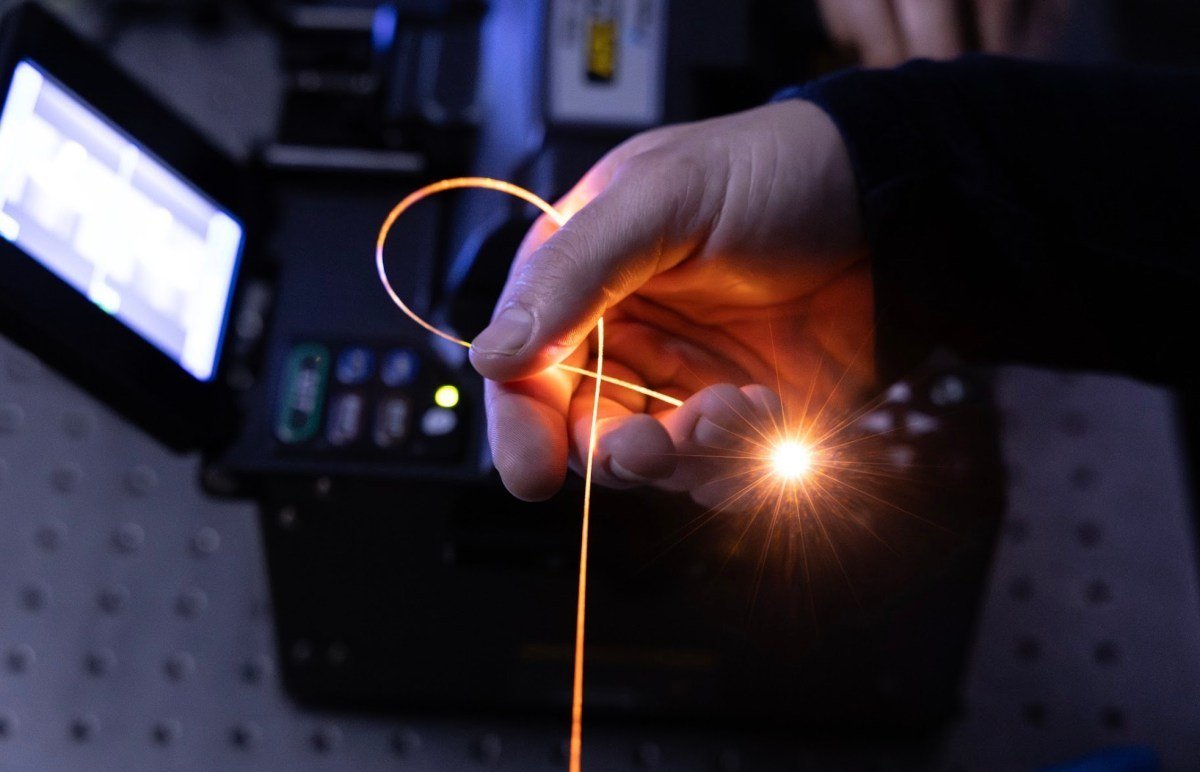
Hollow-core fiber flips the design. Instead of a solid center, the light travels down a tiny hollow channel, closer to the speed it would reach in open air. Relativity Networks says data moves through its fiber 30 percent faster than through the conventional kind. In a world measured in milliseconds, that is not a rounding error. It is the difference between a trade that clears first and one that clears second, between a model that responds instantly and one that stutters.
The idea is not new, and that is part of the story. Hollow-core fiber has lived at the edges of the industry for years, promising and rarely deployed. Manufacturing it is hard. Getting light to stay inside a hollow tube without leaking or scattering took a long stretch of research before anyone could make cable that performed reliably over useful distances. So the technology sat mostly in labs and pilot projects while ordinary glass fiber carried the world’s traffic.
The AI data center makes the math work
What changed is the buyer. Data centers built for AI training and inference are unlike the ones that came before them. Racks of accelerators need to talk to one another constantly, shuffling enormous volumes of data between chips, and every microsecond of delay compounds across thousands of operations. Latency, once a background concern, has become a headline cost. That shift gives an expensive, exotic cable a place where its premium finally pencils out.
Relativity Networks is aiming squarely at that environment. Rather than pitching hollow-core fiber for the long-haul lines that stretch between cities, the company wants it running inside the buildings where AI workloads live, connecting the machines whose speed sets the pace for everything downstream. It is a narrower target than the global telecom network, but a richer one, and it sidesteps the harder problem of ripping out infrastructure that already spans continents.
The $22 million is modest by the standards of AI infrastructure, where individual data centers now cost billions. But hardware companies do not need to match those numbers to matter. They need enough capital to prove the cable works at scale, to manufacture it consistently, and to convince operators that a faster fiber is worth the switching cost. Money at this stage buys the chance to show the technology in the one setting where customers are desperate enough to try something unproven.
A hard bet on the physical layer
Betting on hollow-core fiber is a bet that the next gains in computing will come not just from better chips but from the wires between them. That is a less glamorous frontier than the models grabbing headlines, and a harder one. Photonics startups have a long history of brilliant physics that never survived contact with a factory floor. Turning a laboratory result into a product that ships in volume, at a price data centers will pay, is where most of them have stumbled.
Relativity Networks now has to clear that same bar. The physics is settled, and the demand is real in a way it was not five years ago. The open question is manufacturing, and whether a small company can produce hollow-core fiber cleanly enough, cheaply enough, and in enough quantity to move it from novelty to standard.
Watch what the hyperscalers do. If the operators building the largest AI clusters start specifying hollow-core links in their next facilities, a technology that spent years as a curiosity will have found its moment. If they hold off, the cable stays a promising answer waiting for its question. Either way, the fight over AI’s future is quietly moving into the space between the machines.
For more coverage of data center infrastructure, visit Mylistingo.
Source: Original Article
The Netherlands, for internationals
One email a week: the week's news for internationals in the Netherlands, new practical guides and what changed in the cities. No spam, unsubscribe any time.