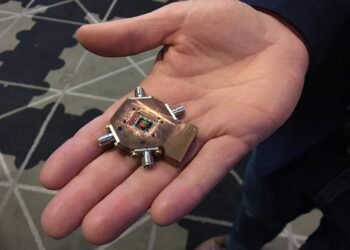




Superconductivity has been one of physics’ most tantalising promises for over a century. Materials that conduct electricity without any resistance could slash energy waste across every sector of the economy. The problem has always been temperature: conventional superconductors only work when cooled to near absolute zero, making them impractical outside highly specialised laboratory or medical environments. Research published in June 2026 from Chalmers University of Technology may have shifted that calculus in a meaningful way.
The team developed a technique using nanofaceted substrates to influence superconducting properties. By carefully engineering the material at the nanoscale, they were able to preserve superconducting behaviour even when magnetic fields are applied and at temperatures that would normally destroy the effect. It is the kind of foundational advance that does not produce a commercial product overnight but removes one of the stubborn physical barriers that has kept superconductor applications narrowly confined.
What nanoscale control unlocks
Superconductors already appear in MRI machines, particle accelerators, and a small number of maglev train systems. Their broader use is constrained by the requirement for extreme cooling, which means cryogenic infrastructure that is expensive to build and maintain. Devices built on the Chalmers approach could eventually point toward electronics that generate almost no heat and lose almost no energy in transmission.
That matters because modern data centres are constrained as much by heat management as by raw computing power. A processor or interconnect that wastes significantly less energy to resistance would change the economics of large-scale computing infrastructure. Long-distance power transmission also loses roughly 5 to 8 percent of electrical energy in transit through standard copper lines. Superconducting cables, once viable at practical temperatures, could recover much of that loss.
A new eye on the universe
The same month brought a different kind of milestone. The Vera Rubin Observatory, located in the Chilean Andes, opened as planned and released its first images in June 2026. A single frame contained millions of galaxies and thousands of previously unidentified asteroids.
Over its ten-year survey mission, the observatory is expected to catalogue tens of billions of astronomical objects and generate approximately 20 terabytes of data every night. That pipeline requires custom AI systems to identify, classify, and flag anomalies in real time. Astronomers working on dark matter, dark energy, and the structure of the universe will have access to an observational archive that simply did not exist before this month.
Sodium-ion batteries edge toward the mainstream
Alongside these headline advances, a quieter shift is gathering pace. Sodium-ion batteries are emerging as a serious contender to lithium-ion in applications where cost and material availability matter more than energy density. Sodium is derived from salt — abundant, geographically distributed, and not subject to the supply pressures that have made lithium a geopolitical concern.
MIT Technology Review included sodium-ion technology among its 2026 breakthrough technologies, and manufacturers in China have already begun commercial-scale production. The batteries are well-suited to stationary energy storage — backing up solar and wind farms — where weight constraints are less demanding than in passenger vehicles. That segment of the energy market is expanding fast, and sodium-ion’s cost advantage over lithium could accelerate deployment significantly over the next several years.
Brain-computer interfaces and the evidence gap
Brain-computer interfaces generated significant attention in the first half of 2026 as researchers and companies refined direct communication pathways between the brain and digital systems. The core challenge is no longer whether a BCI can record and transmit neural signals. The question is whether non-invasive devices, which avoid surgery but pick up noisier signals, can deliver enough precision to be genuinely useful beyond narrow clinical applications.
Light, wearable neural interfaces aimed at improving focus and memory recall have started appearing in consumer markets. Their clinical evidence base remains thin. Regulators in both the US and EU are watching the category closely, and the next twelve months will likely bring the first significant enforcement decisions on efficacy and safety claims. A well-designed clinical trial could change the picture quickly in either direction.
The superconductivity work at Chalmers may take a decade to reach a commercial product. Vera Rubin will spend years collecting data before its most significant discoveries emerge. Sodium-ion batteries are already in factories. BCIs are already in consumer packaging. Each is at a different point on the same arc from laboratory to shelf, and the distance between them is a useful reminder that the pace of technology is never as uniform as the headlines suggest.
For more coverage of future technology breakthroughs, visit Mylistingo.