
The 2026 FIFA World Cup — the first to feature 48 teams across 16 cities in the United States, Canada, and Mexico — has become the defining laboratory for the future of football officiating. As the tournament enters its knockout phase with matches drawing record-breaking global audiences, one transformation stands above all others: the arrival of VAR 2.0 and artificial intelligence-driven officiating systems that are fundamentally rewriting the role of the referee.
Gone are the days when a single human eye judged a marginal offside or a potential penalty in real time. At this World Cup, FIFA and its technology partners have deployed a layered system of AI-enhanced tools — from semi-automated offside detection with 3D skeletal tracking to an upgraded video assistant referee protocol that aims to eliminate the delays and controversies that plagued the first generation of VAR. The results, so far, are reshaping how players, coaches, and fans experience the beautiful game.
The integration of artificial intelligence into live sport officiating represents one of the most significant technological shifts in athletic competition since the introduction of instant replay. Just as AI officiating systems have begun transforming multiple sports in 2026, football is now experiencing its own digital revolution — one that promises to make the game fairer, faster, and more transparent than ever before.
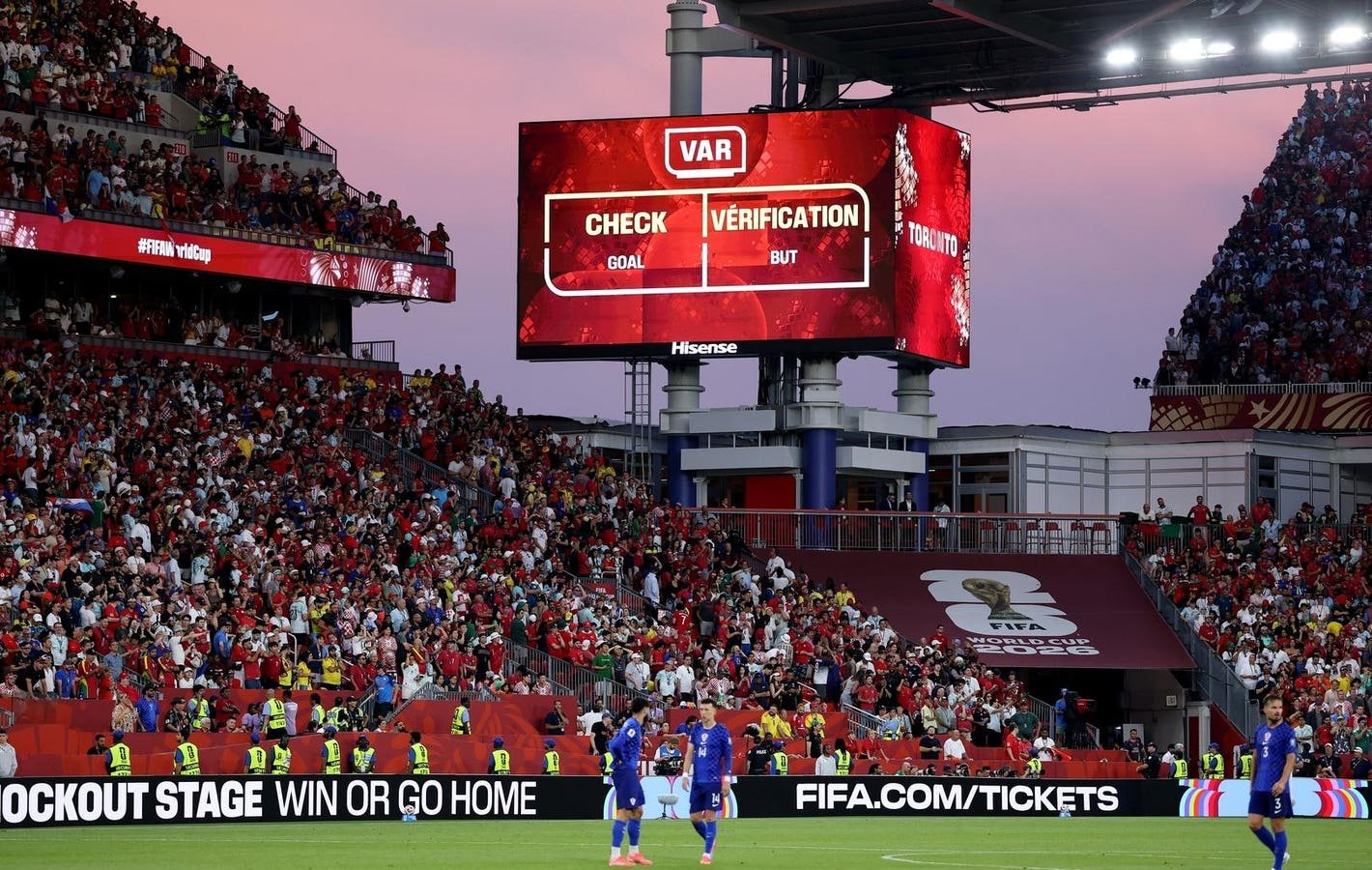
From VAR 1.0 to VAR 2.0: The Technology Leap
The first version of VAR, introduced to top-flight football in 2018 after IFAB approval, relied on human video assistant referees manually reviewing broadcast footage to identify “clear and obvious errors.” While revolutionary at the time, the original system quickly attracted criticism: reviews took too long, offside lines were drawn clumsily on screen, and subjective interpretations of fouls varied from one match official to the next. Studies published by the International Football Association Board showed that the average VAR check in the 2022 World Cup took 72 seconds — an eternity in a sport built on fluid momentum.
VAR 2.0, deployed for the first time at a full-scale international tournament in 2026, represents a generational upgrade. At its core is a tightly integrated system combining three technological pillars: semi-automated offside technology (SAOT), an AI-powered incident detection engine, and enhanced communication infrastructure connecting the referee on the pitch directly with the video operations room.
The semi-automated offside component uses 12 dedicated tracking cameras mounted under stadium roofs, each capturing 50 frames per second. These cameras track 29 different body data points per player — up from the 10-point system tested at the 2022 World Cup — creating real-time 3D skeletal models that the AI compares against the offside line at the exact millisecond the ball is played. FIFA’s technology partner Lenovo provided the edge computing infrastructure that processes this data locally in each stadium, reducing latency to under five seconds for an offside alert. The official match ball, the Trionda developed by Adidas, contains an inertial measurement unit that captures kick data at 500 samples per second, providing the precise moment of ball contact that triggers the offside analysis.
The AI incident detection engine continuously scans the live feed, flagging potential red-card offences, penalty-area incidents, and violent conduct that might escape the referee’s peripheral vision. Unlike the first-generation VAR, which required the video assistant referee to manually scrub through footage, VAR 2.0’s AI highlights suspicious frames and presents them to the human reviewer alongside a confidence score. This “human-in-the-loop” design means the final call always rests with a qualified match official, but the machine handles the vast majority of data processing and pattern recognition.
Referee communications have also been overhauled. Each on-field official wears a bone-conduction headset that relays VAR decisions directly without ambient stadium noise interference. The review process, once visible only to broadcast audiences, is now displayed on stadium screens with a standardized interface showing the incident, the AI analysis overlay, and the final decision — a transparency initiative FIFA hopes will rebuild trust in officiating among live spectators.
Controversies, Adaptations, and the Human Factor
No technology as ambitious as VAR 2.0 could debut without sparking debate, and the 2026 World Cup has produced its share of contentious moments. The most heated arguments have centred not on the semi-automated offside system — which most pundits acknowledge is significantly more accurate than its predecessor — but on the AI’s involvement in subjective foul detection.
During the group-stage match between Argentina and Senegal, the AI flagged a challenge in the penalty area that the on-field referee had waved play on for. After reviewing the AI-generated clip in the video operations room, the VAR recommended a penalty review, and the referee overturned his original decision — awarding a spot kick that ultimately decided the match. Senegal’s coach publicly questioned whether the AI was “too sensitive,” arguing that the contact shown would not have been penalized at any previous World Cup. FIFA responded by noting that the VAR protocol had been applied correctly under the existing Laws of the Game, but acknowledged that the AI’s sensitivity thresholds were being evaluated for potential adjustment in the knockout rounds.
Another flashpoint emerged in the USA vs. Netherlands Round of 16 clash, where the offside system ruled out a Netherlands goal for a marginal offside measured at 8.3 centimetres — a call that would have been almost impossible for a human assistant referee to make in real time. The Dutch camp protested the decision, arguing that the margin was so narrow it fell below the “clear and obvious” standard that VAR was originally designed to correct. FIFA refereeing chief Pierluigi Collina defended the decision, stating that the technology had been calibrated to detect offside positions exceeding 5 centimetres as a deliberate buffer against measurement error, and that 8.3 centimetres was well within the system’s margin of confidence.
Yet for every controversy, there have been dozens of quietly correct calls that went entirely unnoticed — precisely the outcome FIFA intended. The average VAR check time has dropped from 72 seconds in 2022 to approximately 27 seconds in 2026, according to FIFA’s tournament data released on July 3. The number of “clear and obvious errors” corrected by VAR per match has increased by 34 percent compared to the 2022 tournament, while incorrect interventions — where VAR overturned a correct on-field decision — have fallen by 60 percent. For the first time in World Cup history, no major offside controversy involving a clearly onside player being wrongly flagged has occurred in the tournament’s first 80 matches.

The Broader Impact: How AI Officiating Is Changing Player Behaviour and Tactics
The introduction of VAR 2.0 is not merely a technological upgrade — it is beginning to reshape how football is played. Defenders, knowing that marginal offside traps will now be caught with sub-second precision, have adjusted their positioning. The offside trap, a tactical staple for generations of coaches, has become a significantly riskier proposition. Data from the tournament’s first three weeks shows that the average defensive line has dropped 1.2 metres deeper compared to the 2022 World Cup, as backlines opt for safety over high-risk, high-reward positioning.
Attacking players, meanwhile, have adapted their movement off the ball. Strikers are making runs that are less reliant on timing the defensive line perfectly and more focused on creating separation through acceleration and positioning — knowing that a well-timed run will be rewarded by the SAOT system even if a human assistant referee might have mistakenly flagged them. “It changes the calculus for forwards,” former England international and current ITV analyst Gary Lineker observed during broadcast coverage. “They can trust the system to get the tight calls right. That means we’re seeing more attacking freedom, not less.”
The ripple effects extend beyond the pitch. Broadcasters have embraced the 3D avatar replays generated by the Lenovo system, which render offside decisions as full-colour, rotatable 3D models rather than flat lines on a screen. Fox Sports, the tournament’s English-language broadcaster in the United States, reported that viewer comprehension of offside decisions increased by 41 percent in audience testing when the 3D avatar system was used versus traditional side-by-side video comparisons. The technology has become a staple of half-time analysis and post-match debate, fundamentally altering how the sport is consumed and discussed.
Training and preparation have also been affected. Several national teams — including Germany, Brazil, and host nation Canada — have employed AI simulation tools during their tournament preparation that replicate VAR 2.0’s decision-making algorithms. Players have been drilled on how the system interprets different types of contact, shirt-pulling, and offside movements, allowing them to adapt their in-game behaviour proactively. “In previous tournaments, you prepared for the opposition,” said Canada’s head coach Jesse Marsch in a press conference after his team’s qualification for the Round of 16. “In this tournament, you also have to prepare for the technology.”
The Future: What VAR 2.0 Means for Football Beyond 2026
FIFA has already signalled that the systems deployed at this World Cup are not a one-off experiment but a template for football’s future. The governing body announced on July 2 that a “streamlined VAR 2.0 certification” programme would be established for domestic leagues worldwide, with tiered implementation timelines based on league resources. The Premier League, La Liga, and the Bundesliga — all of which have already introduced semi-automated offside technology in some form — are expected to adopt full VAR 2.0 specifications for the 2027-28 season. Lower-resourced leagues will receive FIFA-subsidised hardware and training packages under a programme called “VAR Equity,” designed to prevent technology from widening the gap between football’s richest and poorest competitions.
The next frontier is fully automated decision-making for objective calls — out-of-play decisions, goal-line technology (already standard), and offside. FIFA’s chief technical officer has confirmed that the organisation is working with partners on a “VAR 3.0” concept that would eliminate the need for human video assistant referees entirely for offside decisions, with the SAOT’s confidence threshold calibrated to zero false positives before implementation. That timeline is estimated at three to five years, pending rigorous testing across multiple competitions and climatic conditions.
For a deeper look at how technology is transforming the broader sports landscape — from automated umpiring in baseball to AI-driven tactical analysis across multiple disciplines — read our companion article AI Officiating in 2026: How Technology Is Taking Over Sport. And for a comprehensive tournament review exploring every technology deployed at this year’s World Cup, see World Cup 2026 Review: How AI and Technology Changed Football Forever.
The debate over how much technology is too much will continue long after the final whistle on July 19. But one conclusion seems inescapable: VAR 2.0 has passed its first major test at the 2026 World Cup with measurable improvements in accuracy, speed, and transparency. The genie is out of the bottle, and football — like every other sport — is learning that the algorithm is here to stay.
The Netherlands, for internationals
One email a week: the week's news for internationals in the Netherlands, new practical guides and what changed in the cities. No spam, unsubscribe any time.