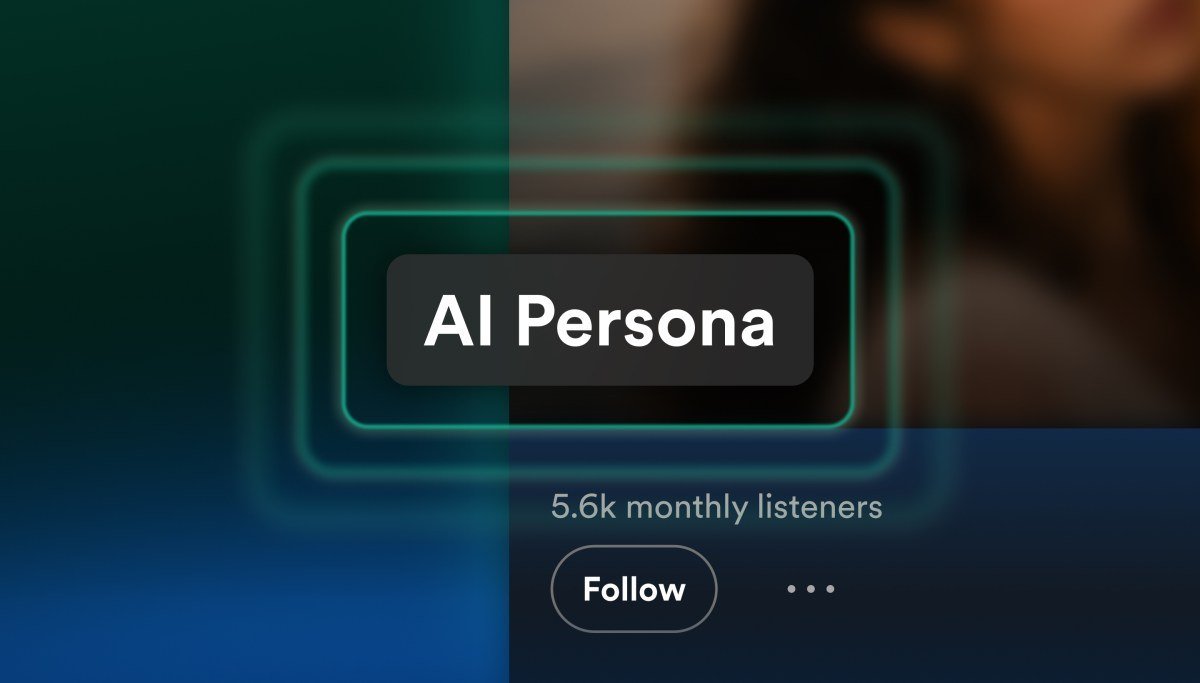
Spotify just drew a line most streaming platforms have been reluctant to touch. On August 11, 2026, the company said it will start attaching an “AI Persona” label to artist profiles that represent AI-generated identities, and it will keep the music behind those profiles out of its recommendation engines by default. No editorial playlists. No algorithmic radio. No personalized “made for you” mixes unless a listener seeks the artist out directly.
That last part is the one that matters. Labeling something is a disclosure. Excluding it from recommendations is a business decision, and for a platform where discovery is the whole game, it functions as a soft demotion. A track that never surfaces in a playlist or a Discover Weekly slot has to fight for every stream on its own.
What Spotify is actually flagging
The “AI Persona” tag applies to profiles built around a synthetic identity rather than a human performer. Think of a fully AI-generated act with a name, an avatar, and a catalog, presented as if it were a band or a singer. Spotify is not banning these profiles. It is naming them, and it is deciding that its own tools will not push them toward listeners who did not ask.
The distinction Spotify appears to be drawing is between the tool and the mask. Plenty of human musicians use AI in the studio the way earlier generations used drum machines, autotune, and sampling software. That work still comes from a person with a name and a face. An AI Persona is different because the artist itself is the generated thing. By treating the two cases differently, Spotify is betting that listeners care less about how a sound was made and more about whether there is a human on the other end of it.
Recommendations are the leverage here. Spotify’s editorial playlists, its algorithmic radio, and its personalized feeds are the machinery that turns an unknown upload into a career. Pull a profile out of that machinery and you have not censored it, but you have quietly capped how far it can travel. A listener can still search for an AI Persona and play every song. Almost nobody will stumble into one by accident.
Why a platform bothers to do this
The move reads as a response to a flood. AI music generation has gotten cheap and fast enough that anyone can spin up an artist, a genre, and a back catalog in an afternoon. That creates two problems for a streaming service at once. It clutters the catalog with material that can be produced faster than any human could ever record, and it muddies the trust between a listener and the name at the top of a track.
Spotify’s answer splits the difference between an outright ban and doing nothing. A ban would invite hard questions about where the line sits, and about the many legitimate artists who lean on AI tools without hiding behind them. Doing nothing would let synthetic acts game the recommendation system, farming playlist placements and streams at industrial scale. Labeling plus exclusion lets Spotify keep the content on the platform while refusing to amplify it, which is a more defensible position than either extreme.
There is a self-interested logic too. Every stream Spotify pays out comes from a finite royalty pool. If AI Personas can manufacture listens faster than humans, they siphon money away from the artists most listeners actually came for. Steering recommendations away from synthetic acts protects the catalog Spotify has spent years and billions of dollars licensing.
The questions Spotify hasn’t answered
Enforcement is the obvious weak point. Detecting an AI-generated identity is harder than detecting AI-generated audio, and even that is a moving target. What stops someone from wrapping a synthetic act in a human-sounding backstory to dodge the label? Spotify has described the policy, not the detection system underneath it, and the credibility of the whole effort rests on that hidden layer.
Then there is the matter of who decides. A default exclusion from recommendations puts Spotify in the position of judging which artists are real enough to be promoted. Get that call wrong and a legitimate musician who works heavily with AI tools could find themselves quietly buried. Get it right consistently, at the scale of tens of millions of tracks, and Spotify will have built something no rival has managed.
Other platforms will be watching how this lands. Apple Music, YouTube, and the rest face the same wave of synthetic uploads, and Spotify has just handed them a template to copy or reject. If listeners reward the transparency, disclosure becomes table stakes across streaming. If they shrug, the label becomes one more badge nobody reads.
The real test is whether “AI Persona” comes to mean anything to the person hitting play. A label only works if it changes behavior, and streaming is full of metadata that scrolls past unnoticed. Spotify has decided that the origin of a song is worth telling you about. Whether that reshapes what people listen to, or just what the algorithm feeds them, is the thing to watch over the next year.
For more coverage of AI in music, visit Mylistingo.
Source: Original Article