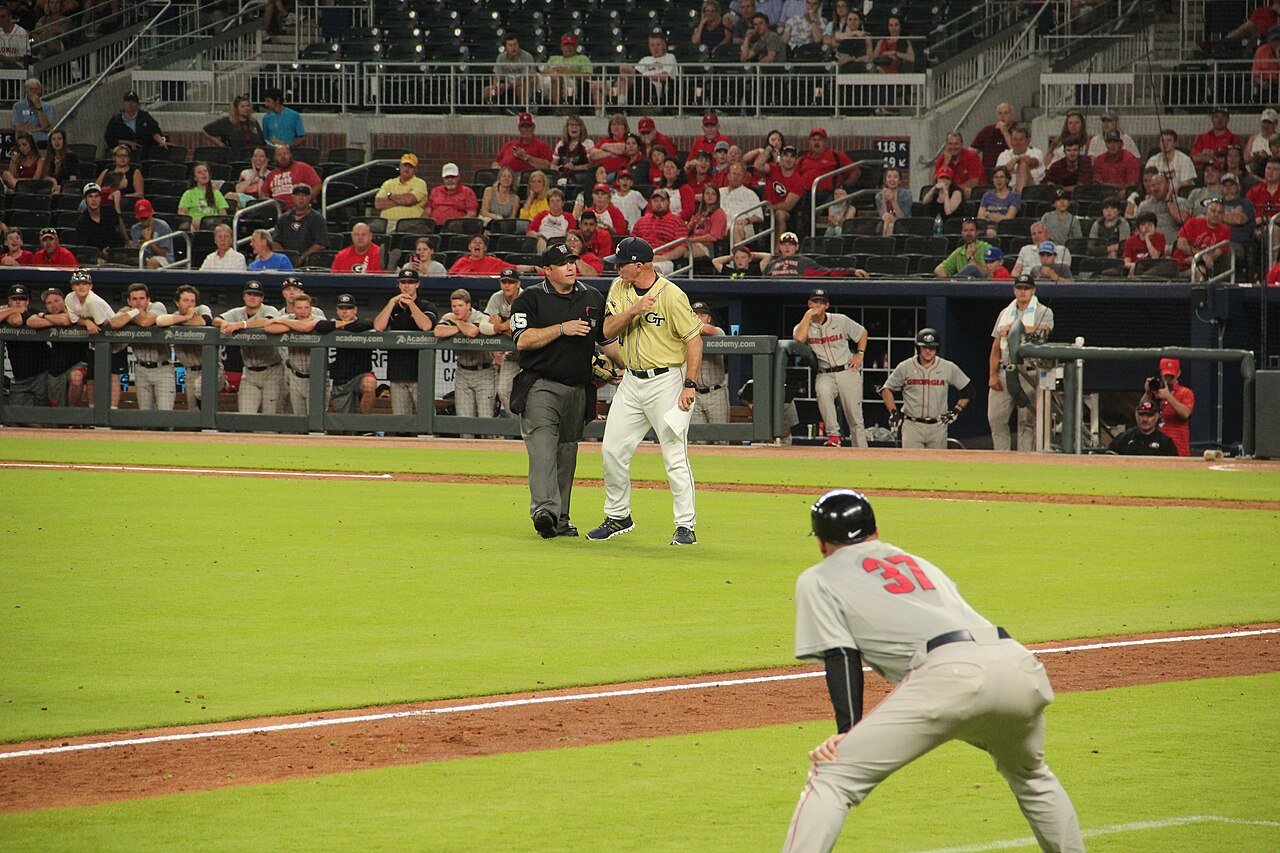
Seven thousand one hundred challenges. That is roughly how many times a major league player tapped his helmet or his cap this season and asked a computer to check the umpire’s work, counting through the trade deadline on 3 August. Just over half of them succeeded. For a technology that spent a decade being described as the end of the human umpire, a 53 percent hit rate is a strange result, and a revealing one.
How the system actually works
The Automated Ball-Strike system arrived in the majors this year not as a replacement for umpires but as an appeals process. Twelve Hawk-Eye cameras ring the field perimeter and track the location of every pitch, feeding a private 5G network supplied by T-Mobile for Business. The umpire still calls the pitch. If the pitcher, the catcher or the batter disagrees, he taps his hat or helmet immediately and says so, and the tracked location goes up on the scoreboard and the broadcast within seconds.
Each team gets two challenges per game. Win one and you keep it. Lose one and it is gone. That single rule is doing most of the work here, because it converts a question about accuracy into a question about resource management. A manager who burns both challenges in the second inning has nothing left when the count is full in the ninth.
Fifty-three percent is the feature
Half the challenges failing sounds like a bad advertisement for the system. It is closer to the opposite. Baseball’s borderline pitch has always lived in a band a couple of centimetres wide, and if human umpires were badly wrong on a large share of the calls players contested, the success rate would be far higher than a coin flip. It is not. Teams are averaging just over four challenges a game, and they are barely beating chance.
Spring training pointed the same way. Across 1,844 challenges, 53 percent were overturned, the identical rate. The split by role was sharper: batters won only 45 percent of the challenges they initiated, while the defence won 60 percent. Games averaged 4.32 challenges with 2.28 succeeding. The regular season has essentially reproduced those figures at ten times the sample size, which is the sort of stability that suggests the numbers describe something real rather than a novelty effect.
The catchers were right all along
The most interesting finding of the season has nothing to do with cameras. It is that catchers are dramatically better at knowing where a pitch went than anyone else on the field, and now there is a public scoreboard proving it.
Cubs catcher Carson Kelly has been the outlier. Working behind the plate he has gone 21 for 25 on challenges, an 84 percent rate that Baseball Savant translates into 2.3 runs above expectation, the highest figure of any catcher, hitter or pitcher in the league. Across all 37 challenges he has made this season his success rate sits at 78 percent, fourth among catchers with at least ten attempts. Toronto’s Schneider leads the outfielders, winning 77 percent of his 13 challenges.
Hitters, meanwhile, are the weakest challengers in baseball. A batter judges a pitch from a moving stance with a fraction of a second to decide, while a catcher receives it in his glove and knows exactly where the ball ended up. Two decades of pitch framing analysis argued that catchers had a finer sense of the zone than anyone credited them with. The challenge system turned that argument into a leaderboard.
What the appeal did to the game
The rule has also changed the emotional texture of a disputed call. Arguing balls and strikes used to be theatre with no possible resolution, ending in a manager kicking dirt and getting tossed. Now it is a budgeted transaction that resolves on a screen in about fifteen seconds, and everyone in the ballpark watches the answer arrive at the same time.
Whether that is an improvement depends on what you thought baseball was for. The arguments were part of the show. So were the wrong calls that people talked about for years afterwards.
The open question is what happens in October, when a single pitch decides a series and two challenges suddenly feel like a very small allowance. Postseason usage patterns will say more about whether this system is a fix or a compromise than anything the regular season has produced. For more coverage of AI in sport, visit Mylistingo.
The Netherlands, for internationals
One email a week: the week's news for internationals in the Netherlands, new practical guides and what changed in the cities. No spam, unsubscribe any time.