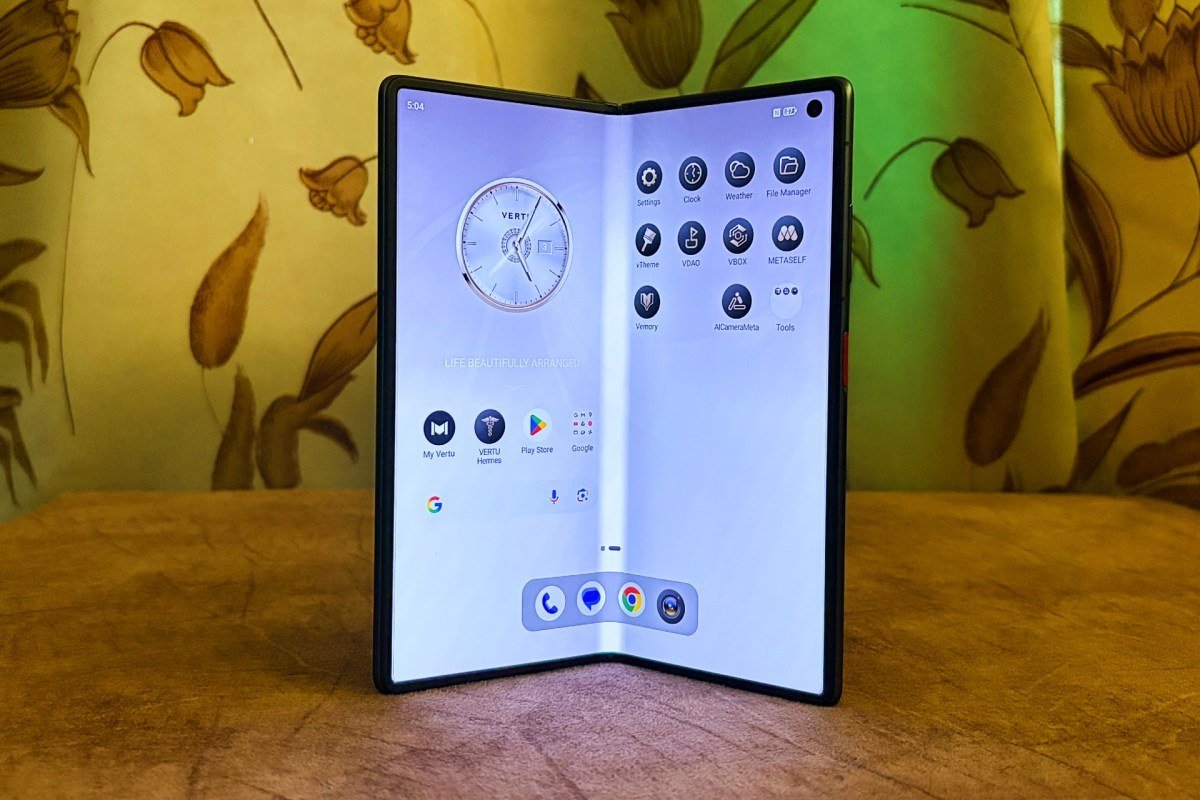
Six thousand, eight hundred and eighty dollars. That is what Vertu wants an executive to hand over for its latest luxury foldable, and the pitch is not the leather, the hand-polished hardware, or the concierge button that has defined the brand for two decades. This time the sell is an AI agent, one that promises to run a busy professional’s day from inside a phone that costs more than most laptops.
Vertu has always sold status. What is new is the claim that the status now comes with a brain. TechCrunch spent real time living with the device, and the review works through the parts that actually matter to someone spending that kind of money: how the AI workflows hold up, whether the battery survives a working day, and how seriously the security holds together.
The agent is the product now
For years, a Vertu was a beautifully made way to make phone calls and feel important doing it. The company is betting that wealthy buyers in 2026 want something different. An AI agent, baked into a foldable, positioned as a digital chief of staff rather than a fashion object. That is a meaningful shift for a brand whose entire identity was built on physical craft you could hold and show off.
The question hanging over the whole thing is simple. Does an AI assistant justify a price that could buy ten flagship phones? Vertu is not selling raw capability here, because the underlying models are the same ones anyone can reach through cheaper hardware. It is selling packaging, exclusivity, and the promise that the agent has been tuned for the rhythms of an executive’s life. Whether that framing survives contact with daily use is the entire test.
Living with the workflows
The AI workflows are where the phone either earns its keep or exposes itself. TechCrunch’s time with the device focused on exactly this, treating the agent not as a demo but as something that has to perform every day, across scheduling, communication, and the small grinding tasks that fill a professional calendar.
An agent marketed to executives has a high bar to clear. These are users who already have human assistants, who guard their time, and who will abandon a tool the moment it adds friction instead of removing it. A workflow that mostly works is a workflow that gets switched off. The review’s value lies in that ordinary pressure, the difference between a feature that impresses in a keynote and one that quietly saves an hour on a Tuesday.
Battery, security, and the price of trust
Battery life sits at the center of any judgment about an AI-heavy phone, and a foldable running an agent throughout the day asks a lot of a cell wedged into a slim luxury body. Constant AI processing tends to drain power fast. For a device sold to people who cannot afford to be caught with a dead phone in the middle of a deal, endurance is not a spec-sheet footnote. It is the whole proposition.
Security carries even more weight at this altitude. The buyers Vertu is chasing are precisely the people whose calendars, contacts, and conversations are worth stealing. Handing that data to an AI agent raises an obvious concern: where does the information go, who can reach it, and how much of an executive’s life is now flowing through a system that promises discretion. A luxury badge does not answer those questions on its own, and TechCrunch’s review weighs the phone against them rather than the marketing.
Put those pieces together and the $6,880 price reads less like a hardware cost and more like a bet on trust. You are not buying silicon that outperforms a cheaper flagship. You are buying the belief that Vertu can wrap a capable agent in enough security, endurance, and polish to earn its place in a powerful person’s pocket.
Whether the math holds
Luxury tech has always run on the gap between what something costs to build and what a buyer will pay for how it makes them feel. Vertu understands that gap better than almost anyone. The gamble now is that an AI agent can carry the same emotional weight that gold trim and sapphire glass once did, and that executives will treat intelligence as the new luxury material.
The harder truth is that AI does not stay exclusive for long. The models powering this agent are widely available, and the workflows Vertu is charging a premium for tend to trickle down to ordinary phones within a year or two. That is the pressure worth watching. If the agent genuinely reshapes how a busy professional works, the price finds its justification. If it is a familiar assistant in expensive clothing, the market will notice quickly.
For more coverage of luxury AI hardware, visit Mylistingo.
Source: Original Article
The Netherlands, for internationals
One email a week: the week's news for internationals in the Netherlands, new practical guides and what changed in the cities. No spam, unsubscribe any time.